Policing public sex: Inside the decades-long ban on gay bathhouses in New York City

An AIDS-era ban on “adult saunas” is still in place. Now, two lawmakers are fighting to overturn it.
In the summer of 1970, Bette Midler—who was then a relatively unknown actress in the Broadway play Fiddler on the Roof—inked a three-month contract to perform once a week at the Continental Baths. Founded two years prior, the bathhouse was a haven for gay men in New York City. The baths were already famous, and soon Midler was, too. She released her debut album in 1972, and in 1976, the venue closed. Nine years later, nearly all the rest of the gay bathhouses in N.Y.C. followed suit.
Though the Continental Baths shut down before the onset of the AIDS epidemic, similar locales—including the St. Marks Baths and the Everard Baths—were forcibly shuttered after then-Mayor Ed Koch enacted a ban on gay bathhouses in 1985. At that point, nearly 12,000 cases of AIDS had been reported nationwide, according to the National Library of Medicine.
“We want to save lives,” Koch said at the time, per The New York Times. New York City Health Commissioner Dr. David J. Sencer criticized the approach, however, as contributing ''little if anything to the control of AIDS.''
Sencer wasn’t alone. Many New Yorkers protested the ban when it was first enforced in 1985. Forty-one years later, it remains in place today: Having sex in bathhouses is still illegal in N.Y.C., and no “adult saunas” have opened since the prohibition was enacted.
New legislation introduced by two lawmakers in August 2026 aims to overturn the longtime ban. Sponsored by New York state senator Erik Bottcher and state assembly member Tony Simone, the Public Health Modernization Act would both repeal the existing ban and pave the way for the legalization of bathhouses that double as places for semi-public sex.
"The science has changed. Prevention has changed. Our laws need to keep pace when the facts on the ground change," Bottcher told The Advocate. "These restrictions were adopted during an extraordinary public health emergency, but emergency measures shouldn't automatically become permanent policy."
Ken Lustbader, who is a historic preservation consultant for the N.Y.C. LGBT Historic Sites Project, agrees.
“You can't freeze science in 1985 and not explore where we're at today,” he says. “So I think it's a really important point to investigate.”
Origins of the N.Y.C. bathhouse
The first bathhouses in N.Y.C. were established in the mid-19th century, at a time when many residential buildings did not have running water or bathrooms. For many New Yorkers, bathhouses were the only place where they could bathe and attend to their hygiene. And though bathhouses that explicitly catered to LGBTQ+ people didn’t exist yet, there were some that “turned a blind eye” to accommodating gay male clientele, Lustbader says.
One of the city’s most legendary gay bathhouses, the Everard Baths, opened in 1888 and established itself as a destination for gay patrons around 1910. Police raids subsequently took place in the decades that followed. Still, going to a semi-private bathhouse was often safer than cruising in public, where getting caught was much more likely.
Bathhouses continued to operate as essential social institutions throughout the twentieth century, and in 1968, a defining moment for the explicitly gay bathhouse scene occurred when Steve Ostrow—then a patron of the Everard Baths—decided to make a “purpose-built gay bathhouse,” Lustbader says.
Ostrow founded the Continental Baths later that same year in the basement of the historic Ansonia Hotel. A “Disneyland of gay bathhouses,” as Lustbader described it, the venue boasted a swimming pool, a cabaret lounge, and a baby grand piano. It was open 24 hours a day. Aside from Midler—who, by virtue of her success there, became known as Bathhouse Bette—the Continental Baths hosted stars like Barry Manilow (who accompanied Midler on the piano), Frankie Knuckles, and Peter Allen.
“When I went on the stage in front of all those gays, they threw their hands up and screamed,” Midler recalled in a 2026 interview with Rolling Stone. “And it was great fun. We went from 30 people in the house to hundreds. Because it was such an odd venue, and transgressive in those days, we were a huge hit.”
“People would go in on a Friday and not leave until Sunday,” Lustbader says of the Continental Baths’ patrons. “In some ways, they were creating what defines a gay world by just being with each other there.”
In 1969, one year after the Continental Baths opened, a police raid at the Stonewall Inn sparked what later became known as the Stonewall uprising. Though it was not the first time that queer people had resisted persecution, and it wouldn’t be the last, the event marked an inflection point in the gay liberation movement.
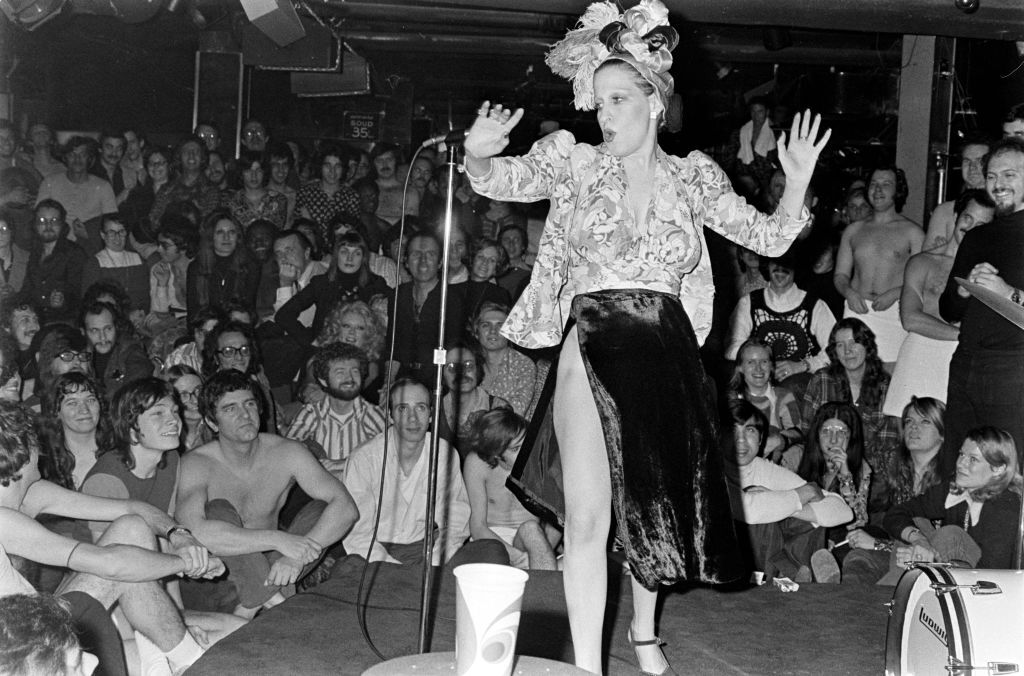 Bette Midler perfomance at Continental Bath House, WWD. Penske Media via Getty Images.
The heyday of gay bathhouse culture
The two decades following Stonewall represent, in retrospect, a kind of heyday for gay bathhouse culture in N.Y.C. Though Ostrow closed the Continental Baths in 1976—Plato’s Retreat, a straight swingers club, subsequently opened in its place just one year later—other bathhouses popped up elsewhere in Manhattan. The St. Marks Baths, for example, became a beloved destination in the East Village. The bathhouse on St. Marks Place had technically been open since 1917, however it became more exclusively gay in the 1960s and was refurbished and reopened by entrepreneur and theater-owner Bruce Mailman in 1979.
Mailman also owned and operated The Saint, a gay, members-only club on 2nd Avenue. Patrons of both businesses could spend the night going from the bathhouse to the disco and back again.
Jay Blotcher worked at the St. Marks Baths in the spring of 1983. An associate producer at WNYC-TV at the time, Blotcher got the job thanks to his manager Vito Russo. While employees were barred from fraternizing with clients at the baths, he did end up having sex in the notorious bleacher seats of The Saint during a screening of the 1979 horror film Dracula.
“It was a level of freedom that puzzled me and also scared me,” Blotcher says, “because there were no rules.”
That May, Blotcher attended the first AIDS Candlelight Memorial March in N.Y.C. He wasn’t wearing a watch, and when the event ended, he asked the crowd what time it was—he had to get to his job at the baths.
“When people heard that, they turned on me and said, ‘You work at the bathhouse, don't you understand how many people are infected at the bathhouse? That place is a vector for disease. How could you work there?’” Blotcher remembers. “I was very impressionable at the time, and what they said sounded logical. But the fact is that epidemiologists and doctors have pointed out that the bathhouse, while maligned, while demonized, was often the only place for people to get safer sex information.”
The St. Marks Baths were forcibly shuttered following the 1985 ban, and The Saint closed three years later, in 1988. Mailman became a passionate opponent of the bathhouse closures and eventually died of AIDS-related complications at the age of 55 in 1994. He was survived by his longtime partner, John Sugg.
The 1985 bathhouse ban
Blotcher left the St. Marks Baths in the summer of 1983 for a job at Fire Island News. Two years later, the AIDS epidemic gained national attention when actor Rock Hudson died from AIDS-related complications at the age of 59. Then-President Ronald Reagan publicly uttered the words “AIDS” for the first time that September. One month later, N.Y.C. moved to close its bathhouses.
The ban meant the St. Marks Baths and the Everard Baths permanently closed, along with other spaces where “high-risk sexual activities” were taking place, per the Times. Lustbader remembers discussing the baths at GMHC (Gay Men's Health Crisis) meetings at the time.
“People were talking about missing the baths, and [asking], what does safer sex mean?” He says. “It was really about eroticizing safer sex and… how to negotiate safer sex in a period when the virus was raging through the community, and it was quite scary.”
In Harlem, meanwhile, the Mt. Morris Baths remained open until 2003. According to The New York Times, the bathhouse was allowed to stay open following the ban for two reasons: It was far from the city’s “gay meccas,” and its owner, Walter Fitzer, prohibited sex. Mt. Morris also distributed pamphlets about AIDS, and the space thus became a place known for safe sex education.
In 1997, more than a decade after the original ban, the debate over the bathhouses resurfaced when the city adopted a new set of sanitary codes to crack down on public sex. At the same time, then-Mayor Rudy Giuliani clamped down on N.Y.C. nightlife with a slew of zoning laws that banished a huge swath of sexual spaces to the fringes of the city.
“At that point I had been a seasoned activist for about 10 years,” Blotcher tells me. “There was an interesting rift between AIDS activists. Some of them argued that sex clubs and bathhouses should remain closed… and then there was a group of us who said, ‘We cannot give this level of power to the authorities to close our spaces. Who knows where the closures will stop? They look at us all as carriers of the disease, and this is being fueled by homophobia.’”
The 21st-century bathhouse boom
Four decades post-ban, New York City is once again experiencing a bathhouse boom, the likes of which have not been seen since before the advent of indoor plumbing. The city’s new bathhouses cater to a wide range of identities, with one overarching theme: luxury.
In 2026 alone, several have opened in the city, including Lore Bathing Club, Saint, Schwet, and the Altar. The city hosted its first-ever sauna-themed festival, dubbed Culture of Bathe-ing, in February. There are now more than 30 bathhouses one can visit across the five boroughs, including multiple locations run by chains Bathhouse and Othership.
This resuscitation of the bathhouse scene as luxury wellness culture represents a sea change in what was once an industry dominated by working class and queer New Yorkers. And while these bathhouses do not explicitly cater to any one sexual identity or gender expression, they may offer a blueprint for the potential (re)opening of gay bathhouses in N.Y.C., if and when the Public Health Modernization Act is signed into law.
“I give credit to people like Erik Bottcher for bringing this up at a particularly sensitive time in our country where LGBTQ people are being scapegoated again by an aggressive Republican administration,” Blotcher says, though he believes it may be unrealistic, given the current political climate. “Whether [the Public Health Modernization Act] is a step too far or whether it’s the wedge that we need to open up the conversation again remains to be seen.”