

Delayed gratification: a conversation with Wayne Koestenbaun

Wayne Koestenbaum, Pastoral Self-Portrait with Pat Twice, acrylic, casein, Flashe, screenprints, and grommets on unstretched canvas, 37 x 33 inches, 2024. Courtesy of the artist and Gattopardo gallery.
The process of writing is edging the reader. Wayne Koestenbaum discusses his new novel, drawing lines between all the ways he refuses resolution and his sexy rabbinical aspirations for himself and his audience–until the final moment.
I have sexy rabbinical aspirations. It should be no surprise, then, what led me to pick up Wayne Koestenbaum’s most recent book, My Lover, The Rabbi. I could not have known what was in store: not just the midrashic, neurotic whodunnit that is his new book, but the entire oeuvre that extends beyond and before Koestenbaum’s first novel to be published in 20 years.
The rabbi has a lover—the narrator—but he also has a red-headed husband bankrolling him from out of state; a seemingly omniscient all-purpose personal assistant named Monica Prague; a dog walker; an orphaned nephew whose boyfriend studies anti-capitalist assemblages; a dermatologist; a late wife; and a late three-year old son, Rockland, who died under ambiguous circumstances. The rabbi’s acolytes and entanglements swim in and out of the murky shadows of his past. As the newest member of this flock, the narrator undergoes the initiation rite of figuring out how all of these characters are connected, and who has slept with whom.
A rabbi will always give their closest disciples a different kind of teaching, and this rabbi is no different. But, in Koestenbaum’s novel, the lover finds himself on the outer edge of the inner circle. Like any good hysteric, he longs for total union with his beloved, both sexual and psychological, but the rabbi is fickle, otherwise engaged, preoccupied with his congregants, and plagued by the loss of his child. The lover is desperate to uncover what makes his rabbi tick. What ensues is a frantic, conniving quest for anything that might spell ultimate attainment—a quest for knowledge, understanding, affirmation, penetration—that devolves into near-manic amateur private investigation.
Koestenbaum is not bound by any convention of genre or content, writing across scholarly tomes, trance poems, Jewish pornography, a hybrid novel-essay ruminating on hotels, and a musical micro-movie. There are over twenty books in all, countless paintings, and at least one libretto. Koestenbaum loves lists. He has written on opera, silent film, Warhol, and cleavage. Koestenbaum is subsuming his subjects as they subsume him. He’s obsessed; he’s obsessed with being obsessed, and with giving obsession form and function. He has said, in an interview with BOMB magazine, that he experiences abject glee in breaking rules that don’t exist anymore. He knows there is a diva behind the curtain. But when Koestenbaum pulls back the plush folds, who does he find … not Jackie O., or Barbra Streisand, or Susan Sontag, or even Harpo Marx, as he might’ve suspected. This time, behind the curtain: the rabbi, and his lover.
Any good mystery requires delayed gratification, and Koestenbaum and I spoke at length about how he keeps himself, his readers, and his characters in suspense. The question of the rabbi’s originating mystery led us down a digression about catastrophe, doomed patriarchs, and sacrificial sons. Like any good rabbi, Koestenbaum’s inspires us to search for talmudic counterparts.
Koestenbaum pointed me to one of his earliest poems, “Rhapsody,” published over 30 years ago, as an instance where he had previously played out a story from the Torah that he returned to in our conversation. Beyond this specific allusion, one line in particular struck me as clairvoyant: but I’ve always secretly been a mystic / * / and I stumbled over sex as the stone obstructing mysticism’s way—
I don’t know if the sex obstructs—or illuminates—the lover’s search, or the rabbi’s mysticism. My conversation with Koestenbaum, however, was unequivocally enlightening. He spoke to me from his Chelsea apartment in mid-August.
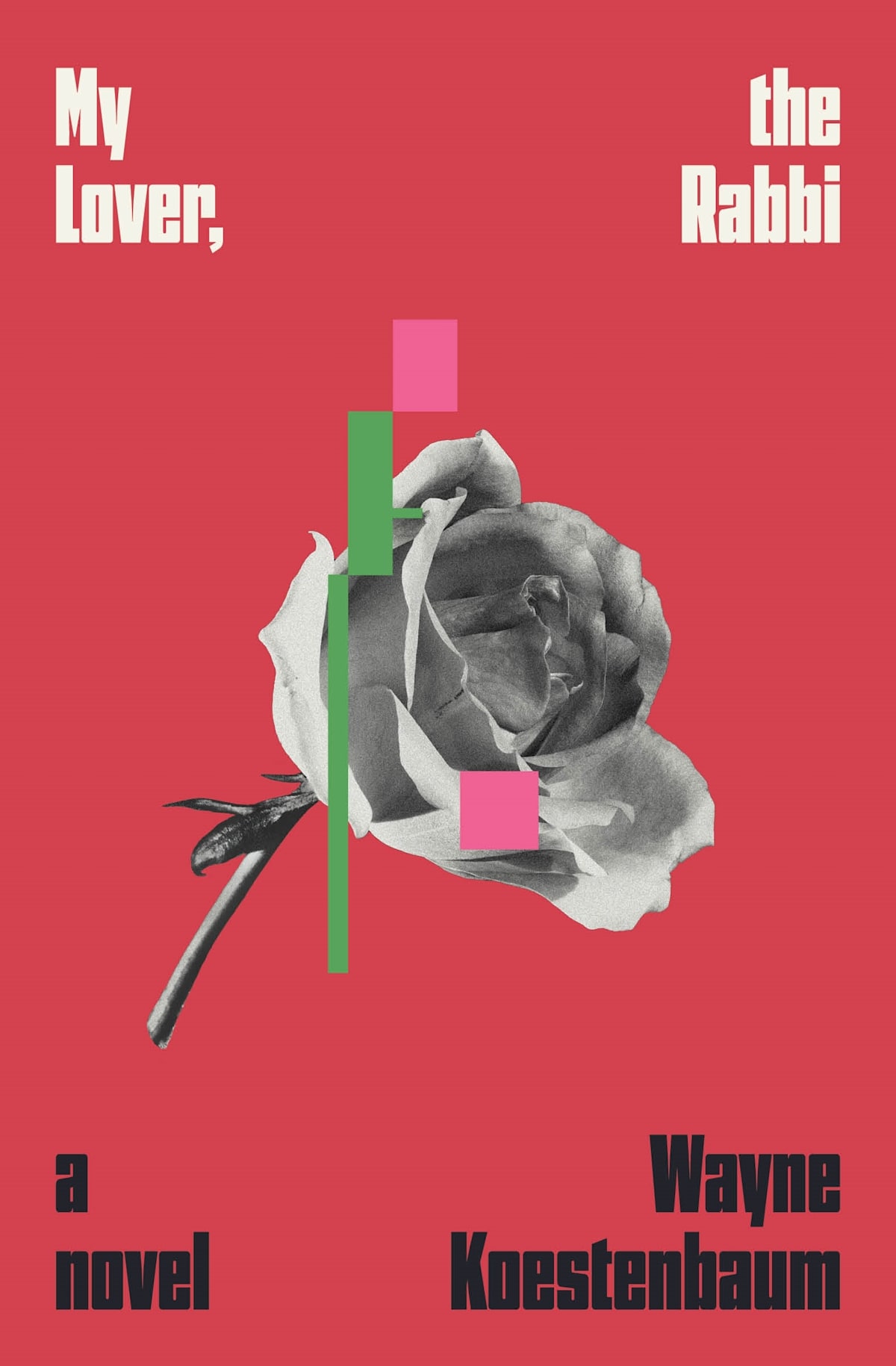
Book jacket for My Lover, the Rabbi

Wayne Koestenbaum. Photography by Jan Rattia
Wayne: Yes.
Yes. I don’t think I can say any more. You’re actually the first person to ask that very bold question, and I’ve given you a very honest answer.
I really appreciate your candor. I’ve noticed that readers have been interested, of course, in this book’s Jewishness, in the way that it does Jewishness. It caused me to reflect on what makes something sexy in a Jewish way, or what makes something Jewish in a sexy way.For me, the period of direct engagement with synagogue attendance, or Sunday school, or Jewish holidays, was childhood. When I step into the word “Jewish,” it brings me back to that childhood space, and any sexuality in that childhood space is forbidden … It gives me a charge. I was a very sexually preoccupied kid, though, so it wasn’t as if sexuality was absent from my fantasies. There’s a bit of transgressiveness for me in staging my sexuality or my imagined sexuality in the zone of my Jewish childhood.
I would imagine that your relationship to writing about sex has evolved over the course of your life. In this book, it’s fantastic, it’s absurd, it’s pedantic, it’s vulgar, it’s precise, it’s circuitous. I’ve never had to look up so many words in a sex scene.Thank you for being so diligent.
I can’t really say things in a very straightforward way.
I was aware in my sentences, when they get very long and complicated, of finally being very accurate about my thought process. I wasn’t thinking about the intricacy. In my writing life I’ve often tended to tone down and domesticate that intricacy in the interest of being a clear writer. And one of the luxuries for me in this book is that, through the narrator’s perverse constitution, I was able to indulge my actual thought process, and my actual syntax, which is very roundabout. I can’t really say things in a very straightforward way.
It was indulging my very natural way of thinking, but I was also sort of imitating the sentences of the later novels of Henry James. Take The Ambassadors as one example, one of his last novels and my favorite of them, probably. The sentence’s length and intricacy rhymes with its avoidance of what I would call, in a fancy way, epistemological closure, which really just means: getting to the point, figuring it out, knowing what’s going on. The narrator’s consciousness in the James fiction is in the dark about everything. And I borrowed that for my narrator.
It's more fun to edge the reader, and the process of writing is performing that edging. And the sentences mimic that edging.
I hoped to have staged it so that there’s this charade of a gradual unfurling of some dark mystery. The narrator never simply asks the rabbi, So what happened to your kid? I don’t make him aware of that as a possibility. It’s a Jamesian state of willful alienation from having the key to the mystery. Because it’s more fun to edge the reader, and the process of writing is performing that edging. And the sentences mimic that edging.
I really did feel like the novel was a murder mystery.I did leave that possibility open to myself. For much of the writing of the novel, I held open the possibility that the son, the dead son, was actually alive.
It’s very interesting to hear you say that you refused to let these things resolve. On the subject of edging, it’s almost as if the process of writing is one of edging the reader, but also a little bit about edging yourself.Absolutely. Edging myself in that I didn’t want to finish writing the book, I wanted it to reach its proper length. I didn’t want to come to the conclusion, the way I could in an essay or a poem. Start a new one. I wanted to dwell with the rabbi more and more and more. I didn’t want him to disappear.
There is a line that nobody has commented on, somewhere towards the end of the book, a very complicated sentence—it’s a sentence that I revised probably more than any other sentence in the book. I say something about the narrator feeling that he needs to conform his body to the shape of the catastrophe. And that concept was absolutely crucial to me.
What we’re talking about is the edging. The refusal of closure has to do with the fact that the narrator has to conform his body and his mental process to the shape of the catastrophe. And to do that, he has to remain in the dark, and he has to remain kind of molten and plastic, so that he can be formable. And so that the catastrophe has the upper hand. The catastrophe being what happened to Carla and Rockland, but also in some sense you could say the Holocaust, the origin of some kind of primal wound of Jewishness and of desire that the narrator stumbles onto and needs to warp his life and his mind to. That’s bigger than the rabbi. That hardened for me during revision.
Do you think that, for the narrator, that desire to mold to the shape of the catastrophe came from an originating place of wanting to preoccupy the object of his desire—i.e. the rabbi—in the same way that this catastrophe occupies the rabbi?I’m not a biblical scholar in the least, and I don’t know Hebrew. But when I think of molding yourself to the covenant, the moment of the ten commandments, or even the burning bush—the moments of God manifesting himself to his chosen people, his sons, his acolytes, come as a doctrinal burden. And it requires that his congregation or his people, they need to believe in him, which means, you could say, that they need to conform themselves to a belief system. And so, to that extent, Judaism is an imposition—willingly or not willingly accepted by those upon whom it imposes its mark. And so that’s also the catastrophe.
Even just speaking loosely, it seems to me that the moments of God manifesting himself in the Garden of Eden, the burning bush, other moments of God’s prophetic emergence of presence come within a punitive context.
I guess I’m saying that the arrival of God is a catastrophe and you could say that Rockland is Isaac, the sacrificed son. If things go one way, he is sacrificed. But he isn’t sacrificed. Rockland cannot be named dead or alive. At the moment of approaching that moment, you don’t know. Abraham does not know which path it will take.
I feel like every year on Rosh Hashanah you’re listening to the portion and you’re like, oh my God, is he gonna kill his son? Even though you know that he’s not going to. But it does cultivate the same level of disbelief and suspense that we’re talking about here. We touched on this a little bit, but I want to come back to it. Death touches the rabbi a lot. Is the rabbi a man surrounded by an unusual volume or intensity of death? How does that figure into his nexus of desires?Rabbis, like doctors, are surrounded by death. They’re involved in the rituals of birth and death. So it’s going to be their bailiwick. For me, the notion of Jewishness is very death-inflected. But any religion is. Christianity is totally death-inflected, it’s based on death. And its reversal.
For me, it’s not a surprise that the rabbi is surrounded by death. Death quickens life, so I think the immediacy of the narrator’s engagement with the rabbi and the sense of the relationship’s flame-like perishability hinges on the nearness of death as the coda, or the interruption.
You said it all with the edging business. You want to postpone death. But you’re aware that there’s a catastrophe to which you are conforming your body. You’re shadow boxing with death the whole time.
Freud is really complicated but he’s also really simple. In that kind of universe, death is a given. Even within object relations, or in Freud’s fort-da story. The kid drops the toy, and the toy is dead. The toy reappears, it’s alive. So the death-life alternation as it happens for the child with the object dying and coming back to life is a religious paradigm. For one thing, about death and resurrection, but it’s also just about daily life. Not to mention, dating apps. Embrace, and then ghosted. The disappearance. Wow, we were just chatting. Where did he go?


