"The World of Interiors," October 2025
Unmaking the bed, drawing the curtains, and other private pastimes. A very intimate history of "The World of Interiors."
In 1857, Leopold II, the Grand Duke of Tuscany, presented a seventeen-foot plaster cast of Michelangelo’s David to Queen Victoria, who was then aged thirty-eight. It had been cast from the original only a year earlier by Clemente Papi in Florence, and it was given to Victoria as an apology for the Grand Duke’s veto of a sale of a Renaissance altarpiece by Domenico Ghirlandaio to the National Gallery. The Queen installed it in her new museum on Cromwell Road in London, named for her and her husband, who would die a short while later in 1861. Yet she was so personally disquieted by David’s visible genitalia that London’s most expensive plaster and bronze casting firm—D. Brucciani & Co.—was commissioned to create a fig leaf to cover his modesty. Whenever Queen Victoria visited the museum, the fig leaf would be taken from its case and attached to the statue by means of two small hooks.
This Victorian prissiness about everything sexual was, as has been widely argued, the outward expression of a deeply perverse social undercurrent—a culture that outwardly championed intense moral surveillance and restraint while privately cultivating an intense preoccupation with clandestine sexuality.
But this play on revelation and concealment also remains part of our broader erotic topography. The fig leaf, since the moment it was plucked by Adam or Eve, represents the core of the erotic: the tension between the seen and the veiled—what the writer Lauren Hall describes as “the negative . . . both in space and experience,” an absence that is vividly present.
The magazine The World of Interiors understands this tension better than most. Long celebrated for its photographs of exquisite, empty rooms—spaces animated by the bodies they omit—it has now released its first lewd publication. Top Shelf, a print-only publication of “the hot & wanton makings of mankind,” was created in parallel with the magazine’s September 2026 issue, for which the theme is “The Body.” But while the Body issue looks into all the possible valences of the body in space (as The World of Interiors style director and Top Shelf editorial lead Ruth Sleightholme explains, the issue explores interiors that either center the body—as in sanatoriums, dance schools, and gymnasiums—or depict it through statues, murals, and other figurative works), Top Shelf focuses much more explicitly on sex and sexuality. It contains a gallery of fig-leafed crotches (David’s included), alongside features on the female body in twentieth-century design, the Secretum at the British Museum—where the Victorians hid away erotica—and images depicting furniture bristling with phalluses. There is also a 1990s Murano work showing a woman pouring honey-colored liquid over her own arse, and a cream chaise longue created for Albert, Prince of Wales, to allow him to have sex with more than one woman at a time. Top Shelf is a non-euphemistic, non-PG response to the eternal question of the interiors magazine: What’s going on in there?
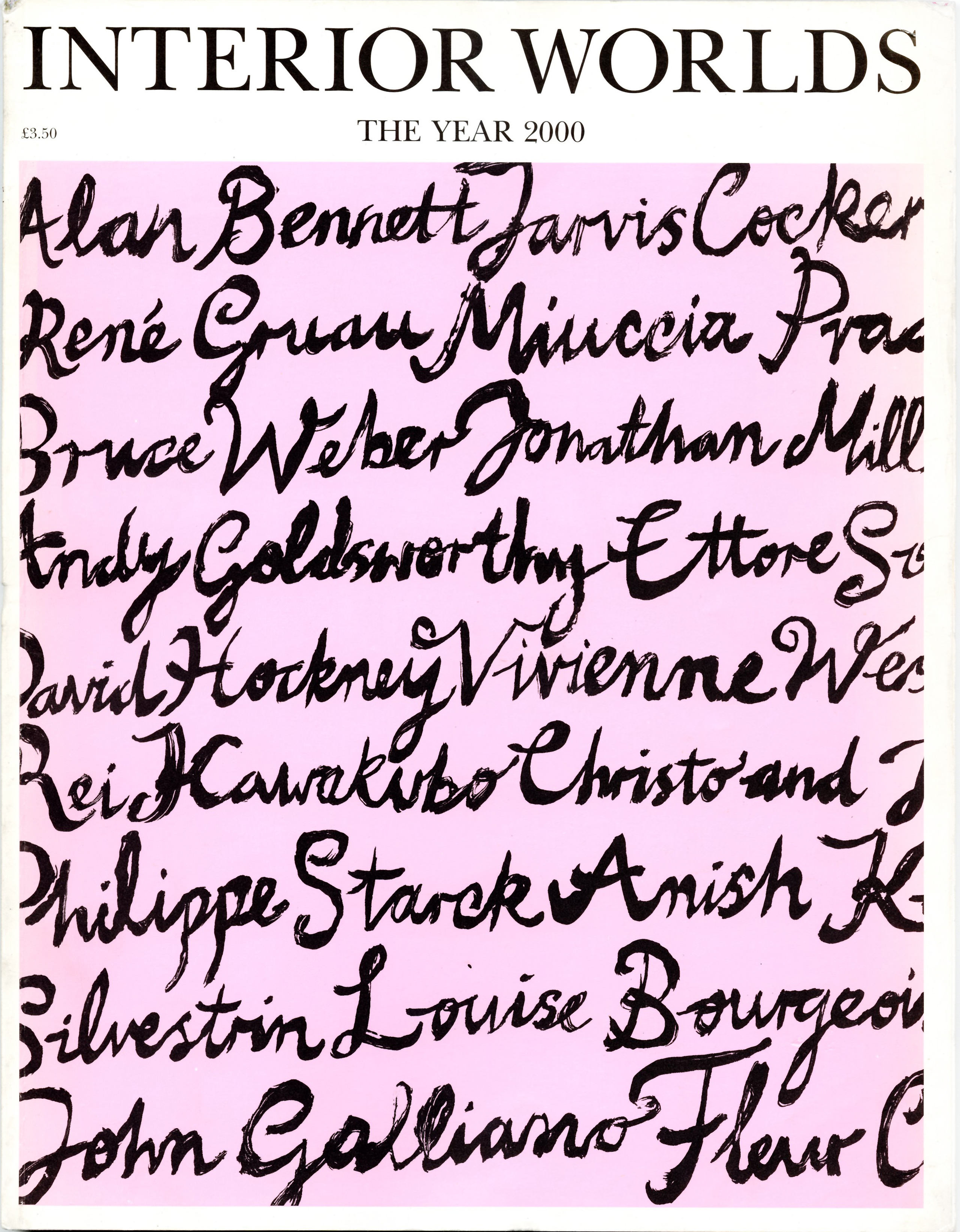
2000: This special supplement commemorating the turn of the millennium asked famous figures for three things that shaped how they looked at the world.
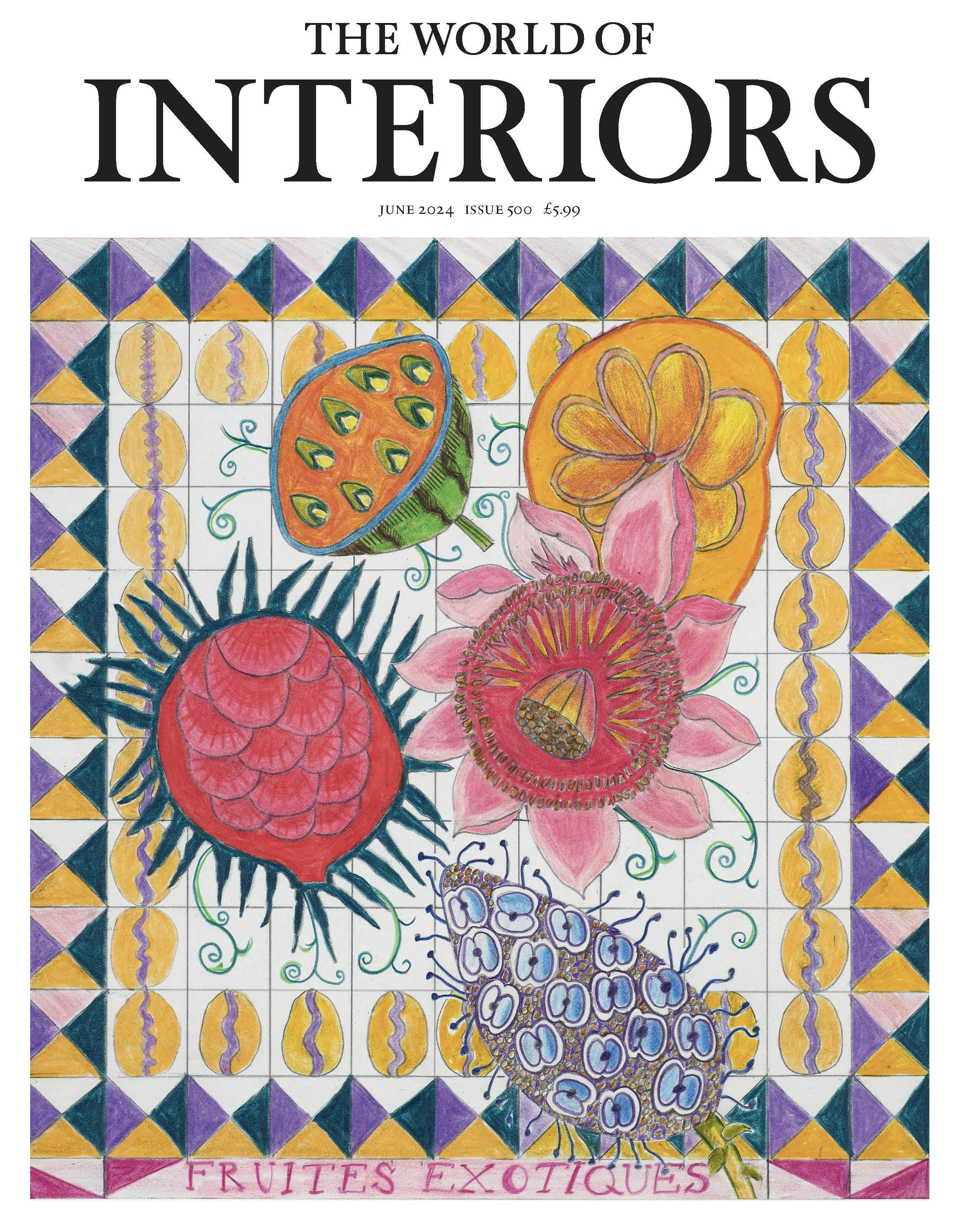
2024: The 500th issue and the first to be published under Emily Tobin as editor-in-chief featured a cover by the British artist Lubaina Himid.
Elsewhere, interiors journalism is still dominated by prudishness. Sleightholme tells me that at another magazine she worked for, the idea of publishing an image of an unmade bed would have caused consternation. Yet the act of entering another person’s home to poke a camera at it already carries an erotic charge. Art director Ben Weaver compared the work to taking one’s coat off—not exactly stripping, but bringing us “down to a lower layer.” This is because what you find might be deeply revealing, sexual or not. The World of Interiors photographer Henry Bourne told me about being sent to shoot the Castle of Mey, the Queen Mother’s remote fortress in Caithness, Scotland. Inside “mummy’s drafty castle,” as Princess Margaret called it, Bourne photographed a mantelpiece below a beautiful eighteenth-century mirror, on which stood a collection of Ming vases and a small plastic figure of a Smurf.
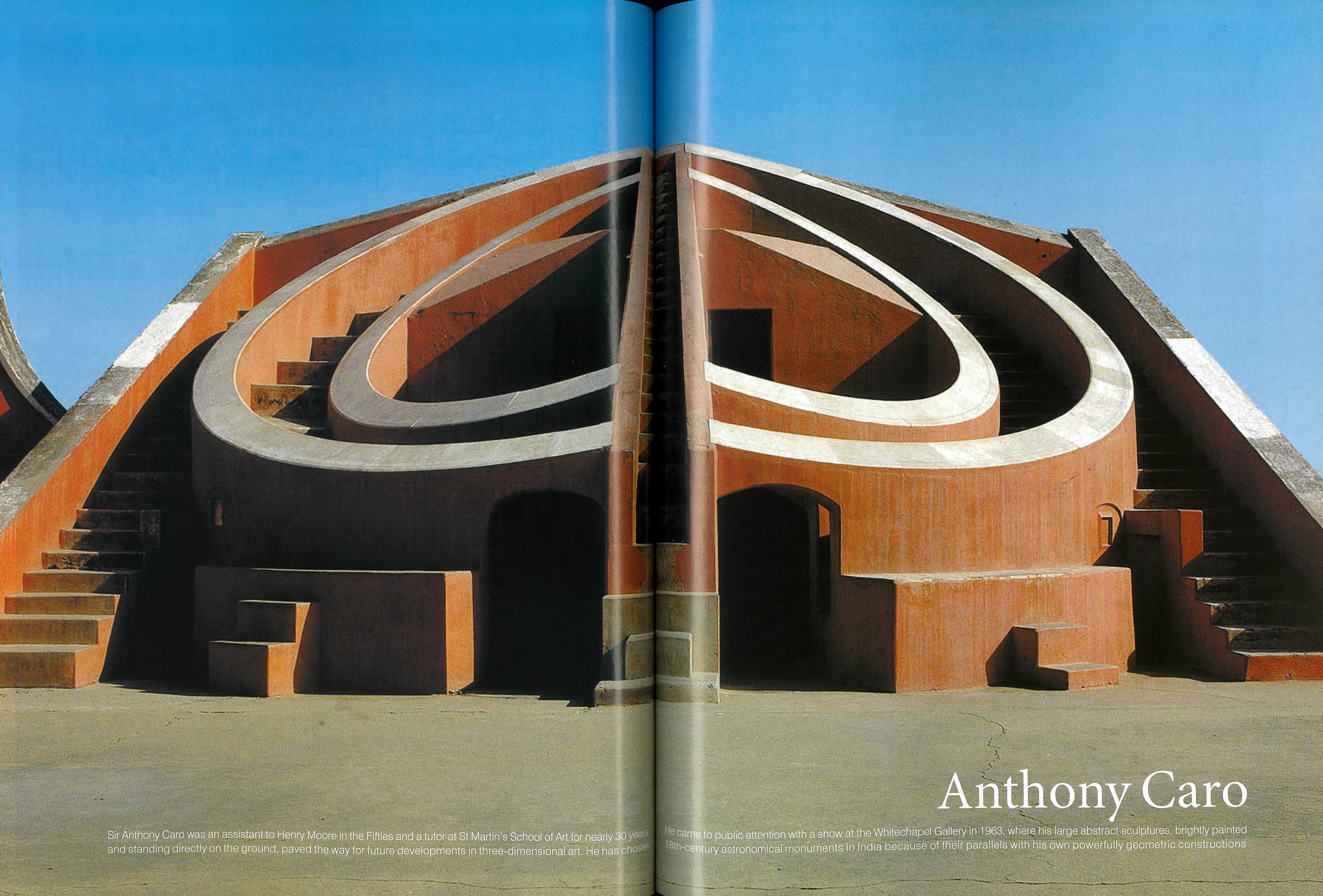
2002: As part of this special 20th anniversary issue, the abstract sculptor Anthony Caro presented a series of Indian astronomical observation sites that influenced his work.
The World of Interiors’ exacting visual and intellectual style has been passed down from editor to editor since its launch in 1981. Min Hogg, who launched the magazine, ran it for the next nineteen years. She was succeeded by Rupert Thomas, who edited it from 2001 to 2021, when Hamish Bowles became editor-in-chief. He stepped down to become creative-director-at-large in March 2024, which is when Emily Tobin took the helm. Throughout, the magazine has held a rare place in the cultural imagination, mainly through its maintenance of an unswerving, even haughty sense of taste—but characterized and clarified always by irony, humor, and self-awareness. Though there are rarely people in shots, there’s often lots of clutter. Flicking through an issue is like walking down the weirdest street in the world. An Argentinian football bar hung with flags and pennants appears alongside a Tribeca loft full of huge puppets. Here’s a little house belonging to a Dutch milkman who’s painted his walls with murals of boats and birds in primary colors, and here are soaring straw mudhifs in the Mesopotamian Marshes of Southern Iraq.
On taking over, Tobin saw through a design overhaul with Graphic Thought Facility, which sought to strip back the visual language of the magazine with an eye on the early Min Hogg style of the 1980s. “If you hadn’t picked up the magazine for ten years and you bought one today, the issues would look quite distinct from one another,” Tobin tells me. “But if you hadn’t bought one for forty years, you’d see that thread running through.” Some of this is about Tobin’s desire to “crack the world open,” working with local photographers and writers wherever possible. As she tells me, “In the last year, we’ve done a story on a public toilet in New Zealand, a mountain pavilion in Japan, beehives in Slovenia, Dries Van Noten’s garden in Belgium, and a hydraulic station in Mexico.” As Tobin insists, these decidedly non-domestic spaces reflect to the magazine’s intention of showcasing the real ways in which people live.
The task of the interiors photographer is communicating all the intimacy of a room when it’s splayed out on the page. In a recent production of Dangerous Liaisons at the National Theatre, the set designers were faced with the same issue. Halfway through Act One, Vicomte de Valmont seduces the virginal Cécile de Volanges by concocting a scheme by which he gains possession of the key to her bedroom door. But how could the set communicate the suffocating, coercive eroticism of what follows, in so expansive a space as the stage? They settled on a white room, blown open, as if someone had set off a small bomb, sending each wall a foot or two outwards and exposing the interior as Valmont makes his horrible and inexorable approach. Likewise, the interiors photographer has to prize open the room just enough to let in the light.
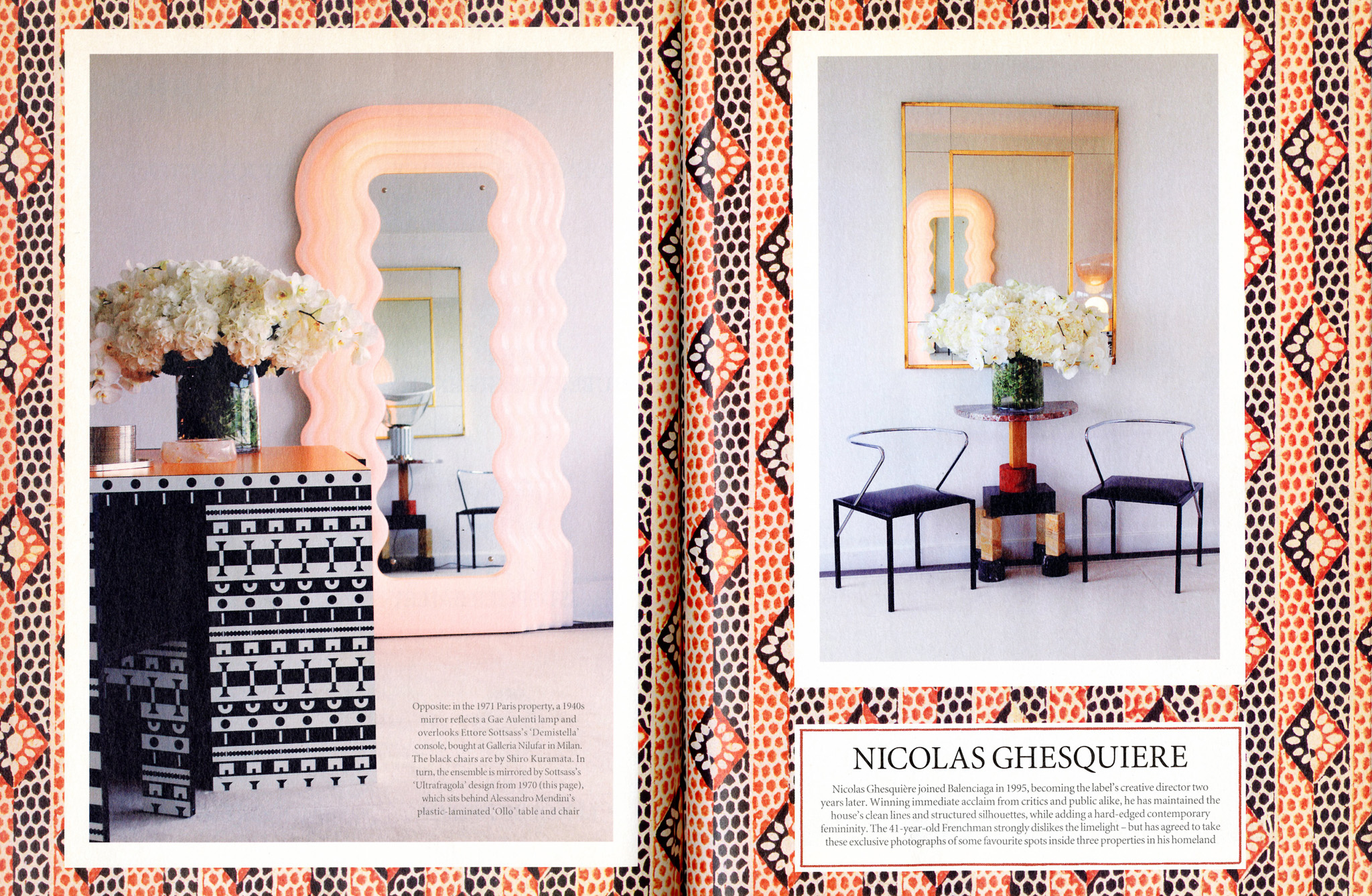
2012: The “Designers by Themselves” issue gave a glimpse into the private spaces of fashion designers. In Nicolas Ghesquière’s Paris apartment, an Ettore Sottsass Demistella console table steals the scene.
The bedroom—the room in a house that visitors are least likely to see—is especially seductive in this respect. In 1782, when the original novel Les Liaisons Dangereuses was written by Pierre Choderlos de Laclos, the boudoir had recently completed a century-long transformation from a private devotional space to a room primarily associated with sex. At the beginning of the 1700s, the boudoir was a kind of closet to which a woman could retreat to pray, be alone, or receive close friends. Some annoyed husband, presumably, gave it its name from the French bouder, meaning “to sulk.” It was initially distinct from the bedroom, more likely to contain a chair and a desk than a bed, and invented at a time when houses were beginning to be divided into sets of rooms primarily intended to aid in the organization of social life. Aristocratic couples had three types of apartments in their maisons: ceremonial rooms for morning business, appartements de sociétés for receiving callers or friends in the afternoon, and apartments for private living. Husband and wife would each have their own suite of rooms. Over the course of the century, as France transitioned from a feudal state to a more egalitarian bourgeois-ism, the boudoir’s meaning changed into a site of sexual activity: a place where the couple (or more) could meet for more erotic exchanges.
In this context, the boudoir might be understood as the bud at the heart of the rose, the one room in which the private and the social life came together, with the capacity to explode or unsettle the established order. This is what produces the feverish gossipy energy of Dangerous Liaisons and explains why, in 1795, the Marquis de Sade set his philosophical treatise on libertinism, Philosophy in the Boudoir, in that most private of rooms. The more formal conjugal relations which took place in the bedrooms were, presumably, of a different nature—less risky, less exciting, and less charged with desire.
The boudoir, then, became a site of extensive fantasy, for those on the outside more so than those indoors. As architectural historian Diana Cheng writes, the boudoir is a psychological architecture, formulated around complex systems of exposure and secrecy; the proffering and withdrawal of access; and the presence or absence of its inhabitant. It’s a space set up for the visitor to penetrate. A psychoanalytic reading might connect the frustration of the locked door—and the thrill of the peephole—with the prohibition on entering the parental bedroom. As with other aristocratic architecture, the boudoir “can be seen as the ‘staging’ of a particular behavior and social interaction,” writes Cheng—a space animated by the heady experience of encountering an other.
The decoration of the boudoir gave material form to this idea. Cheng writes about high-profile courtesan Mademoiselle Dervieux, who mastered the design of the boudoir in the eighteenth century through liberal use of mirrors and fabric. Designed in an Oriental style, the room was a mirrored enclosure, divided by green taffeta curtains. There was even a little hidden alcove in which Dervieux could hide, eavesdropping and peeping through a window concealed within a rock-crystal rosette. She knew that the room itself was a conduit of erotic energy—her “nightcap, corset, pink ribbons, and tortoise-shell comb, placed with apparent negligence,” all conspired to give the visitor the impression that she was just out of sight. The opportunity to study the room itself and its objects as clues, or elements of individuality that just fail to cohere into the whole, is a vital part of the pleasure paradigm. As Tobin told me about her loose adherence to The World of Interiors’ “no humans” rule, the interior itself is loaded with indications as to the sensibility, personality, and life of its inhabitant: “The room is portrait enough,” she says.
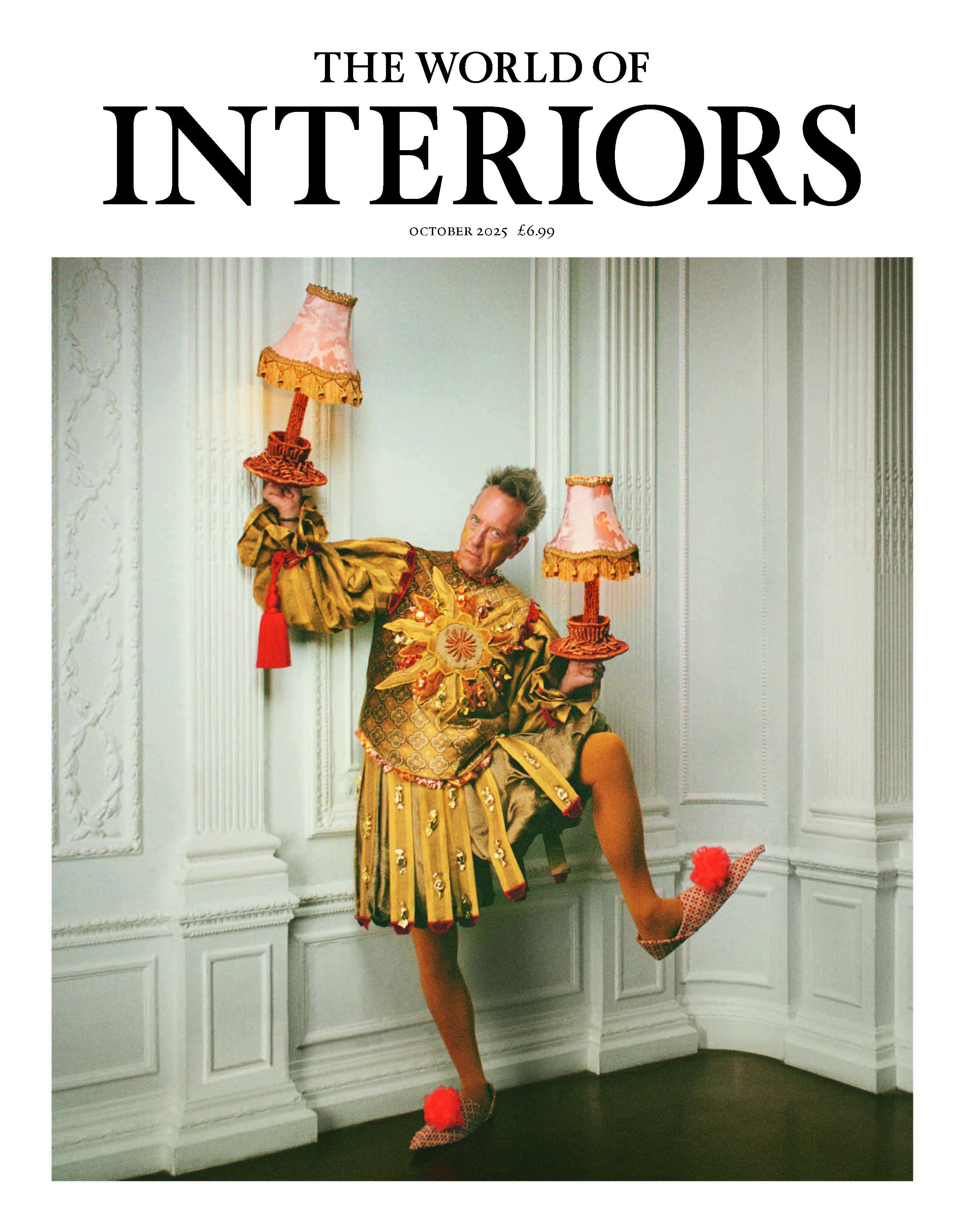
2025: Blurring the line between people and the objects they own, magazines staffers and celebrities (like Joanna Lumley and Omari Douglas) dressed as household ornaments and objects.
Yet rules can be broken. In 2025, Tobin put a person on the cover for the first time: actor Richard E. Grant, dressed as a candelabra. The image was taken from a shoot inspired by the 1983 classic Jane Asher’s Fancy Dress, which also included Kathryn Hunter, Jo Brand, Joanna Lumley, The World of Interiors staff, and others dressed as totemic interior objects (see Miranda Sinclair and Frank Gallacher as two Staffordshire dogs, in outfits and ears made of popcorn). The cover, and the entire shoot, perhaps highlight that under Tobin, this era of the magazine is interested in subjecthood and self-expression as forms of play. Play is the substance of creativity, and as the shoot photographer Polly Brown notes, every shoot has this quality—“even if you’re trying to make them professional and serious, they often have that element of a big group of people just putting on fancy dress.” This particular shoot was also a way of literalizing—and making gentle, self-aware fun of—the magazine’s long-standing maxim that, in some way, we are our things.
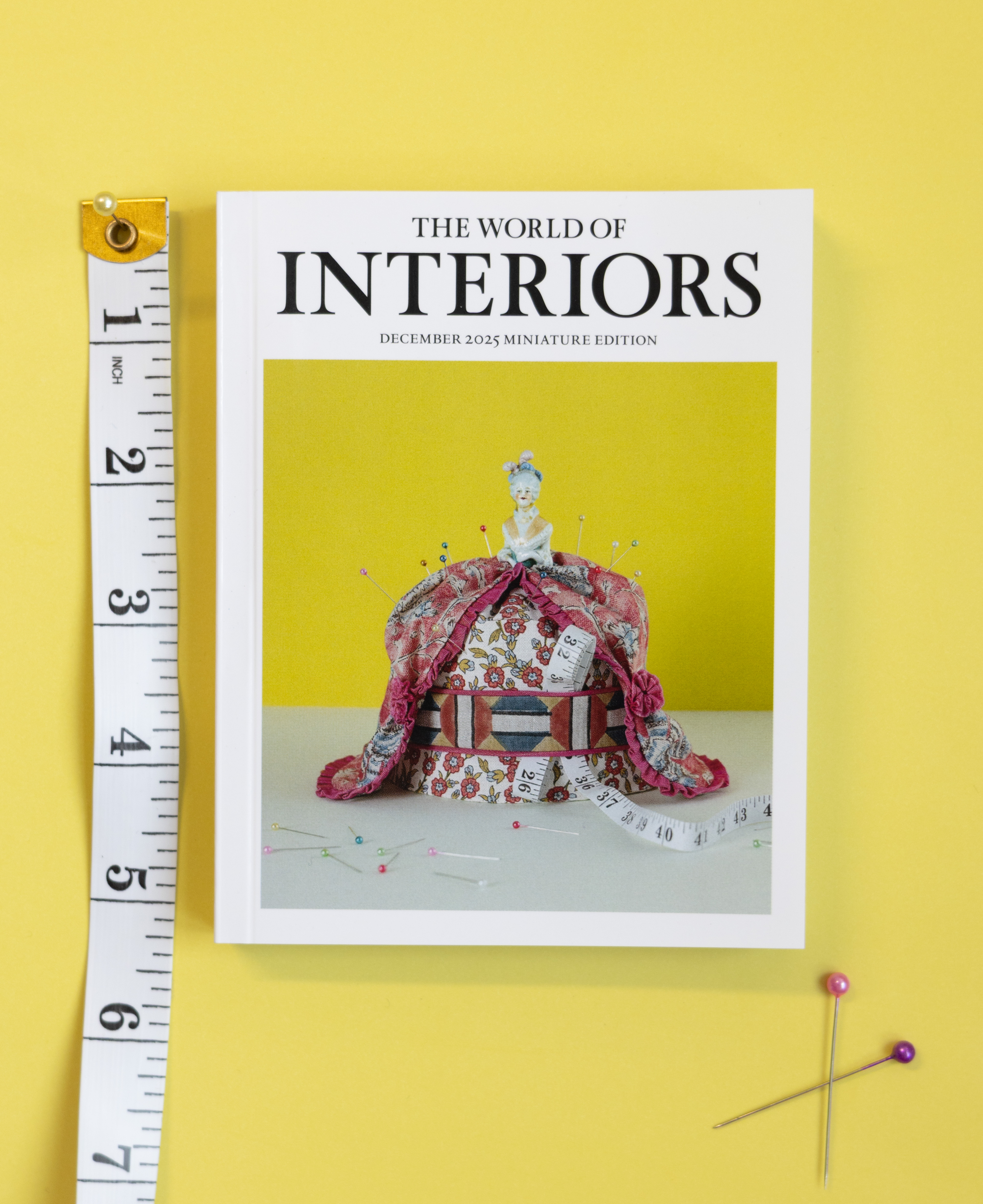
2025: A feat of print publishing, this pocket-sized edition featured miniature spaces and objects, including Edwin Lutyens’s doll’s house for Queen Mary.
That same spirit of playful excess extends into the language of decoration, particularly in its voluptuousness. In Tschumi’s essay “The Pleasure of Architecture,” he links criticisms of the ornamental to a fear of sensual disorder—a lack of restraint that might repel the more straightlaced. If we look at the popular image of the boudoir, the classic design principles (canopied beds, wall textiles, fringed lampshades) are all suggestive of a criminally explicit sense of excess. But profligacy can be both sensually and financially profitable. The eighteenth-century courtesans would commission extravagantly expensive houses and boudoirs to advertise their desirability (“if men have given me this much money, there’s good reason for it”). It doesn’t feel a million miles away from the reasons why an interior designer, flower artist, or ceramicist might want their services on show in the pages of The World of Interiors. All of it is a way to say, you should really want me.
The desired object remains just out of reach. Tobin’s rule-breaking and belief in restraint come from the same instinct. As Tschumi wrote of architecture, rules are “like so many knots that cannot be untied”—and he compares these rules to those used in bondage, where the more complex the restraints, the greater the pleasure. Tobin sees the endless interest sustaining the magazine’s readership as rooted in the constraints of its form: the way an infinite variety of human expression must continually play out within the home—in the bedroom, the sitting room, the kitchen, and the bathroom. “The very clear parameters within which we all live, and our needs as humans, return us to the body,” she says. “And yet how do we express ourselves within those confines?” The presence of the confine creates the desire for what’s beyond. As Marquise de Merteuil tells Valmont, “How characteristic of your perverse heart that longs only for what happens to be out of reach.”