


You go looking to women in history to help you decide what to do and only find more contingencies. In the twelfth century, aristocratic genius Marie de France wrote wildly romantic poetry; senior intellectual nun Clemence of Barking translated the stories of Christian women. The modern child grows up being lied to. You would’ve only ever touched one woman in the Middle Ages, we tell boys, and every girl would’ve had six kids by twenty-one before dying of the pox. Really, a stable thirty-ish percent of women stayed single in the Middle Ages, not including widows, and the average age of first marriage was well into one’s twenties. Who benefits from this hallucinated history of desire’s political economy?
We live amid the wreckage of a sexually repressive Christian culture—but so does an erased artistic tradition. Visions, renunciation, isolation, martyrdom, housewifery, longsufferingness, chastity, charity—we no longer credit these considerations, which represented entire columns of artistic discourse and existential contemplation in eras gone by, with providing comfort or insight into what it means to be alive. Those are personal problems.

The first place called a “cell” was a windowless room that had nothing to do with the body. In ancient Egypt, the naos (Greek) or cella (Latin) was the unknown, mysterious darkness sealed into the middle chamber of the temple, symbolizing the primordial void of pre-creation.
Later, Greek and Roman then Byzantine temples also built cellae at their core. Christians held onto the idea as a three-dimensional space for religious ritual living. In Ireland, a monk lived in a communal cell—the origin of cill or Kil(l)- in, for example, Cill Airne in Irish, “church of the sloe tree,” or “Killarney” in English. But in medieval England a cell was an individual room where you would find a religious recluse or anchorite.
A woman recluse is called an “anchoress,” but the medieval English word ancre covers all genders, because all chose to undergo the same ritual of enclosure. A devotional lifestyle of complete withdrawal, enclosure meant living in a cell of a few feet square, built into the north side of a church. For some ancres the sealing was more symbolic than literal, but those with servants or other types of aid could remain contained in their chambers. The new anchorite or anchoress (from Greek anachorein, to retreat) watched the doorway bricked up and the priest recite the Office for the Dead. The idea was that they’d only leave in their coffin.
For the entire late medieval period in England, the gender balance of the ancres leaned female. Becoming an ancre was not available to just anybody, and a girl or woman’s enclosure would often be negotiated between a wealthy family and the church. The uniting concept of all professional religious women was rejecting the path of marriage and maternity.
In the twelfth century, for example, a monk wrote down the life story of Christina of Markyate (c. 1096–1155). Her mother told her she must be holy because during her pregnancy a dove flew into her sleeve and lived there for a week. During her childhood she beat her own body with rods if she thought she had done wrong. Committed to being a bride of Christ, she fled an arranged marriage and a rape attempt, changed her name, and hid in a tiny, uncomfortable cell until the men gave up looking for her. There, “her burning thirst caused little clots of blood to bubble up from her nostril.” Later she struggled with sexual desire for her friend Sueno but always rejected him.
Before mass incarceration, the cell was a place entered into voluntarily. Desire sent you there.
The only full treatise that was definitely authored by an enclosed medieval woman is the work of Julian of Norwich. Julian writes about wanting to be sick, to suffer, so that she could experience the pain that Christ had felt when he was tortured using her “bodily sight,” a way of seeing without eyes. She was a great success, spending weeks at a time prostrate with illness and, she says, paralysis. She’d lie in bed and see visions of Jesus: “I saw the rede blode trekelyn down fro under the garland,” she writes, “hote and freisly”—hot and freshly. His “faire skynne was brokyn ful depe into the tender flesh,” so cut up that the “hote blode ran oute.” If this had taken place in our physical dimension, “it should have made the bed al on blode.”
It’s breathless; overcome. One scholar calls this thought “somatic theology”—Julian philosophizes through the medium of sensation. The flesh tore from Christ’s skull and fell in pieces. His garment is “raggid and rent . . . the thornys and the naylys, the drawyng and the draggyng, his tender flesh rendyng.”
The ritual meaning of leaving the world for the company of God alone is among the most ancient of Jewish, then Christian gestures, and Christian hermits have always been a type of celebrity, whether wandering the desert or walled up at the edge of a church or getting dripped on in German forest caves. In her introduction to a splendid volume on anchoritic life, the historian Liz McAvoy cites an observation by 1960s medievalist monk Dom Jean Leclercq. The “eremitic impulse”—the urge to become a hermit—that characterized the Middle Ages, he wrote, “does not perhaps explain everything, yet there is hardly anything that can be completely understood without it.”
Today the cell mostly connotes incarceration and involuntary deprivation of freedom; all of the non-ritual meanings of “cell”—in prisons, beehives, batteries, terrorism—are extensions of the original meaning. Before mass incarceration, the cell was a place entered into voluntarily. Desire sent you there, mixed with suffering to make philosophy.
Two women carved from walnut and finished in gold and paint stood on a plinth at the edge of the gallery. In a scene from the Gospel of Luke titled The Visitation, the Virgin Mary visits with her cousin Elizabeth. Both are pregnant, one with John the Baptist and one with Jesus. A sculptor uncovered their shape in Constance, Germany, in the first decades of the fourteenth century. Their veiled heads, which are about the same width as their shoulders, tilt both toward each other and inward. Between them, they clasp hands.
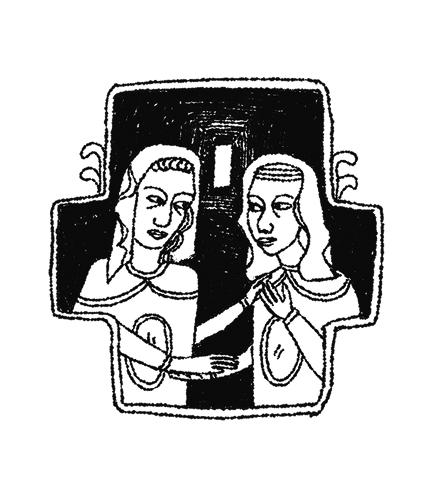
Illustration by Rama Duwaji
Feeling sick and tired, I went out of the gallery and sat on a marble bench in the nearby cloister. It’s covered and open to the sky, delivering fresh air and a sense of the outdoors to the interior of an institution.
I was at an exhibition at The Cloisters about eroticism in medieval art. I was thrilled to be there and also a tiny bit concerned, because The Cloisters is at the top of a big hill in Upper Manhattan and I was not well. For some years I’d been very nauseous and sporadically dyspeptic in a way that mostly made me afraid to go out for dinner. Living a life of horizontal leisure between teaching and writing, counterpoised with decisions made in fear of tummy aches, gave me the overall impression that I lived with a permanent hangover like a feckless baroque aristocrat afflicted by a moral consequence like gout or scurvy. It had not occurred to me that I might be unwell somehow “legitimately.” I was still on my wife’s health insurance, although we split up about a year before because we couldn’t agree on whether or not to have kids. I think I want them but can’t really decide. Every piece of media I’ve ever consumed regarding the choice of whether or not to live in the company of a family emphasizes the choice. There’s no right or wrong, anymore—only what you want.
I took away the message that one ought to commit with discipline to not having any rules, to live by pure choice, by desire-driven action. As I looked back over my life from the cold stone bench in The Cloisters it seemed as though I had navigated romance with an oddly precise inversion of the discipline of the ancres. I’ve followed my desire wherever it has led and here I was getting divorced; returning to solitude. Julian of Norwich is unique, but the erotic frisson of suffering and confinement ripples through all kinds of different types of literature attached to her lifestyle. “Hali Meiðhad” (Holy Virginity) is a lecture in Middle English written for an audience of young girls on the brink of choosing between paths. Primarily you should stay a virgin, the lecture says. Fornicators who seek “foul pleasure” find themselves “sated with filthiness in the space of a moment; but that loathsome sin remains and lingers on, and the remorse for it, a long time afterwards.”
As discouragement, “Hali Meiðhad” consists in one part of a lecture about how terrible it is getting married and having children. You can try not to serve God, it reads. But turn to the world, and you will serve “the worthless man you are subject to, for nothing or for a trifle, that your life will be hateful to you, and make you regret your choice.” These “queens, these countesses, these proud ladies,” it goes on, would admit that they are unhappy. “No one but themselves knows what they often suffer.”
The travails of marriage and the debate over its meaning was a hot topic for everybody in the Middle Ages. The message of “Hali Meiðhad” derives from the patristic tradition of the molestiae nuptiarum, the evils of marriage. Such anti-matrimonial propaganda sprang from commentary traditions on Luke and in particular on Paul’s contemplation of flesh and its problems, the same Biblical sources of the general attitude of contemptus mundi—contempt for this realm of earthly things, and love for the invisible.
There survive thirteen separate English “Rules,” disciplinary documents that describe how women who enter the anchoritic lifestyle ought to behave once they have made the choice that “Hali Meiðhad” recommends. The best known of these and the longest is the “Ancrene Wisse,” or “Wisdom for Anchoresses.” It’s divided into the “inner” and “outer” rule of their conduct. At times the author is clarifying dull regulations. No, you may not invest in cattle; yes, you may wear footless leggings to bed. Then feminine sin appears in negative outline. His charges should stop starving themselves without permission. In fact, don’t mutilate yourself at all, please: An ancre “should not sting herself anywhere with nettles, or scourge the front of her body, or mutilate herself with cuts, or take excessively severe disciplines at any one time, in order to subdue temptations.”
The literature of enclosure in later medieval England is passionate and mystical in places. In others, it is very similar to a girls’ boarding school regulation handbook.
Her outer clothes don’t matter “because men don’t see you.” But underwear gets dozens of details. It shouldn’t feel too silky: “Nobody should wear linen next to the skin unless it is made of stiff and coarse fibres.” Instead, you “may wear an undergarment of rough wool.” When you sleep, wear “a robe” with “a belt,” but not too bodycon: “so loosely fastened that you can put your hands under it.” Make sure the belt is on the outside: “Nobody should wear a belt of any kind next to the skin except with her confessor’s permission, or wear anything made of iron or hair or hedgehog skins, or beat herself with them, or with a scourge weighted with lead, or holly, or with thorns, or draw blood, without her confessor’s permission.”
The literature of enclosed women of medieval England is very difficult to pin down or name. Some of it was definitely written by enclosed women, and then other texts were simply telling them what to do, or spreading their cult. The literature of enclosure in later medieval England is passionate and mystical in places. In others, it is very similar to a girls’ boarding school regulation handbook. All of these texts cause the quality of my attention to shift radically, perverts and voyeurs and desert fathers jostling in my mind. All share an electric obsession with sealing away the body from society and committing it to where it can truly be free, the cell.
I could still just about see into the gallery from my seat, so I drew what I could see of the backs of Mary and Elizabeth on my lined notebook in green pencil. Contemplating the strangely flexing figures of the exhibition in The Cloisters, where ivory saddles gleamed and knees bent with devotion, I felt calmed. The word “cloister” is from the same root as “enclosure.” Then I felt a sharp abdominal pain. My misshapen gallbladder had blocked the bile duct running between it and my liver, causing the bile in the former to run back into the liver. There the bile was sort of attempting to digest me.
“Gall” and “bile” are medical terms that retain their historical atmosphere. “Bile” only comes into English in the seventeenth century, but the notion that the body is governed by four balanced liquids is much older, and structured much of medieval medicine, though the words they used were different.
A doctor of medieval England would have called my organ problems and my personal problems by the same word: melancholie. That was their word for bile. They knew that a mean juice collected somewhere near the spleen, that it caused people to become angry, sad, and insane, and that it was related to the planet Saturn. The melancholy man, one text says, is slender of body and dark in color, proud in his ways and bearing, thinking too much by himself, and loving to be alone.
There’s some wall I can’t get past with people. I try, because I do love people, but some years into a relationship it always turns out that I have misrepresented myself. The other person doesn’t know me at all. I will have forgotten to mention some clump of years or critical piece of information. It isn’t that I’m editing myself to fit, like a scholar turning a manuscript into a modern edition. My mannerisms don’t change. It’s more like only some parts of me rise to the surface to greet the person I’m with, depending on their nature.
The “gall” in “gallstones” is a curious word too. It can mean the strange excrescence on a leaf or branch caused by a wasp’s nest, or impudence, or to annoy somebody, or a very strong wind.
I straightened up and walked back to look at The Visitation from the front. The two women’s heads were very big, but perhaps they were supposed to be observed from below. Each woman sported a large cabochon—a type of gem polished to a smooth, curved pebble—embedded in their solar plexus. The two holiest pregnant women ever with shining crystal bellies.
The pain glowered from the exact location the cabochon would be in my own body. As I looked at the peaceful biblical women carved of wood and gemstones I thought of how everybody I knew seemed to instinctively know how to love one another. It was as if I too had a gem in my solar plexus, but it was black obsidian, or something else pure and dark. Instead of shining outward, my gem sucked the light out of the world around me. Overcome, I left the gallery and walked up the punishing hill until I found the part of Fort Tryon Park that is a cliff looking out over the West Side Highway to the Hudson River. There I destroyed the last rays over New York. Sucking the power of the sun itself into my body, my rotting organ made the afternoon disappear.
Satisfied with my little historical drama, I trudged back to my divorced person–sized apartment, where a hundred dates arranged on apps could pass by without leaving a trace on my perfectly arranged belongings. I wondered if the opposite of an ancre was Satan, or the exact same girl but a happy slut. In the packed cell of the subway car home, I stood bent, moving gingerly around the void in my torso, so I had no trouble getting a seat. In the Middle Ages a bad case of gallstones was fatal. Fortunately they invented a keyhole surgery: no need to open the whole thing up.


