

She Wants to Belong in Earth

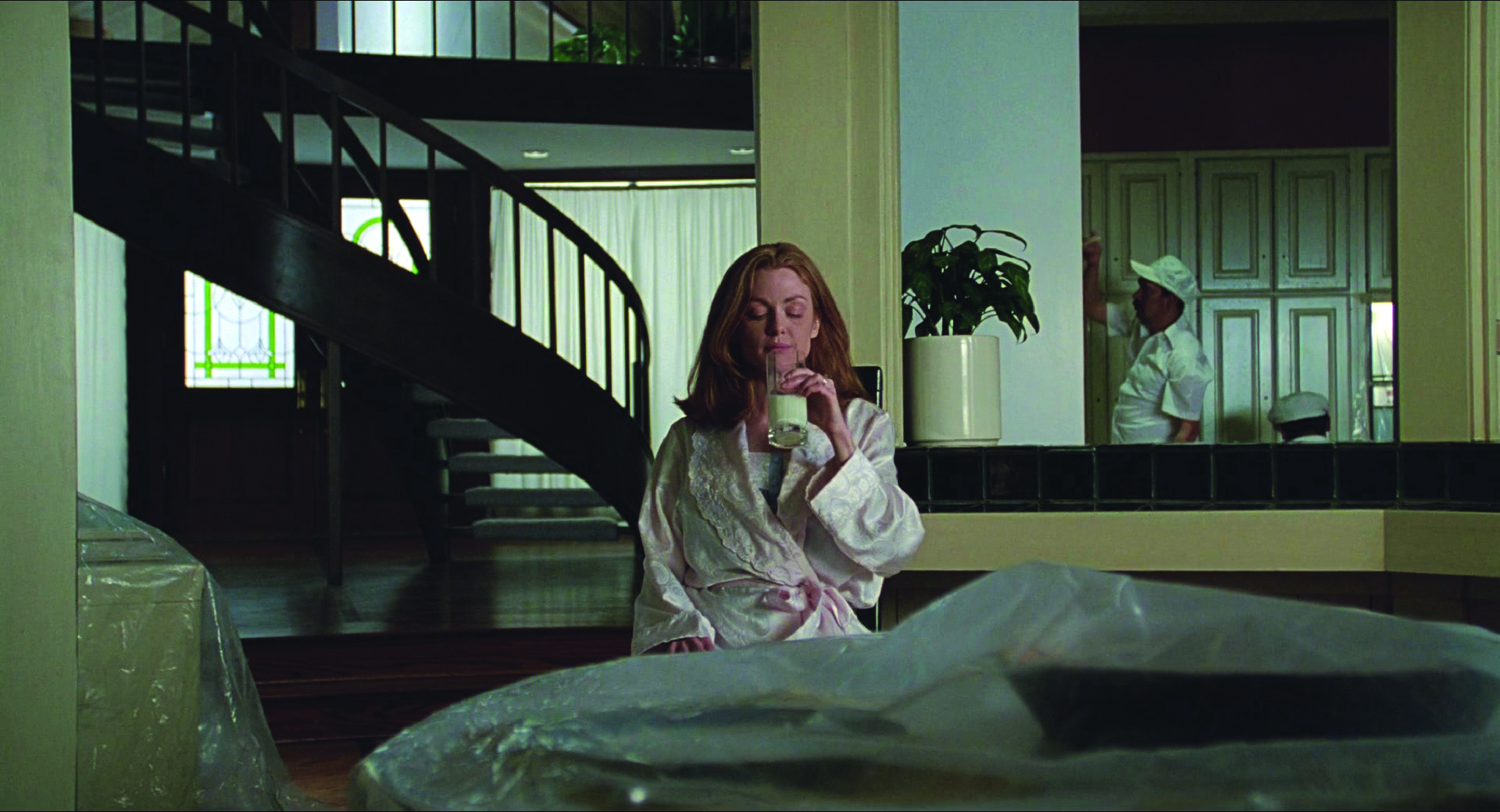
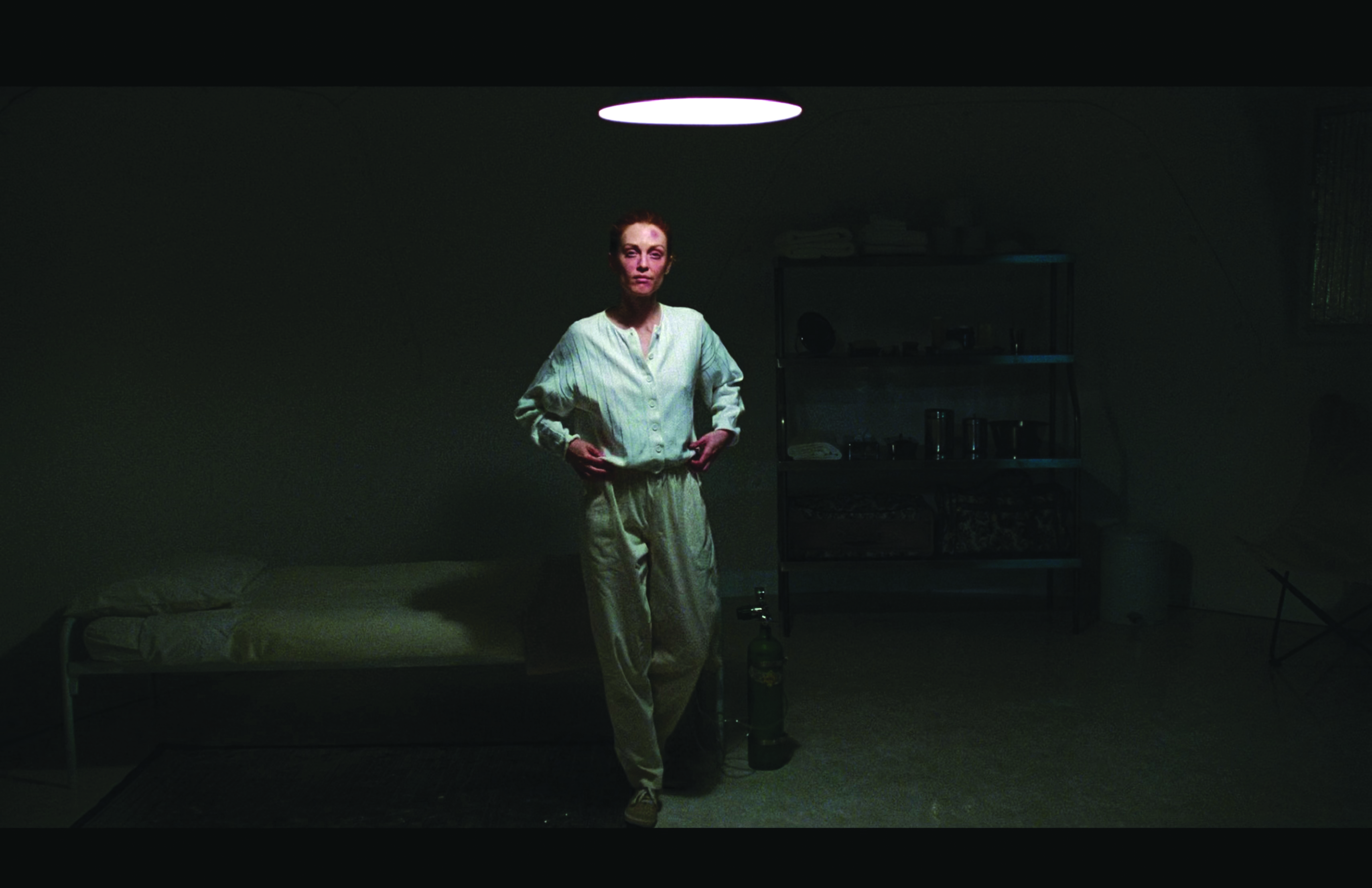
Film stills from "Safe," directed by Todd Haynes (1995). Courtesy of MEP Capital.
In Julianne Moore’s Safe (1995), when Carol tells her husband “it’s freezing,” Moore doesn’t shiver. Moments later, as said husband—Greg—has sex on top of her, she pats his back. She speaks in short, handy phrasings: “I’m fine,” “he’s fine,” “they’re fine,” “this is delicious,” as if practicing language from a guidebook. She eats fruit salad because her friend does, drinks milk like people do only in milk commercials, mirrors the women in her aerobics class. “You know, Carol, you do not sweat,” one of them says. Then we notice she never swallows either. There is a child in the house—not hers; his. If she has blood relations we neither see nor hear them, though once on the phone she says (we take her word for it) “mother.”
The ninth or tenth time I watched her phone home and say “mother,” I startled myself by saying oh my god, it’s because she’s an alien.
(I was alone in the desert trying silence and I felt I was having a Joycean epiphany.)
Possibly this sounds a bit schizoid, but to me at the time the crazy thing was that no one else could see it. Few films made in my lifetime have suffered so many readings. The Carol White story—a housewife in the San Fernando Valley finds she is allergic to the world—has been interpreted as, inter alia, a body horror, a psychological thriller, a women’s picture, a New Age satire, and an allegory for plagues as diverse as AIDS and COVID. Written and directed by Todd Haynes, who grew up in the Valley and who, as a gay man in ACT UP, had a political interest in the wellness cultures that arose in the absence of state care. Safe is a masterpiece of symptomatology: It turns every viewer into a critic, a diagnostician.
Because, at the time of its release, most professional critics were (straight) men and the patient-protagonist was a woman and it was the ’90s, too much discursive time was spent questioning whether she was sick or neurotic. Obviously she is sick. We can all see her dying. But why? Alienation was the smart diagnosis, yet the slippage between meanings of its root word manifested mostly in formal description. Dennis Lim, introducing the Criterion edition in 2014, registered “a science fiction sheen” and “the sense of traversing an alien landscape.” Amy Taubin, in Sight and Sound in 1996, heard music that “swells ominously, as in an upscale horror or sci-fi film.” Jonathan Rosenbaum, in the Chicago Reader in 1995, noted the film’s “alienating strategies,” then quoted a filmmaker friend’s complaint about Carol (or Julianne): “Nobody is that empty.”
A body serving as the perfect host, however, might be. Under the skin, something grows unconstrained by normal organs. In Screening Space, her 1987 study of the American science fiction film, Vivian Sobchack named a subgenre thereof the “invisible invasion film.” In films like Invasion of the Body Snatchers and It Came from Outer Space, she writes, we sit “attentively watching ordinary people being ordinary, so pointedly ordinary at times that they appear finally as wooden as the aliens,” until we can no longer tell who has been taken over, or who hasn’t. What finally gives the resident alien away is “primarily a matter of negative behavior, of not doing something: a gasp not gasped, a kiss not returned.” (Or with Carol, the orgasm not ’gasmed.)
One day a big black couch arrives at the Whites’ house uninvited; Carol, sure she ordered teal, becomes frantic. Critics sometimes read the couch as the cause, the off-gassing intruder that triggers breakdown. But if the housewife herself is the home intruder, then her outsized reaction suggests fear of exposure through likeness, as when, in a different kind of movie, a poor man from the heroine’s past arrives to vitiate her parvenu status. Besides, we never see her order the couch, so how do we know she wasn’t already disordered? Recall that in the first frame she is freezing, even though it is spring. There is no “before,” only a long duration.
00:13:09
Her symptoms compile: inhibiting headaches in the bedroom, a choking fit in the wake of a diesel truck on the freeway, an attack of either asthma or panic at her friend’s boring baby shower. Questioned, she says at first that she’s fine, then—totally guessing—that she must be stressed. She sees a doctor, then another. She sees a shrink. Everyone says she is normal. But at night she can’t sleep, and lies on the couch watching infomercials, or wanders the lawn, while Greg in a wifebeater wonders, “What the hell’s going on here.”
One day she coughs up a clearish liquid as if she has morning sickness, but if she is pregnant it’s not with a baby; her person reeks of sterility. When her nose erupts post-perm at the hair salon, she makes a face in the mirror like she’s never seen blood. “Where am I? Right now,” Carol cries from her bed. “We’re in our house,” says Greg. “Greg and Carol’s house.” Notice what he doesn’t say: home.
Moore plays two characters in one body, Carol and the thing inside. She does it by habit: Very early in her career it was her fate to play, on the soap opera As the World Turns, two half-sisters who share a face; when she left, it took two actresses to replace her. (You could argue that all acting is an attempt to represent a duality or dualism of the human. But not all actors can act.) Embodying is the better half of Stanislavsky’s system, after experiencing. Here Moore pulls off the obverse, a disembodiment done not by withdrawal but by giving her sympathies over to the interior, so that the fullest presence is the invisible, invading. She built the character on a literally disembodied voice, talking above her vocal cords, never “actually making . . . contact.” Pneuma on one planet, soma on another. To further efface her physical self she dieted off a tenth of her weight, the first and last time she ever changed her body for a part.
“Look how delicate you are,” Haynes says, fondly, on the 2001 commentary.
Moore replies, “I was so hungry.”
“You were brave,” he says.
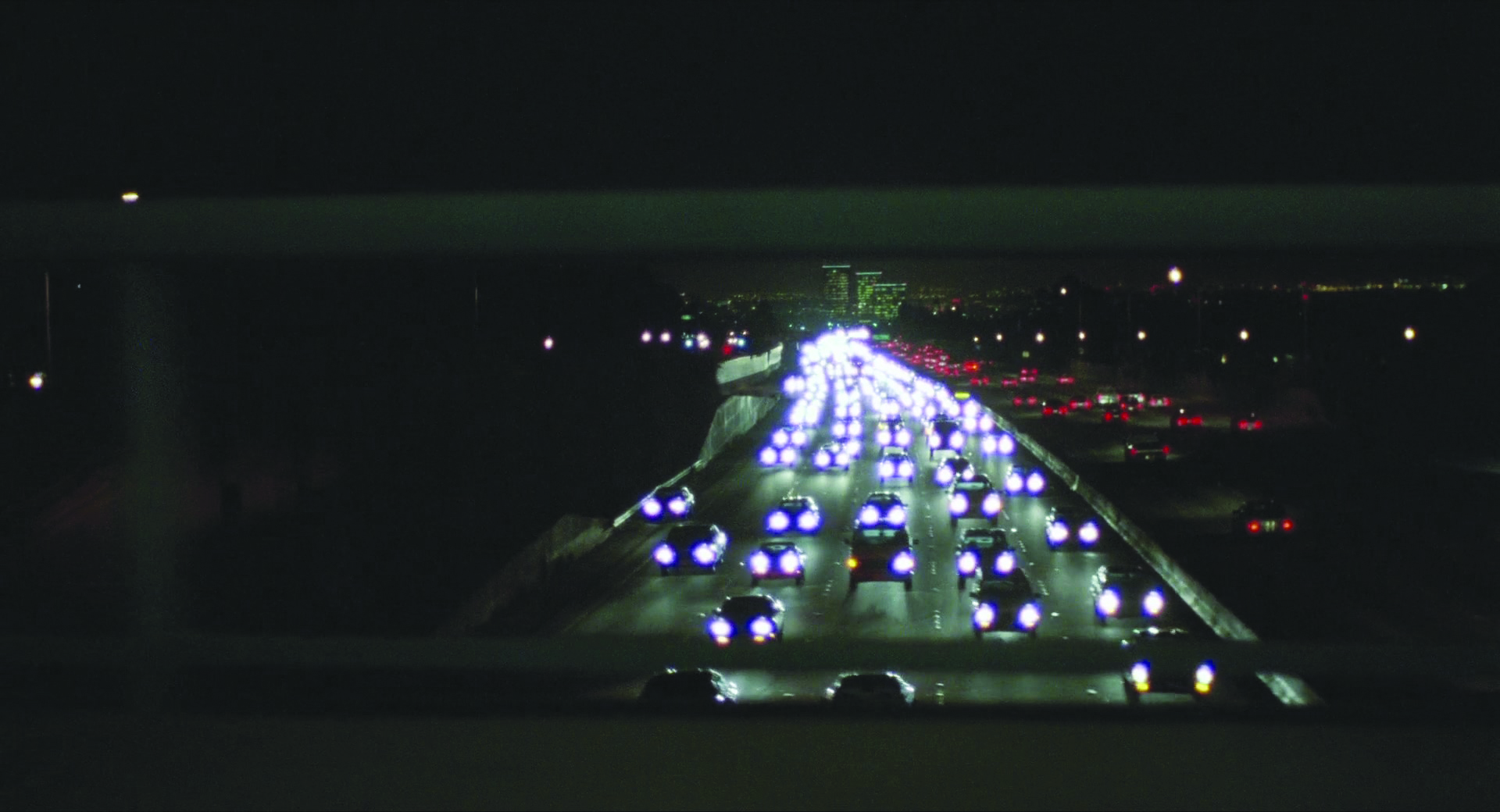
Driving back at night from the doctor’s office, Greg is at the wheel, Carol the passenger. The car passes through the interchange, over the freeway. Carol watches the bright arterial rush, the white and red lights signifying in one of two directions, home or away, east or west, inexorably moved by the vascular flow of necessity and ferried by fate, fate in the hands of the drivers of all the other cars. For a few distended seconds she looks like we have never seen her: like she could cry.
“I don’t ever remember looking that emotional,” Moore says.
“When Carol looks out,” says Haynes, “you don’t really know what she’s seeing.”
I would say some of us do. “Home begins outside,” the composer John Cage wrote in his diaries. “Shelter’s inside.” Carol, who in the film’s first act could not be more housed or less at home, longs for what sickens. “The air, the smell.” She wants to belong in Earth.
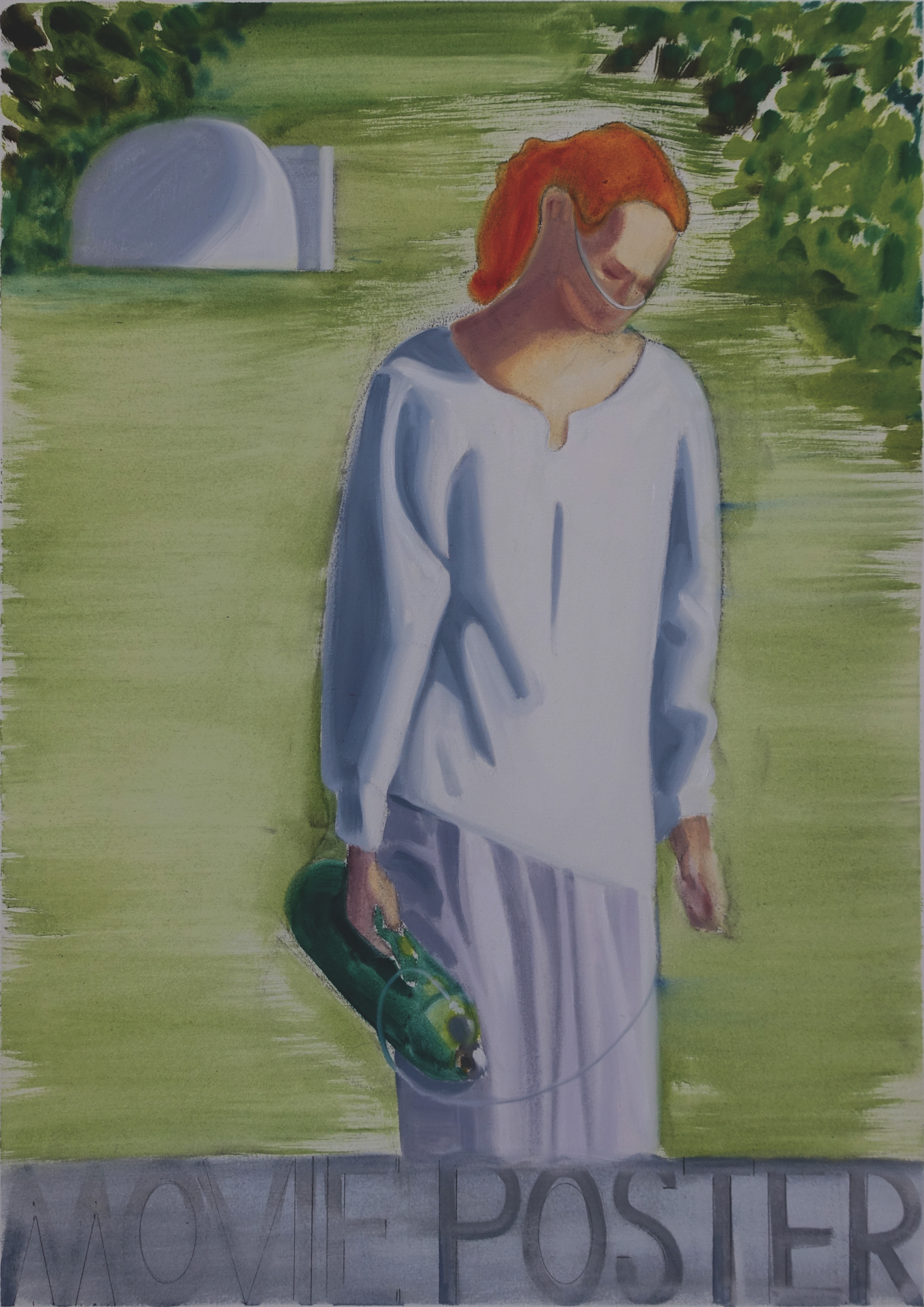
Nicole Eisenman, Movie Poster, 2026, oil on paper, 16.5 x 23.4 inches.
Haynes watches his own film as though he did not himself write it or, six years earlier, direct it. Like me, he seems to be a fan of Moore’s reading. Over the famous final shot of Carol facing the mirror, he says there is “almost an element of the classic alien image” in her, “all eyes and no face.” Moore never says this. She does it, putting in her hungry, delicate eyes what Haynes sounds surprised to find in his mouth. Previously Haynes had suggested that Carol is like a doll, meaning less than terrestrial, not extra. Here he sees what I see. She looks like an alien because she is.

Moore was a stranger on location. After appearing in three films shot more or less where they were set in the Valley—the other two being Robert Altman’s Short Cuts and Paul Thomas Anderson’s Boogie Nights—she was named by The New Yorker as “the quintessential California actress,” which bemused her and made her think: “I’ve never been to California!” This was how she remembered it later, talking to Haynes about Safe for the 2014 Criterion release. Moore explained that while she had known they were filming at his uncle’s house in Malibu and his grandparents’ house in Lake Encino and the furniture store in the Sherman Oaks Galleria, had known that “Malibu” and “Lake Encino” and “Sherman Oaks” were significant to the story, had even understood what was being signified, she formed no cognitive map. Like her character, she “didn’t know where I was half the time.” What the magazine actually printed, in a caption accompanying a black-and-white photograph of her face, was a line about how she was “revitalizing Southern California types.” But if anything, her actressy confabulation undersells the drama at play: The portrait ran in a 1998 California-themed double issue, inset in a report on the state’s undocumented field workers, headlined “INVISIBLE MEN.”
Nothing could be more quintessential to “California” than this practice of naturalizing the invader and estranging the native. Palm trees, stripped of their Mexican heritage, became symbolic of Los Angeles despite being technically an invasive (trans)plant; the Valley’s endemic pine tree was called by the same slur—“digger”—that settlers used for Indigenous Californians. Nativism can be a real trip. In America Day by Day, a diary of her 1947 States tour, Simone de Beauvoir writes of crossing into California under strict agricultural inspection. By way of explanation, she tells a story as apt as it is apocryphal, about a cargo of seeds that, having been sent to the United States as a gift by the Japanese emperor, was allowed to pass through customs unchecked; this diplomatic gesture led to an “epidemic that ruined all the farmers.” This fantasy of ruin is karmically easy to parse: California’s 1913 Alien Land Law, expanding on the federal Chinese Exclusion Act of 1882, cast a growing class of farmers and farmworkers—mostly Japanese, but also Korean and Filipino—as an invasive species, barring “aliens” from owning the land they worked.
One year earlier, in his 1912 sci-fi novel A Princess of Mars, a future Encino man named Edgar Rice Burroughs imagined a Confederate veteran living as “an alien” among the martians. This is how it began, the word meaning not only a person from another place, but also an unplaceable non-person. A host of sci-fi writers took up the figure, inverted it. All American, naturally. As the historian Mae Ngai writes in Impossible Subjects (2004), the federal immigration quotas of 1924 counted whites by country but everyone else by race, imagining the “colored races” as having no country of origin and therefore as existing “outside the concept of nationality.” America is populated by many generations of settlers, but it was the first wave, the whites, who gave the place its permanent sense of derangement, projecting their alienness onto all later arrivals.
Nothing could be more quintessential to “California” than this practice of naturalizing the invader and estranging the native.
Where the past is a foreign country, the alien is the past self, unrecognized on its return. On November 8, 1994, California voters enacted Proposition 187, known as the Save Our State (SOS) initiative, to stop “illegal aliens” from accessing public social services. The state to be saved was the most populous and fertile in the union, and, by its governors’ favorite metric, the seventh-largest economy among nations, if it were one. It was also the state with the union’s largest populations of the homeless, the imprisoned, and the undocumented. Across Southern California, the Los Angeles Times reported in 1989, developers of condominiums and subdivisions were installing gates to “seal out the pressures and dangers of the outside world.” In the San Fernando Valley, where the number of gated communities was reported to have grown from nearly zero to a hundred in a decade, the initiative passed at sixty-one percent, five points ahead of Los Angeles county as a whole; and one in two voters named “illegal immigration” as being a vote-deciding issue.
In his 1946 book Southern California: An Island on the Land, the leftist journalist Carey McWilliams reported newcomers suffering from “persistent and troublesome allergies” and vague illnesses stemming, according to his doctor friends, from “inadequate home construction.” These early signs of what we might call “settleritis” pale beside the case of Carol White. My (mostly) speculative reading of her as an alien is motivated by degrees of shared predicament, but also by the fact that no diagnosis—not even the canonical one, the catch-all “environmental illness”—accounts for all her symptoms, like why she becomes allergic to her daily glass of milk. If her human form is hosting some unidentifiable foreign organism, then everything makes more sense, including her transplant-acquired food allergies. Headache, nosebleed, skin rash, seizure all follow from the discriminating instant in which a host sees a graft as nonself and begins the ineluctable slow attack that is medically known as chronic rejection.
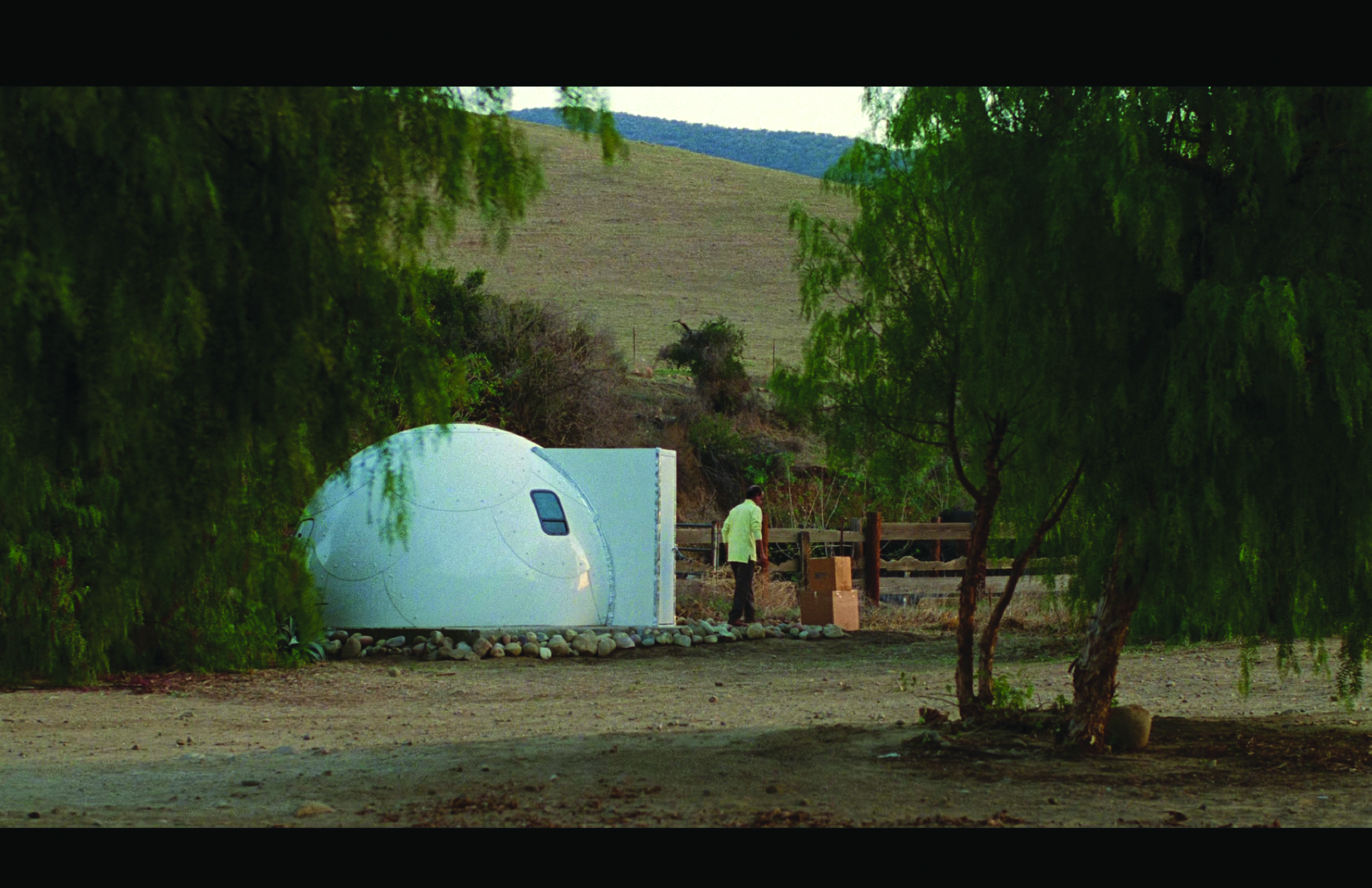
Neither Greg nor her doctor believe Carol when, after seizuring in a pall of freshly sprayed pesticide at the dry cleaner’s, she blames it on “the chemicals.” She is driven to New Mexico, to the Wrenwood Center: a nonprofit communal settlement for those who find the world to be dangerous but the earth to be good. Carol moves into the safest space on offer, a “ventilated and porcelain-lined” domicile that looks like an igloo. From the outside there appears to be a porthole, but inside there seems to be no view. She drinks air from a tank. This, at last, is adequate home construction.
Ten years before Safe was shot and three before it is set, a man stands on a bridge outside Los Angeles, screaming into the dawn, in the Wim Wenders movie Paris, Texas (1984). The man is played by Tom Farrell. The bridge is played by an overpass on Interstate 5. He screams at the commuters below:
They will invade you in your beds! They will snatch you from your hot tubs! They will pluck you right out of your fancy sports cars! There is nowhere, absolutely nowhere, in this godforsaken valley—I’m talking about, from the range of my voice, right here, clear out to the goddamn Mojave, and [. . .] all the way to Arizona! None of that area will be called the safety zone!The scene is a near-perfect negative of the overpass scene in Safe. He screams where Carol is silent. He warns, perhaps, of what she is. Then again so is he: “An alien” was what in the eighteenth and nineteenth and early twentieth centuries they would have called a man like this one, on the premise that he had become a foreigner, a stranger to himself. This sense of the alien is now antiquated, but interesting as it admits the relation between mind and place. To lose one is to lose the other.
Carol’s private institutionalization at Wrenwood is set against the backdrop of public deinstitutionalization, the Reagan-era policy—tested under his governorship in California, then implemented nationwide—by which hundreds of thousands of screaming men were displaced from asylums the state would no longer fund. The absence of public or state-provided healthcare both creates the conditions for and determines the class character of private alternatives. Haynes, in the screenplay, describes Wrenwood as being “nestled in the foothills of Albuquerque,” which is to say just outside the zone of unsafety. To get there, Carol would have passed through a fork at Barstow, from which point, an hour up the road not taken, is the ghost town of Zzyzx: a man-made oasis where in 1944 a radio evangelist built a Mineral Springs and Healing Center using homeless men he paid in meals and lodging, and raised himself a castle on a street he named the Boulevard of Dreams. The federal government shut it down in 1974; the men, presumably, returned to Skid Row.
In 1982, with the Los Angeles Summer Olympics two years away, the city council passed ordinances that put the vicissitudes of homelessness—sleeping rough, panhandling, loitering—outside the law. Weeks before the opening of the Games, thirty cops on horseback swept Skid Row. “We’re trying to sanitize the area,” said a police captain to the Los Angeles Times. “The streets have become the asylums of the 1980s,” said the director of the Skid Row Mental Health Program to The Washington Post. “What we have found in this country,” said Reagan on Good Morning America, “is one problem that we’ve had even in the best of times, and that is the people who are sleeping on the grates, the homeless who are homeless, you might say, by choice.” When a problem is misrecognized, the solution becomes imaginary. At the closing of the Games, a costumed “alien” in a prop UFO descended into the LA Coliseum, borne by a military helicopter painted black to match the smogged-out night sky. “Here comes the spaceship,” said the announcer as if talking to children. “Can you believe this?”
In November 1993, as Todd Haynes prepared to shoot Safe, the homeless activist Ted Hayes planted twenty white geodesic domes, designed by a former student of Buckminster Fuller, on a lot near Skid Row. When I say “homeless activist” I mean an activist who literally “unhoused” himself, reasoning that the condition he sought to cure could not be understood except by way of radical standpoint epistemology. He was the one man in Los Angeles to whom Reagan’s verdict—“homeless by choice”—applied. His dream, short-lived in its fruition, was to establish Dome Village as a sheltering place, a more permanent respite for those evacuated from state institutions, swept from city streets, forgotten by citizens.
Watch enough times, and the all-white carapace comes alive with different shades of meaning.
Haynes saw the domes in the paper and recognized the “antiseptic space capsule” he had described in his screenplay. He acquired two, the smaller for exterior shots, the larger for interior. Narrative closure becomes almost comedically physical: Carol’s domicile is a symptomatic projection of a social contradiction, built to shelter those dispossessed by and through the same social order from which she, as a White, was meant to benefit. Haynes with his degree in semiotics must have known that this is what he was doing. But he did something else too: He cut a hole into the enclosure, which is a mirror. Through this mirror, everybody’s readings and projections come in. Watch enough times, and the all-white carapace comes alive with different shades of meaning, the iridian hues it is white’s task entirely to repress.
01:33:30
00:34:52
When in my early twenties I first watched Safe, I saw the last scene as ambiguous in intent, but clearly suicidal in outcome: Wrenwood is where Carol goes to die, whether she knows it or not. I wanted a bourgeois life, so it makes sense that I could not perceive the spiritual or political value in this alien finding a home among the alienated. Though it did occur to me that if she really wanted to die it should be easier. Not even a jump from the overpass. Just stand there while enough trucks pass by. Instead she spends days making contact, and is only alone at night, in her isolation pod, whereas before when she lived among people who often resembled pod people she was alone all the time.
A decade later, I wrote a draft of this essay in the middle of the California desert, where I had gone to get clear. I was married and in order to stay that way had spent years on a course of medications that was prescribed to make me normal and, by virtue of normalcy, guarantee me a nicer home. It is a cliché to say that I had lost my voice. I was more concerned with recovering attention. Those days of recovery constituted a rare time in which I felt I could see into the distance, and I understood that prescience is simply a matter of being present. But, on my return to New York City, I couldn’t explain to my editors why I was suddenly interested in histories of eugenics and immigration. Wouldn’t I rather write about women who were sick like me, mentally? It was 2016. One year later, the most American president materialized.
This past spring the White House launched a website with the URL aliens.gov, headlined “THEY WALK AMONG US” in the neon green terminal font of an 1980s conspiracy thriller and featuring, alongside instructions for reporting “illegals,” a map of live disappearances. It is hard to know what a cultural critic should do when the subjects of a critique identify so readily with the diagnosis. Normally, I do not believe that malevolent strains of identitarianism can be cured by simple empathy, unless that empathy becomes, as some right-wingers warn, suicidal. But Moore is a powerful empath. At the vanishing point of the reified self, her performance gives rise to a question: what in the new world would change if whites like Carol and even like Greg could see themselves, ourselves, as the aliens here? Or is it too late . . .
In the original screenplay, Haynes’s final directions are as follows:
CAROL looks into the mirror unable to move a muscle in her face. She waits for something to happen.
Carol’s face in the mirror, very close.
Nothing happens.
For a long time I felt that the ending kept the viewer in suspense, and that this explained my compulsion to rewatch it. Vivian Sobchack, paraphrasing the critic Lawrence Alloway, says as much: Suspense is nothing happening, it is the viewer held in place by the withholding of event, of resolution. I now see the nothing as more poetic than cinematic, thinking of Auden on poetry: “it survives / in the valley of its making.” Above Carol’s head there is a wide bright pendant lamp looking like the beam of a waiting spaceship. Couldn’t she just—but no, she steps out of the light, toward the hole.
Carol looks into the mirror; simultaneously, something looks through her eyes, while we look through the camera. The meeting of gazes seems almost unmediated. A moment of infinite recognition. “I love you,” she says, but does not seem convinced. Eyes narrow. Tries again. “I love you,” Moore says to Carol. “I really love you,” says the alien to the host. “I love you,” she says to me too, if you can believe it.
01:54:42


