

Window Shopping

Still from Golden Eighties (1986). Collections CINEMATEK © Chantal Akerman Foundation
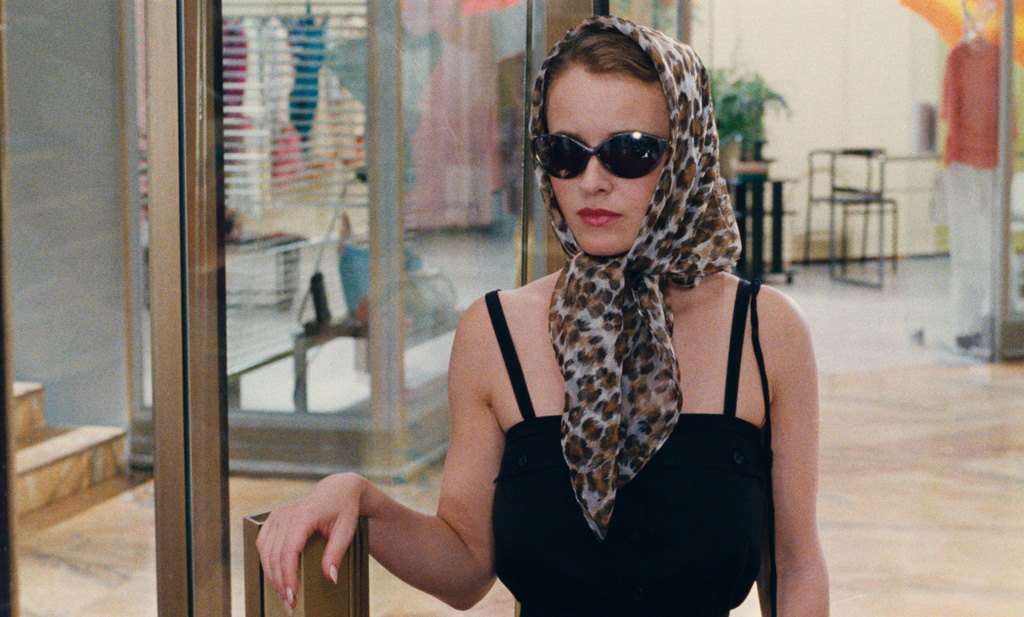
Through its clothing–shiny blue nylon, shoulder pads, and puffball skirts–Chantal Akerman's 1986 movie musical inspires an unabashed desire for objects as a proxy for romance. But if consumerism and love share one principle, it is that there is always more to want.
There is a short scene in the director Chantal Akerman’s musical Golden Eighties (1986) in which a sullen teenage girl, dressed à la garçonne in a Breton-striped top and jeans, goes shopping with her mother. “Now that she’s going on dates,” announces the mother to the shopkeeper, “she’ll need some proper dresses.” When presented with a “discreet” red cocktail number, the girl loudly protests that she’ll “look like a tomato.” She doesn’t want to try it on, but her mother bundles her into a changing room. Minutes later, the girl re-appears, back in her original androgynous garb. “I hate red, I hate dresses, I hate everything, I hate you!” she wails. Yet clothes—how they are presented, exhibited, displayed, and sold—are everything to Golden Eighties. They form part of the film’s study of an unabashedly consumerist decade, in which “love and commerce,” in Akerman’s own words, started to bleed into one another and become inseparable.
When I tell fellow Akerman-admirers that Golden Eighties is one of my favorite of her works, however, they look a bit surprised. More obvious choices might be the critically acclaimed 2000 film La Captive, drawn from Proust’s In Search of Lost Time, or the sublime Toute une Nuit (All Night Long, 1982), composed of a series of fragmented nocturnal encounters. But what I like about Golden Eighties is its artifice and earnestness; its over-finicky dance routines; even its kitsch song lyrics, written by Akerman herself, which refer both to universal interpersonal dilemmas (jealousy, regret, fear of commitment) and to a dizzying range of dairy products (camembert; yogurt; fromage blanc). The film, in its exploration of longing for both an unrequited crush and for a new dress, is simultaneously superficial and touchingly sincere. It is a film that strains for something.
Collections CINEMATEK © Chantal Akerman Foundation
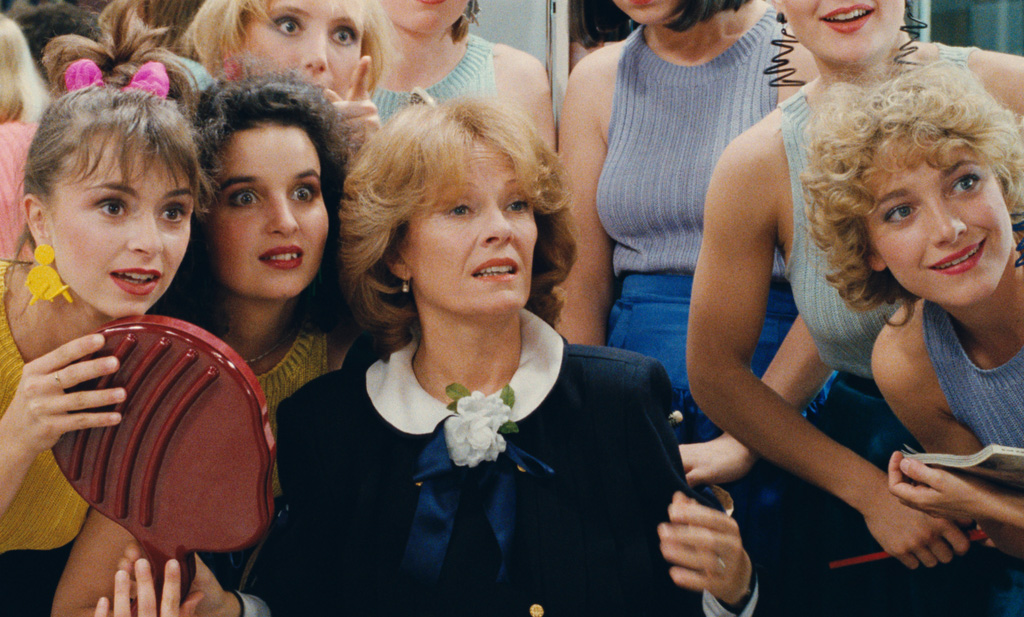
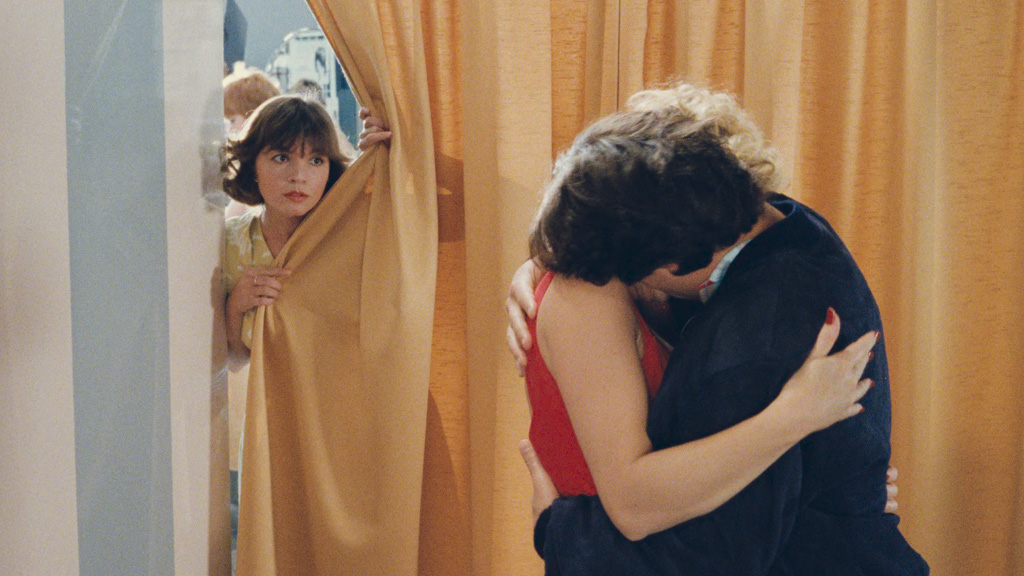
The mall in which the film is set is the Galerie de la Toison d’Or, which still exists in Brussels, yet for the purposes of Golden Eighties was recreated in a Paris film studio. This artificial staging of an already fake setting makes the space of the film a disorienting hall of mirrors. Its plot spins between various romantic constellations orbiting a hair salon, whose star cutter is the unlucky-in-love Mado Morin. From there, it moves between a café-bar run by the thirty-something Aurore; a clothing store operated by the stylish ingénue Lili; and another boutique overseen by Jeanne, a stoic woman in her fifties. Jeanne is settled in her marriage, yet being courted by an old flame, Eli, an American man and former G.I. Jeanne is nervous about opening her heart to love again. “We can go anywhere in the world we want to, start everything over,” Eli says to her. Her steely realism—“The love you’re talking about is for the young”—is an antidote to the swooning platitudes which populate most films made about women and romance.
The choice of the name “Jeanne” can hardly fail to evoke the 1975 masterpiece that earned Akerman the sudden weighty status of a serious auteur. This citation, and the casting of Delphine Seyrig—one of Akerman’s preferred actresses—in the principal role, purposefully flaunts the film’s counterfeit aesthetics. There are also references to Jacques Demy’s 1973 A Slightly Pregnant Man, starring Catherine Deneuve as a hairdresser, and the pastel domestic fantasies of Agnès Varda’s Le Bonheur (1965). It’s worth wondering if these nods were intended to evoke the starry, tumultuous real-life coupling of Varda and Demy, who were known for falling in and out of love. Golden Eighties’s shiny surfaces and rapid musical numbers mount a defense against this inherent vulnerability of romantic love. They offer a distraction from the shattering of unions and what the couple-form cannot contain, salving melancholy with kinesis.
The French expression for window-shopping is faire du lèche-vitrine, which literally evokes the licking of the polished glass panes of a store front; or displays that are good enough to eat. (The film’s US title was Window Shopping.) The last time I watched Golden Eighties, my notes resembled a shopping list: descriptions of 1980s adornment, texture, and color: shiny blue nylon; shoulder pads; power suits; puffball skirt; orange boxy vest top; costume jewelry; knit halterneck tank. Golden Eighties’s incitement of consumerist yearning in the spectator is not accidental. It is another comment on the decade’s interlacing of desire for objects and the desire for romantic love.

Akerman was not especially renowned as a sartorialist. She dressed herself mostly in loose, sombre suits or her pyjamas (she confirmed in an interview with the critic Nicole Brenez that “I go out in my pajamas, I’ve dispensed with fashion. I filmed all of my last film in pajamas.”) She lent her best-known protagonists a similarly spartan, neutral wardrobe: Anna in Les Rendez-vous d’Anna wears a professorial cord blazer; Jeanne Dielman wears a dowdy twinset cardigan, suggesting a woman nervous of the pleasures of getting dressed. But in Golden Eighties, costumes become characters in their own right, harnessed to project a sense of power and professionalism (both very 1980s sentiments) over the contingent, flailing state of being hopelessly in love. The exuberance of outfits on display affirms Akerman not only as an astute reader of the “hyperrealist” gestures of the everyday, to rehearse one critical appraisal of her work, but also of dress, fabric, and style.
Collections CINEMATEK © Chantal Akerman Foundation
Akerman has said Golden Eighties was “not autobiographical,” although her sister Sylviane ran a boutique in the Toison d’Or for a time before emigrating to Mexico. Akerman’s father also worked sporadically in the fur trade and she herself had a gig in a thrift store during her film apprentice years in New York. Her grandmother Sidonie Ehrenburg, murdered at Auschwitz, was a couturier. Clothes, then, were a large part of the family trade. In Golden Eighties, Seyrig’s Jeanne is “Jeanne Schwartz,” a Jewish woman and, like Akerman’s own mother, a Holocaust survivor. In her notes for the character, Akerman writes: “You can still see her registration number tattooed on her forearm.” Like the fastidiously dressed Natalia, who never burdened her daughter with the details of her trauma, Madame Schwartz is also silent about this unfathomable experience. Instead, she works. She glides a shoe onto a varnished mannequin, checks the measurements of a dress. Occasionally, she sings.
If Akerman’s films are well known for their interest in duration, for the way they make the viewer “feel time,” Golden Eighties zips and froths along. But this effortlessness is deceptive: Akerman labored over the film for five years, even making an earlier “trial run”—The 1980s (1983)—before arriving at the finished work. Despite this long run-up, something about the film still doesn’t fully land, or sounds a bit off-key. Apart from Delphine Seyrig’s absorbing solo numbers, like “Cette nuit,” all the singing voices are dubbed—even that of Lio, the pop star cast as Mado Morin. Yet this refusal to offer an “authentic voice” feels intentional. The four interwoven stories of women facing romantic disappointment blur together, suggesting that passion is merely subject to the esprit du temps—or, as Roland Barthes wrote, that “no love is original.”
Critics at the time were less generous in their evaluations. Akerman, anxious to prove her range and comic sensibility, was plunged into a depression and a rancorous “breakdown,” in her words. “They kept wanting me to remake Jeanne Dielman” she bemoaned in a 2011 interview, “but I wanted to spurn everything—spurn my father’s name, not repeat myself.” The film “hadn’t been made as [she] wanted,” which she termed a “disaster,” yet what work of art ever turns out totally as its creator planned? To me, such a statement only affirms the work’s absorbing nature, its resistance to fixity; what Laura Mulvey has called the film’s commitment to the “choreographic potential” of the human body. Things don’t quite come together, but the dance routines and gestures ache with unanswered questions. It could have been the masterpiece Akerman longed for, yet evolved instead to have a life of its own.
Akerman never quite got over her perceived “failure” to make a huge commercial hit: her ambivalence towards Golden Eighties is linked partly to those feelings. Yet she kept experimenting up until her death in 2015, accumulating different styles and skills, each time hazarding the risk of failure in a cascade of different genres, from cinema-as-installation-art (From the East; Nightfall in Shanghai) to literary adaptations (La Captive; Almayer’s Folly) to self-portrait (Chantal Akerman by Chantal Akerman). Some of them received critical raves (From the Other Side; Night and Day) and some of them, especially Akerman’s lone effort at a Hollywood romantic comedy, 1996’s A Couch in New York, were roundly panned. In the process, filmmaking became an ode to not pigeonholing oneself as an artist, and to trying-on different modes and sensibilities.
Collections CINEMATEK © Chantal Akerman Foundation
In the earlier 1983 “trial run” of Golden Eighties, there is an exquisite scene in which Akerman appears on screen to conduct the actress Magali Noël’s rendition of the song “Plus Rien Ne Compte,” which also features centrally in Golden Eighties, before taking over and performing the song herself—a tender ballad about the tumults and exhaustions of consuming love. The scene lasts four engrossing minutes. Akerman wears a white blouse with short sleeves, showcasing her passionate conducting of the music as she performs. The sequence was cut from the later, more polished film.
In the interview with Brenez, which eventually was given the title of “The Pajama Interview,” Akerman expanded on the central role of clothes and textiles to her family legacy:
“My grandmother made dresses and drew the models herself. My mother’s dream, before the war, was to learn to draw so she could open a fashion house with her mother. But that dream died in the camps along with so many others, and nothing more was possible.”
Golden Eighties dramatizes a much smaller, though still fiercely strived-for dream: the opening of a small fashion boutique in a commercial mall in Brussels, through which squabbling mother and daughter-duos, old flames, or future married couples, might briefly pass.


