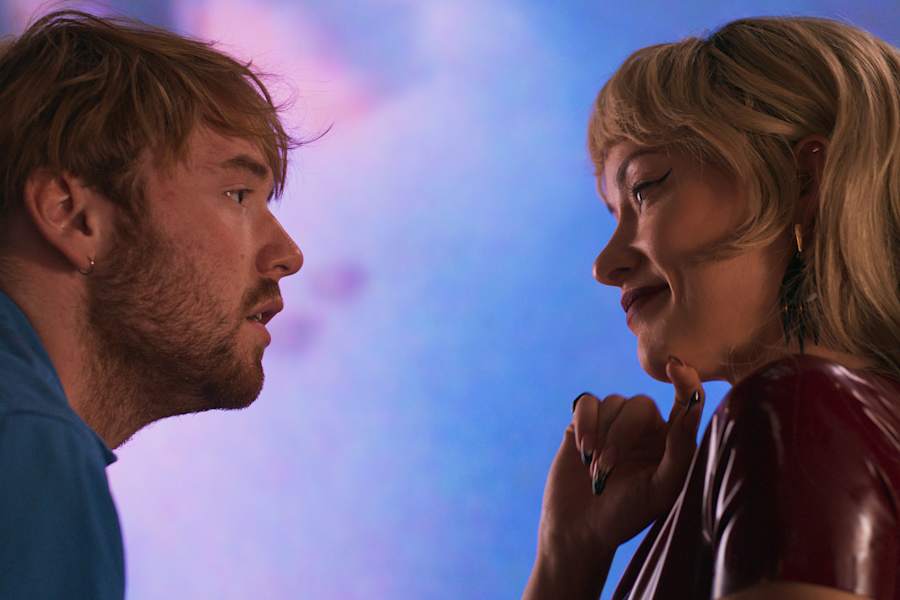
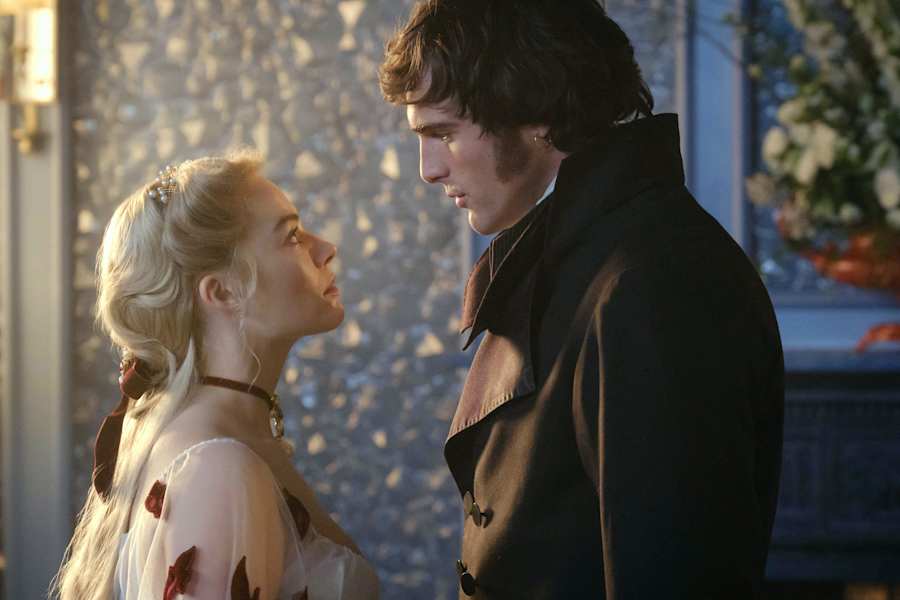
Why are Lizzie Borden adaptations always so horny?

Lizzie Borden—the thirty-two-year-old woman accused and acquitted of hatcheting her father and stepmother to death in their Massachusetts family home on August 4, 1892—had, by all accounts, a small and sad life. Not that you would know it from her depiction in the media.
Screen portrayals—the 2018 movie starring Chloë Sevigny, the 1975 TV movie starring Elizabeth Montgomery, and the most recent Netflix Monster miniseries featuring a notably younger Ella Beatty as Lizzie—all paint the murder suspect in explicitly sensual terms, the killings themselves filmed with the verve of a sex scene. Ever since she skyrocketed to notoriety following her celebrity trial, Lizzie has become a container for society’s desires and fears: about women, about queerness (she was notably unmarried her whole life), about the flesh. And despite her bleak circumstances, the work made about her invariably portrays her as horned up. What I’m left wondering is: why?
Lizzie’s real life
I’ve been obsessed with Lizzie for a while. At age 8, I was taken to a community theater play about her life in my own small sleepy town. For weeks afterwards, that double murder swarmed in my gut, nauseating and entrancing me alike. In response, I became a junior historian. Using my family’s dial-up connection to scope out forums, I downloaded trial transcripts and inquest testimonies, trying to contain my fear within the ribcage of the facts. I eventually put this research away until two decades later, when I began writing my first poetry collection from the perspective of Lizzie and her family as my own father was dying. Several years after that, she snared me again as I returned to her life for my essay collection on horror movies and intimacy, Uncanny Valley Girls. It’s no exaggeration to say that I grew up alongside the life and legacy of Lizzie Borden, that I saw my own anxieties and longings mapped onto her stolid face and frame.
What drew me in about Lizzie, in part, were the contradictions. Not just in her inquest testimony, which is full of holes (Was she downstairs following the first murder or upstairs, where her stepmother’s body lay bleeding out in the guest room? During her father’s murder, was she in the barn eating pears or looking for sinkers for a fishing line? Regardless, why was she sitting there, in the heavy August heat, for over 15 minutes?), but the contradictions in her life itself. Here was a woman raised in the house of one of Fall River, Massachusetts’s upper-crust families, a landlord and former coffin-maker so miserly his home had neither electricity nor indoor plumbing. Here was a woman both the Treasurer to the Young Woman’s Christian Temperance Union (the same year as the murders), and widely known for her fierce temper. And despite her sympathetic portrayal in countless works of media, in the documents that I’ve pored over, Lizzie is also characterized by her own prejudice and cruelty. In her inquest testimony, she admits to calling their family maid, Bridget, by the name of a previous maid for the years-long duration of her employment in their household.
She was in all probability a lesbian. After the acquittal—due to a spectacularly incompetent prosecutorial team, who, among other things, either misplaced or intentionally discarded the handle to the alleged murder weapon mid-trial—Lizzie moved into a less claustrophobic, more luxurious house. There she lived with her sister Emma, nine years her senior. Their relationship lasted until Lizzie hosted an elaborate series of parties celebrating her also unmarried friend, the actress Nance O’Neil. “The happenings at the French Street house that caused me to leave, I must refuse to talk about,” Emma said to The Boston Post in 1905, when she left for good. This has the recognizable whiff of familial homophobia, that mix of scathing judgment and discretion.
And the murders themselves were profoundly violent. Andrew, her father, received eleven hatchet blows to the face, splitting one of his eyes in two and rendering his face, in the crime scene photographs, a blur of ink. Abby, her stepmother, killed ninety minutes earlier, was struck nineteen times, caving in the back of the head completely. Who would look at this life—spent in a cramped home without hallways, all the doors at 92 Second St opening into one another so that there was no privacy even in their bedrooms—and think of eroticism? Yet that has been the throughline of every story about Lizzie: in the collective imagination her story swells with sex like a bullfrog filling with air. And—notably—she’s almost always authored by men, her life rewritten through the prism of their own. Through their art, we see the fear and erotics surrounding women who wield their power through violence and death.
The Legend of Lizzie Borden (1975) and Lizzie (2018)
The most celebrated dramatized depictions of the case emerge at moments of societal gendered anxiety. Look, for instance, at the 1975 Emmy-winning TV movie The Legend of Lizzie Borden—the first feature-length adaptation of her life, written by William Bast and directed by Paul Wendkos. Elizabeth Montgomery’s Lizzie is capricious and hot-tempered, razor-tongued and needy. Outside her trial, suffragettes protest, a detail that connects her explicitly—and negatively—to the second wave of feminism reaching a breaking point at the time of the film’s release. By twining her own anguish with the first-wave fight for the vote, the movie seems to argue that feminism itself is excessive, or sexually perverse, warning contemporary audiences about its latest manifestation. This Lizzie is presented as a woman of monstrous sexual appetites, a victim of incestuous abuse at the hands of Andrew. Yet she is never given a moment to name her pain or protest, remaining a remorseless murderer who strips to the nude to kill her stepmother and father. As she does so, the camera lingers on her bare legs like a striptease. Lizzie was fucked, the movie seems to say—and then she fucks her father with the hatchet in turn.
While following adaptations of Lizzie’s life are decidedly more sympathetic to her, this sensationalized sexuality continues. By the first Trump presidency, Lizzie has become an explicit lesbian. Craig William Macneill’s 2018 Lizzie, written by Bryce Kass, is filled with amber-drenched scenes of Chloë Sevigny’s Lizzie kissing Kristen Stewart’s Bridget (the family’s maid), both women shuddering with desire. Notably, this theory—that Lizzie and Bridget were lovers—was first advanced by Evan Hunter, a pulp novelist who wrote police procedurals under one pen name and pornographic novels under another. His book Lizzie: A Novel was the intersection of the two. (When asked why he made the two women lovers, Hunter answered, perhaps apocryphally, that “sex sells.”) The reemergence of this theory during the post-#MeToo years likely speaks more to the cultural imperative that portrays queer women as empowered and strong—a sort of “Representation Matters!” of axe murderers, if you will. Regardless, the male-gazey traces of its origin remain, as embodied by the camera lingering, peeping-Tom style, outside the barn as the two women begin to embrace.
The film posits Bridget rather than Lizzie as the survivor of Andrew’s sexual violence, a neat resolution to the question of potential incestuous abuse that plagues the Borden case. Here, we can have it both ways: Andrew Borden is a man who acts rapaciously, which makes his murder feel justified. But the violence thought to have been likely in the Borden household—a violence so widespread, common, and horrifying that American society, by and large, cannot look directly at it—is eschewed. In contrast to her father, Sevigny’s Lizzie is presented as someone with healthy, good desires; she teaches Bridget to read and is seduced by her maid, not the other way around. (One scene at the end of the movie complicates the abusive differential of power implicit in a woman sleeping with her servant, but otherwise Lizzie is portrayed as a woman trying to do well.) She even utters enlightened bon mots in response to her oppression: when her father calls her lesbian desires an “abomination,” Lizzie proudly retorts: “Then at last we are on equal footing, father.” And Lizzie, again, undresses as she kills her parental figures—although this time she is accompanied in the murders by Bridget, explicitly mirroring an earlier sex scene. (There is no evidence that the murders were committed in the nude; Lizzie burned a “paint-stained” dress shortly after the killings.)
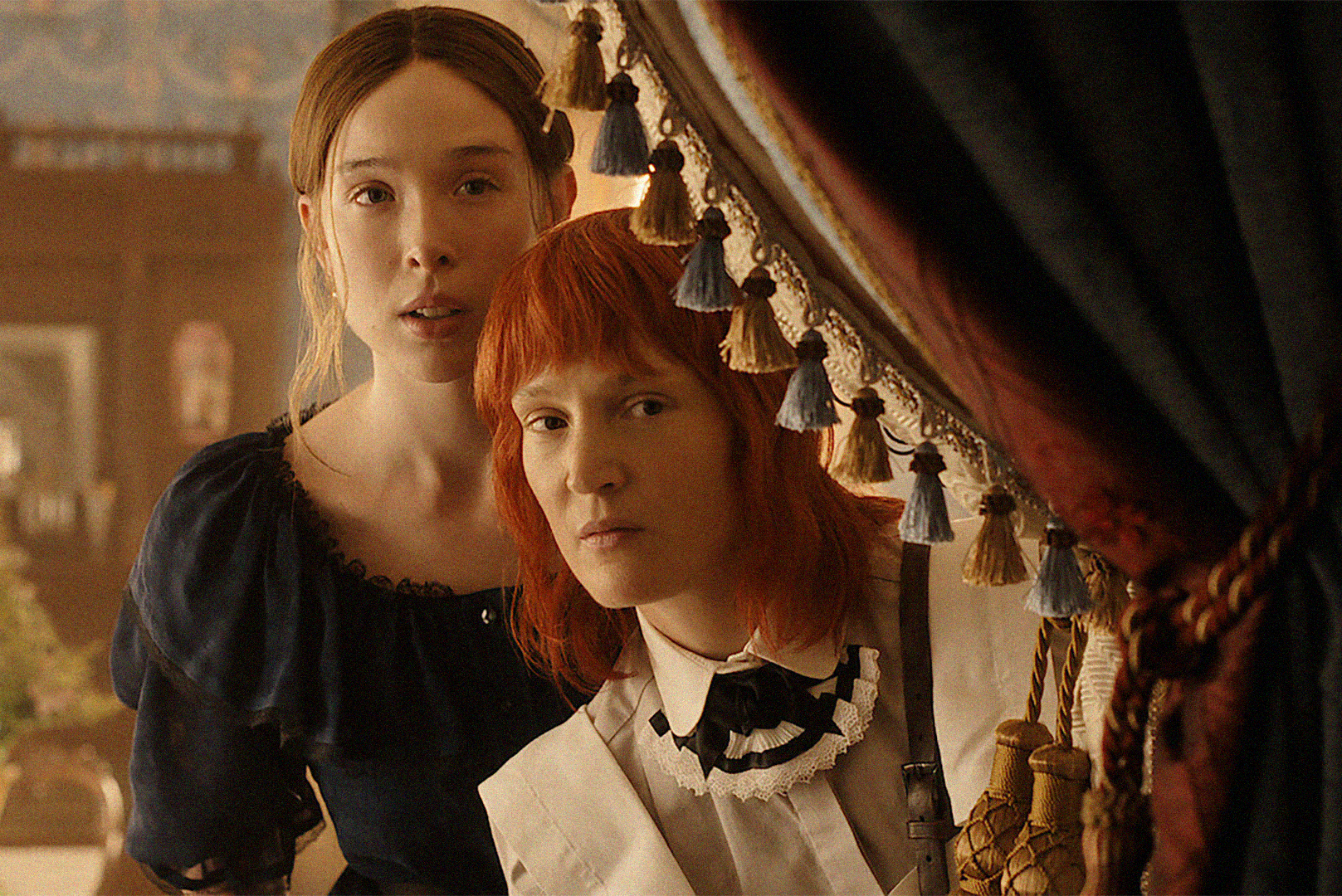
Monster: The Lizzie Borden Story (2026)
This brings us to the most sexualized Lizzie yet, the 2026 Ryan Murphy-produced Netflix series. In showrunner Ian Brennan’s adaptation of Lizzie’s life (he is the sole credited writer for every episode of the show), she’s been dramatically aged down and femmed up. She stares ferally at Bridget who (again in this version) is a lesbian who teaches Lizzie how to fuck, seemingly possessing no interiority of her own outside of her well-traveled maidly bona fides. And once again, in the wake of the Epstein files and Trump’s return to the White House, we see the spiking psychosexual anxiety that the show capitalizes on. When crises in women’s lives become untenable, the result is to sexualize our country’s most famous murderess all over again.
Lizzie, played by Ella Beatty, switches abruptly at the midpoint of the season, going from a woman too delicate for the world to one determined to get what’s hers. This transformation goes unexplained. But regardless, she too is presented primarily through the prism of her sexuality and her desire for Bridget, reinforced by the servant’s own deviant predilections. In the show, she reads to Lizzie from a book detailing the Countess Bathory’s renaissance-era spree of femicide, something that itself is improbably framed as a quasi-feminist act. “Blood is life,” declares Bridget triumphantly, before, one scene later, she presents herself sexually to Andrew in exchange for increased wages. (Her relationship with Lizzie, the show posits, is somehow exempt from the same power dynamics that mark her relationship with the rest of the family.) This overheated sensuality is cemented by the opening scene of the show: Lizzie planting her bare foot on her father’s head as she pries the hatchet out of his skull, the camera lingering fetishistically on her toes.
Beatty’s Lizzie is almost completely untethered from the historical record: femme where Lizzie was butch, young where Lizzie showed all her 32 years, and living in a lavish mansion as opposed to the cramped box that the Bordens resided in. This inversion is most present in the series’ biggest and most ghoulish swing: a fictionalized Aileen Wuornos (convicted of murdering seven men between 1989 and 1990), played by a bug-eyed and filthy toothed Sarah Paulson, pathologically obsessed with Lizzie. (There is no evidence in real life of a connection between Aileen and Lizzie.) Visiting the Borden home, which has been turned into a bed and breakfast (as it was in real life), Wuornos fucks her girlfriend on the couch where Andrew was murdered, fantasizing fucking Abby in the process. To which I have to say: leave Aileen alone!
But Wuornos’s presence speaks to the clearest reason why Lizzie is always made so, well, hot. Just as Lizzie is doing womanhood “right,” Aileen is doing it “wrong”—crass, unattractive, and explicitly psychotic, a caricature of a real woman who was murdered by the state two decades ago. For a woman murderer to be sympathetic, she has to be sexualized in a way that appeals to the gaze of power. Otherwise, the story, for the men telling it and the gender-inclusive audience absorbing it, doesn’t make any sense at all.
The eroticization of pain
I know how deeply intertwined pain and eros are, the throughlines of hurt that shape how we desire. And I believe there is interesting art to be made from the complexities of Lizzie’s life. (Two such works were authored by women: Sharon Pollock’s 1980 play Blood Relations, which sparked my initial interest; and the immortal Angela Carter’s 1985 short story “The Fall River Axe Murders”.) But across the majority of adaptations, we see the most likely interpretation of Lizzie’s life—that she was a woman who committed an act of unspeakable violence in response to conditions that we cannot fathom understanding—replaced, again and again, by a narrative of empty sexualization.
We don’t know why Lizzie would have murdered her father and stepmother so brutally that sweltering August morning in 1892. But what really scared me about the case as a child was its suggestion that violence almost never exists in a vacuum: it accumulates over time, a kettle boiling to a screech on a cast-iron stove. Look at what became of the people who raised her: a man’s face that in profile is half as wide as it should be, the back of a woman’s head that looks more like a mouth than a skull. If we posit that Lizzie did it, the remains of Andrew and Abby Borden she left behind speak not just to a capacity for the extreme but potentially some larger animus, some wound that could only be redressed through blood.
Just several years after the murders, in 1896, Freud would publish his infamous seduction theory papers, hypothesizing that incestuous sexual abuse was both widespread and normalized by society; the following year, perhaps from funders’ pushback, he would withdraw the theory. We don’t know whether Lizzie was a survivor of the same violences that Freud described and then disavowed. But the timing of her cultural reemergences—first in 1975, when the feminist movement foregrounded conversations about the ubiquity of sexual violence; then in 2018, following one of the largest movements of recrimination against rape in the U.S. and beyond; and now, after the reveal of a pedophilic ring tied to the highest systems of power—speak to these connections as well. On some subconscious level, stories about Lizzie seem to gesture at the truth of something suppressed in our society, pointing to the possibility of her pain. And then they swerve, reducing her life exclusively to the realm of the erotic, turning a real, complex woman into an object of fetish—a psychosexual power-slut—once again.
What if a woman hurts us? these adaptations ask somewhat facilely. Well, what if? Faced with that unbridgeable gap between Lizzie and her mythology, of course that hole fills with sex. Her emergence at points of crisis reflects the fears and anxieties around women’s power and capacity for harm alike. Unable to contend with this reality—that if you push someone to their breaking point, something else will break as well—these showrunners fall back on sex, which has always been a way to square these contradictions in the public sphere. As further crises around women’s bodily agency in the U.S. unspool, Lizzie will continue to reappear, dragging behind her an eroticism that was only potentially there in real life. Facts aside, the line between repulsion and desire is never as clean as on the other end of an axe.