

This is no dream. This is really happening.

David O’Neill, "This is no dream, this is really happening," 2026. Five rephotographed iPhone screens and a fiction excerpt, from "Abreaction," a fiction in words and images.
This story is an excerpt from Abreaction, a fiction in words and images. The fiction, drawn from the author’s unpublished novel, Cope, follows Davis, a cinephile searching for his mother, Jean, in the films he loves. The photographs—long-exposure macro shots of an iPhone screen streaming Rosemary’s Baby, Une femme douce, and A Woman Under the Influence—depict women, undone by their domestic space, dissolving into a pixel grid: release, but not resolution.
Manhattan, August 2021
Davis prepped for online therapy like a job interview. He readied his selection of heavily annotated literature and fiction and placed his Drehgriffel Nr. 2 Monocle mechanical pencil onto its matching lemon-yellow Leuchtturm1917 notebook. He started a phantom Zoom meeting to check his appearance. He needed a fresh Carhartt beanie and his shoulders looked a bit slopey; he’d need a dress shirt with greater breadth. Overall, he looked fine, and, anyway, the most important thing would be the sequencing of his remarks. He wanted to hook his new therapist, Erwin, right from the prologue. Like an actor rehearsing his lines, Davis articulated his opening in different registers: “Agoraphobia was the subject that found me, not the other way around.” He landed on a cadence he hoped was reminiscent of Reynolds in Phantom Thread but was dismayed to hear himself sound more like Greg from Succession, kind of always rising into a question: “Agoraphobia was the subject that found me? Not the other way . . . around?”
Erwin was a get. Davis had sought him out after going on a reading bender of the therapist’s oeuvre, from The Heart’s Carnage (1977) through to his most recent masterwork, Don’t Blanch in the Dark (2019). Admittedly, a lot of the stuff in The Heart’s Carnage wouldn’t fly today, and, after falling for the book, Davis had immediately Googled Erwin’s name plus “controversy” to see if he had an abuse-of-power vibe. It was there if you squinted: Erwin portrayed himself curing the incurable almost despite himself, leavening the uncut egotism with well-curated and lovable foibles. No matter, Davis was hungry for his brand of uncle-y wisdom. And Erwin could write his ass off. When Davis woke up feeling wobbly, he read Erwin’s work for hours on his phone, lost in the therapist’s swashbuckling storytelling.
Davis had tried a few remote therapists since the pandemic had amplified his agoraphobia. The previous healer had been a wealthy Connecticut woman whose side hustle was selling Hudson Valley real estate. He’d found her while lusting after a charcoal-colored two-bedroom in Kingston, caught in a bawdy fantasy of escape from New York City during the height of COVID. The house sold in thirty-seven minutes. As a consolation—he’d basically just saved himself $480,000—he downloaded a PDF info pack about the agent’s trauma-informed EMDR practice.
Davis’s early sessions with the agent/therapist were fortuitous. The idea was to mimic REM sleep by tapping on your thighs, right-left-right-left, to process bitter memories or ground yourself in a happy place like a honey-toned library or moonlit beach. Sadly, Davis’s most oppressive recollections never faded. But he did enjoy listening to his therapist’s reedy upper-crust voice emphasize different parts of her script. Even today, he could hear her saying, “What do you notice now, what do you notice now?” Sometimes a little grating and absurd, “What do you no-tice now?” After two months, Davis’s Subjective Units of Distress dropped from an eight to a six-point-five. But the ratings were confusing and he was hung up on that word, “subjective.” The therapy seemed shallow. Writing never came up. Neither did his mother.
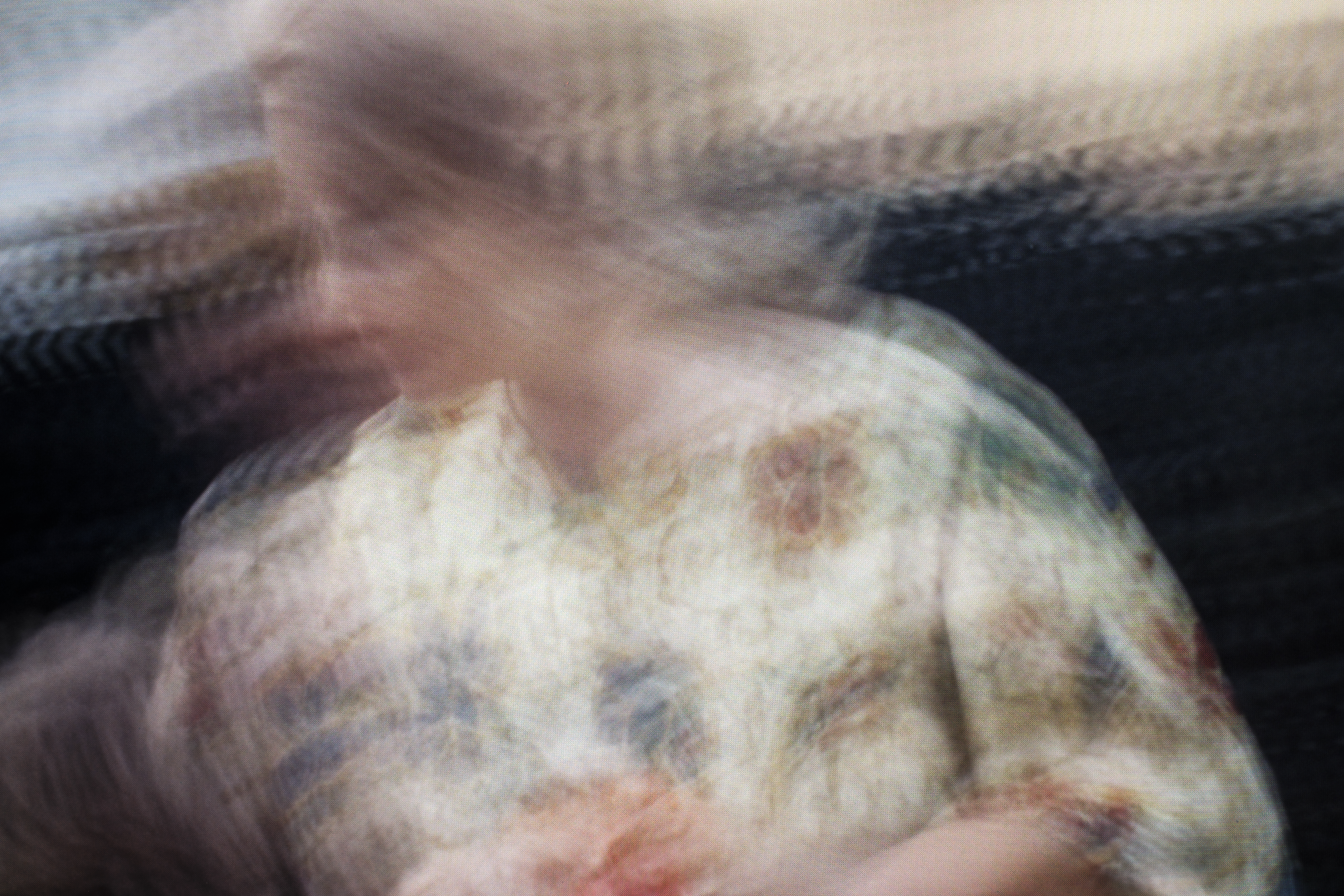
Untitled (Influence 1), 2026.
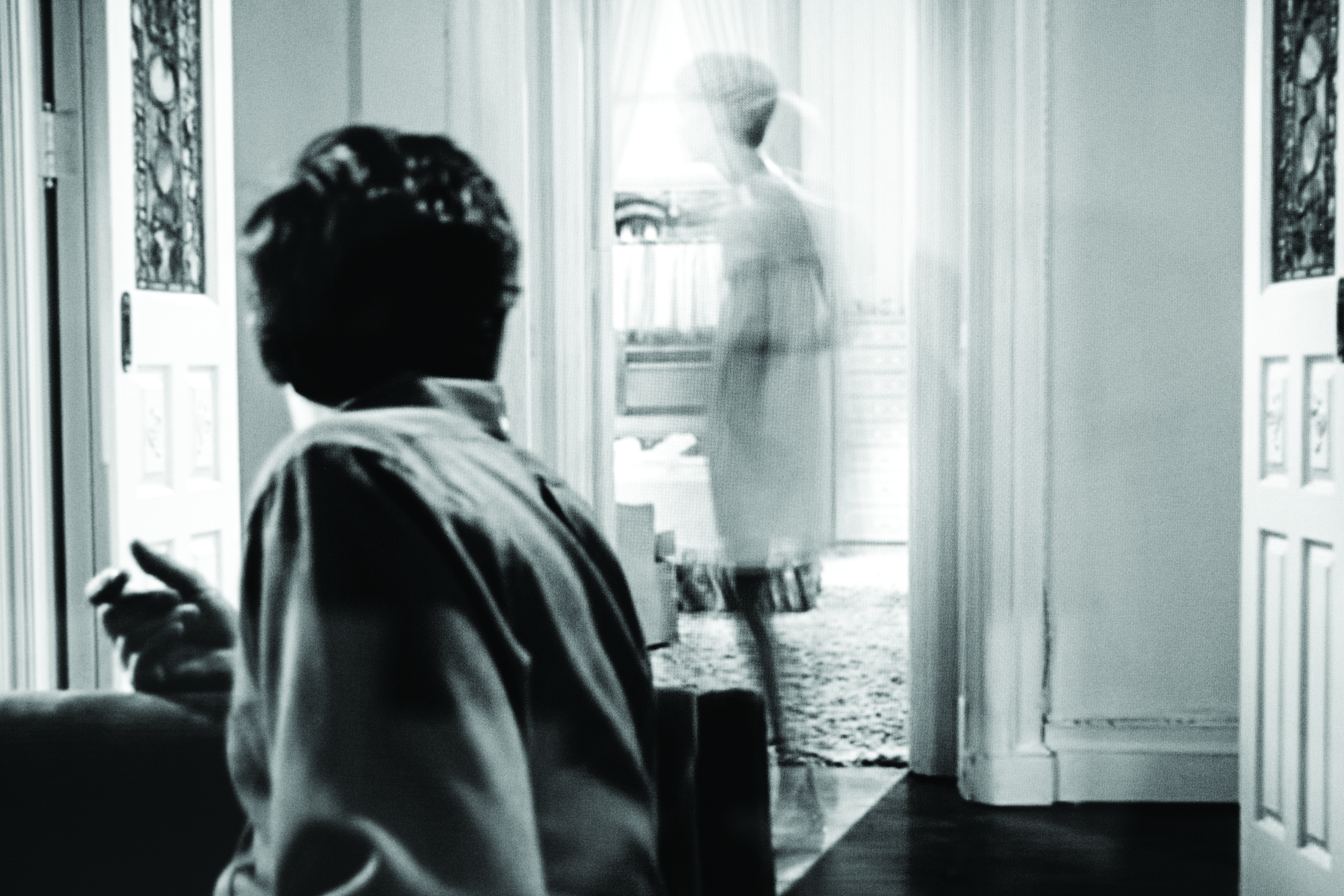
Untitled (Baby 1), 2026.
Now Davis hoped that Erwin would cosign his new essay idea. He fantasized about the language Erwin would use to describe the piece—and its author. A word like “polymath” would be most welcome.
Davis had the beats sketched out along with the most important transitions. He also gave himself permission to go off script. First, the premise: His latest writing project started as an ill-fated video essay about his mother’s trauma, her dementia, and its connection to photography, film, and memory. Before dismantling his abandoned video-essay, he’d have to build it up. He’d act as if it were truly gelling, relaying his exciting discoveries in Barthes’s Mourning Diary and Camera Lucida, among other key texts. (Erwin would grasp that this diptych was deeply connected to Barthes’s own mother.) Davis would then take down the video-essay’s premise with a few well-placed reveals, like how he never finished Camera Lucida.
He felt a little bad betraying the Davis of a few months ago, who happily spent hours looping vintage Polaroid ads and 1960s instructional films on the nature of light in Final Cut Pro, interspersing the footage with long, continuous-shot videos of him expounding into his EarPods mic. None of it landed.
The cue, “Erwin, I swear I’m not pretentious [pause]. OK, maybe a little,” would move Davis to his next topic, an ill-fated attempt to write agoraphobia and panic as a sci-fi farce. The concept of “The Clown and the Editor” was a useful shorthand here, picked up from a guy at The Onion. Davis had tried to write an uproarious satire about nervous strivers whose every fear actually came true. When they worried that they would go crazy if the subway got stuck between stations, or that they would vomit in class, or shit themselves in line at the grocery store, it instantly happened. The story would be scatological and sadistic, with shades of Ballard and Burroughs updated with a Sam Lipsyte-ian inflection. But that, too, was inert on the page. What it really came down to, Davis would intone, getting real, was that he felt that he could die any day now without ever fulfilling his promise as a writer. Taking agoraphobia as a subject was a midlife Hail Mary. Since he didn’t want to write about it, he decided he must.
He already had the title, “Geometry for the Housebound.” Today would be the first time he’d speak about it. Davis knew Erwin would hold the space with his characteristic blend of skepticism and empathy. And if Davis were being honest, he’d admit that some of his concepts were tailor-made for the therapist. He’d frame the word “agoraphobia” as a personal fetish, reveling in the term’s anti-capitalist savor. “A fear of the marketplace”—so great! Davis had written the diagnosis of himself in the third person on a Post-it: “FOE: AGORAPHOBIA. DAVIS’S GREATEST CONCERN IS THAT HE WILL HAVE TO LEAVE THE HOUSE.”
Davis searched Gmail for Erwin’s ClientPortal telehealth reminder. In the self-view, his face looked pasty and resigned, not at all a reflection of his eagerness to see Erwin. Then the leonine therapist appeared, beaming. “Hello Davis! It’s wonderful to see you again. Tell me, what feels most pressing today?” The warmth in Erwin’s eyes, the presence, was all Davis needed to get going. He began: “It’s one word, ‘agoraphobia.’ The subject that found me. But it’s not just a fear of the marketplace, as apt as that definition is . . .” Davis lost himself in the monologue, modulating his voice in a compelling singsong that bottomed out in a gravelly tone. He hit his pauses, creating space and suspense. He talked about clotted sidewalks, halted subways, and raucous movie theaters. He came up with an on-the-fly acronym, FOABTAS, “Fear of Anything Beyond the Aisle Seat.” He did a bit on loud waiting-room TVs, finding a momentary Seinfeldian intonation. Then he turned to more bodily material, a blow-by-blow accounting of what hurt where, his specific fears about various discharges, and how each stab or tingle sent him scurrying across the health-anxiety battlefield. He would mention his frequent urination and tie it to his mother’s relentless texts asking him to send Depends to the nursing home even though she had several economy-size packs. He sensed there was a punchline. Was it something like, “Who is crazier? I guess it depends . . .?”

Erwin zoned out. Junior-level reassurance was beneath him. He logged on to solve existential dilemmas! Davis started in on something else, who knows what at this point, and Erwin looked at himself onscreen in a bid to focus. He thought of a line from The Heart’s Carnage—“When anyone looks at themselves, really looks, they see the void looking back” (or was it “the void in themselves”?)—and recalled the author photo. The cashmere turtleneck and carefully chosen eyewear! The knowing smile. He’d believed that woe could be redeemed by the brotherhood of wounded healers, of which he was now a grizzled old veteran. He redoubled his efforts to listen while formulating a plan B: His cursor hovering over the jaunty “leave meeting” icon, he thought that if all else failed, he could end the meeting and claim there had been a power outage. He needn’t have worried. Davis couldn’t tell he was distracted. The therapist had perfected the look of the active listen. You had to soften your cheeks and open your eyes extra wide on Zoom. The key was to look a bit startled.
Like a great jazz improviser, Davis played the changes. He sensed that Erwin was drifting, so he harmonized with the idea of a larger sociopolitical context, soloing in the key of manufactured humility: “My struggles are small in the bigger scheme of things, of course, and I’m a bit embarrassed to be complaining about my trivial fears when essential workers are risking their lives. These are catastrophic times, and I am very fortunate.” The light had changed, and Davis’s face had begun to look handsome. He turned back to himself: “My phobia had been mostly just an annoyance until the pandemic. I used to be able to talk myself out of believing in these phantom harms, or convince myself I had outgrown my childish fears, but then suddenly everyone from Andrew Cuomo to Jimmy Kimmel was saying that I was right to be afraid, that Greek-named variants with deadly capabilities were hiding in droplets and infinitely misty aerosol particles”—Davis relishing the sound of “infinitely misty”—“and bozos from Curt Schilling to Ted Nugent to Eric Clapton were clamoring for the right to be infected and to infect others because they believed in ‘freedom’”—a mocking whine to indicate verbal square quotes—“or whatever . . .”
The therapist had perfected the look of the active listen. You had to soften your cheeks and open your eyes extra wide on Zoom.
Erwin had never felt less free. The patient was fully filibustering. But he knew the way back from the wilderness: He’d steer Davis to the here and now and address the hitch in their rapport. Erwin felt he must be contributing to Davis’s need to maniacally vamp. How? The art of therapy was intuitive, attending to what the patient was not saying, hovering in that in-between place. A subtle and yet exacting craft, like pointillism. But Davis was wired, practically tweaking, and the conversation was moving too fast for Erwin to find purchase. He’d missed a lot of what Davis had just said; now the patient seemed to be quoting Gillian Rose: “Agoraphobia involves a magnification of space, populated by myriad terrors. Benign sights and sounds acquire a sinister, echoic, persecutory air, mocking your inability to connect signification with the world of objects . . . You feel as if you are suspended on the sharp rim of the world.” Davis was now talking about . . . Ford Madox Ford, was it? A famous agoraphobe? Erwin tried to remember a Ford book but couldn’t. Independence Day? No, that was Richard Ford. His heart was racing. Davis was on to Proust and his bundled overcoat, how Davis would write an essay that allows readers to become readers of themselves.
When Erwin finally did speak, his voice lacked conviction: “Davis, what would it be like to stay with your own words here, your own experience?” Davis fell silent. He looked around his room as if for the first time and was irritated to be interrupted even as he was aware of Erwin’s gambit.
A student of The Heart’s Carnage, Davis knew the therapeutic benefits of the here and now. Repeating patterns. It was just that the here and now inevitably led to the past. And there was so much that Davis couldn’t say. He remembered how he’d spent his childhood thinking he and his mother were both trailed by a cloud of filth like Pig-Pen in A Charlie Brown Christmas. His grandparents had had a blissfully secluded stairway where Davis sat and observed the adults below without being seen. Why had none of the adults invited him down? Perhaps that was respect or protectiveness, letting Davis be Davis. But he longed to be with them.
Davis couldn’t talk about how he had tried to escape the cloud but never could.
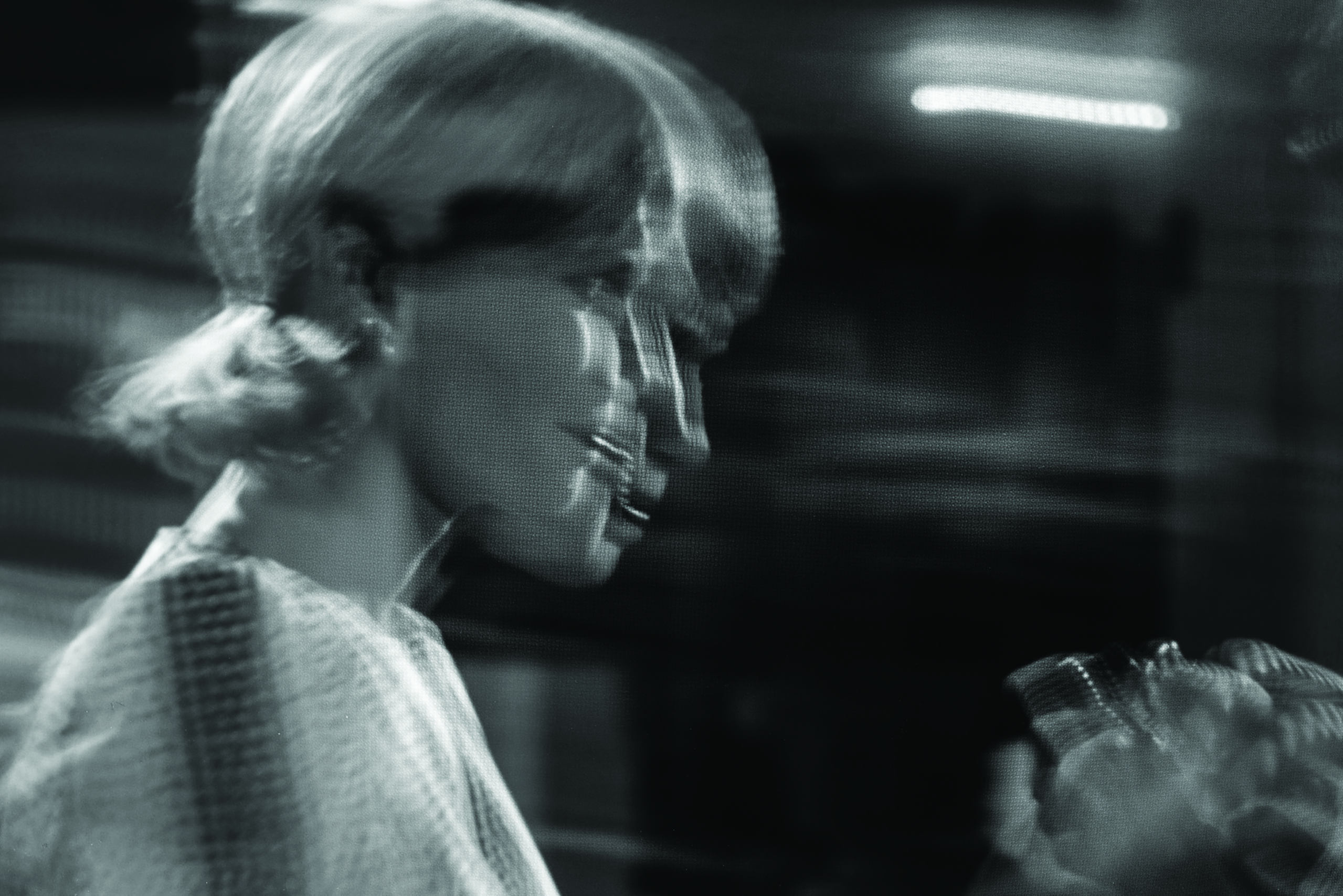
Untitled (Baby 2), 2026.

Untitled (Gentle 2), 2026.
When would Erwin read Davis’s mind? Wasn’t that what he was paid for? He asked Erwin about Freud; he knew playing a little dumb and asking a man a question was the quickest way to win affection. “I’ve heard Freud’s theory that agoraphobic women really fear a desire to become prostitutes—to sleep with strangers in the street. Do you buy that?” Oof, Greg the Egg cadence again, he thought.
Erwin hated Freud but couldn’t say why. Thinking about it now, he guessed he distrusted the idea that the psyche was mere hydraulics. He tried again: “Davis, this is not a seminar, and I’m more interested in conscious actions than unconscious drives, although I do admit, Freud was a hell of a writer.” The wrong tack: Davis spent the next five minutes voicing the opinion that Freud’s prose was tedious and opaque—all that vesicle material in “Beyond the Pleasure Principle,” what the actual fuck? Erwin caught the flicker of rage. Perhaps this was something they could work on—examining how Davis sanctified or demonized men. He took off his glasses and polished the lenses to maintain the silence and get the patient to say more. The silence deepened. The moment passed. Davis reverted to platitudes before logging off. He was trying to take it one day at a time.
Davis was late for the next session, and Erwin spent ten minutes exploring what Davis was trying to communicate with his lateness. He knew that the aggression therapists and patients subtly work out on each other was a path towards healing. Or could be. But this seemed to be yet another dead end. Davis was now digressing on Rosemary’s Baby and A Woman Under the Influence and some French movie you could only watch on Eastern European pirate sites. Most patients didn’t talk about orris root necklaces and Mia Farrow’s Peter Pan collars. Dostoevsky and Cassavetes. Erwin leaned in, arguing with himself about whether this was therapeutically productive talk or if he was just enjoying the respite from more mundane material. Then, in a flash, Erwin realized that the movies Davis was always going on about were more real to him than his own life. Davis saw his mother in Mia Farrow, Gena Rowlands, Dominique Sanda. He saw himself in the women too. This double bind was the root of his confinement and what his essay was really about. Erwin sensed that Davis remembered the Dakota’s kitchen better than his childhood bedroom.
I get consumed, I disappear on myself.
The beginning of their real work together! He spoke confidently for the first time since they’d logged on. “Davis, I’m feeling disconnected from you. Are we perhaps colluding in an unspoken avoidance? I’m wondering—I’d be very interested to know—whether you are still planning to write about Rosemary’s Baby in your essay? It occurs to me now that you’ve talked about identifying with the baby. Do you realize that means you’re identifying with the devil?”
“Erwin, yes, that’s very insightful, and it’s funny, I was just thinking about this. Rosemary’s Baby is a movie about an abuser—played by an almost cartoonishly evil John Cassavetes—made by a man later exiled for statutory rape. The director allegedly forced Mia Farrow, a twenty-one-year-old vegetarian, to eat raw liver in endless takes, and made her walk out into real New York City traffic for the handheld camera scene. And she was married to Sinatra at the time, and ol’ blue eyes sent her divorce papers on set. He apparently hated the haircut. She’s surrounded by controlling men on and off set, and her terror seems real in the film, and yet her speech is so musical, and really reminds me of my mother, the way she trails off into pouts, her doubting of reality; she knows there’s a conspiracy against her, but she can’t prove it. I guess they’d call it ‘gaslighting’ now but I’m not sure that term means anything anymore. The next-door neighbors in the movie, the Castevets, have always reminded me of the way my mom’s friends and acquaintances treated her; they’re nosy, but they also don’t want to know. They’re in on it on some level. Rosemary does try to get help and sees Dr. Hill, Charles Grodin, who appears sympathetic. But he’s the worst one! A honey-voiced liar and double-crosser, and, again, this type is very familiar to me, all these men who appear to be saviors. And I know it sounds wild, and this is a forbidden thought—I can’t believe I’m saying it—but I’ve always seen my mother as a conduit for attacks. Demonic forces are attracted to her, what I would call her trust and guilelessness, but she can channel these forces as well, disappearing sometimes in a way that is completely frightening when you’re a child. Now that I’m grown up, supposedly, I feel that darkness in myself, the need to lash out,
I get consumed, I disappear on myself. And yet she is my mom, and, if you remember, Rosemary really does love the demon spawn at the end. I’ve been telling myself that I love her, but I don’t have to live out her karma. Does that make sense?”
Davis could scarcely believe what he was saying. He thought he’d just been riffing as a film critic, rehearsing some ideas for the essay, but he’d blurted out things he’d never expressed, even to himself.
Erwin’s eyes seemed sympathetic. Then Davis thought he saw Erwin’s hand move. The meeting was over. A box popped up: “This meeting has been ended by host.”
Davis had two options: “Report problem” or “OK.”
He clicked on “OK.”
Five minutes later, Erwin emailed him: “Hello Davis, I am sorry to say that I had a power outage in my office. I am proud of the progress we made today. We have turned a corner in our work together. It is most satisfying. I apologize for the timing of the outage. There’s nothing I can do about it, I’m afraid.I look forward to meeting again as soon as possible. I will be in touch when things are back to normal. In the meantime, be well. Erwin.”
Davis wondered how Erwin could have sent the email if his power was out. One line from his message stood out:
“There’s nothing I can do about it.”
“I’m afraid.”


