A guide to the different prevention options available to help you prioritize safer sex—including barrier methods, PrEP, DoxyPEP, and more.
Staying healthy is about intentionality around safer practices, balancing risks, and making informed decisions on how to reduce any of those risks. We make these decisions every day: for example, we accept that going out to a bar or getting public transport involves the risk of catching a cold, so we wash our hands or wear a mask to reduce it. But if someone does get sick from this, we don’t get judgmental—we accept that it’s a fact of life. STIs—sexually transmitted infections—are just the same, so why judge them?
STIs can seem scary or shameful, but they’re like any other kind of infection. The sole difference is stigma. The only way to completely avoid all STIs is to not have sex at all—which, for many people, isn’t desirable, or realistic. Luckily, there are ways to prevent many STIs and reduce risk for others; what you choose will come down to you, your partners, and your priorities.
Here’s our guide to the prevention options available to you, presented in partnership with The Love Tank, a U.K.-based community organization working to improve the sexual health and well-being of underserved communities. Think of it like a mix and match menu for the best sex with the least risk.
Lower risk sex
Sex comes in all shapes and sizes, and some types of sex involve different levels of risk when it comes to picking up or passing on STIs. One way of preventing or reducing any risk is to choose a type of sex that has a risk level you’re comfortable with. Anal and vaginal sex hold the highest risks for HIV and STI transmission (if no prevention tools are used), but there are other ways to play that can reduce some risks:
- Oral sex can transmit most STIs, but it is much lower risk for HIV. If you’re receiving oral sex, this is extremely low risk. If you’re giving, there’s a small potential risk, which increases if your partner cums in your mouth or is on their period. Even then, you’d need an open wound in your mouth (like recent dental work) and your partner would need to have a detectable viral load. In other words, it’s very rare.
- Mutual masturbation is not a risk for HIV or STI transmission. However, if someone has bodily fluids (like cum, vaginal fluid, or blood) on their hand and puts this inside someone else, then STIs could be transmitted this way.
- Toys hold no risk for HIV or STI transmission if they’re used on one person. If you’re sharing them, then STIs can be transmitted on the toy—so just use a condom on it, remember to replace the condom between partners (see below), and ensure you’re washing toys thoroughly after use.
Barrier methods
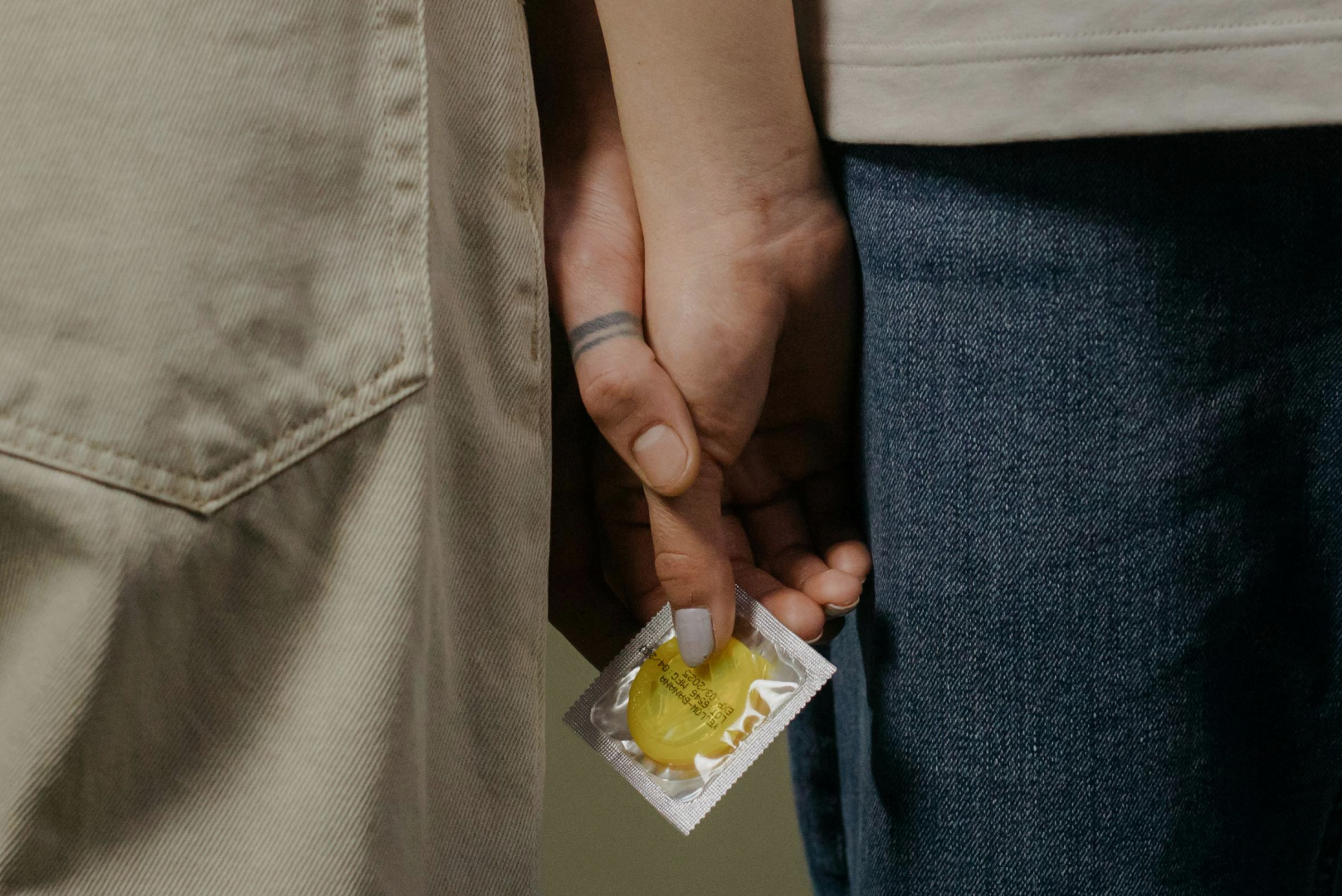
One way to help prevent HIV and STIs is with barriers. Barriers are any product (usually latex) that gets between you and your partner’s genitals, blocking bodily fluids from transferring between you. This is because fluids like semen, anal fluid, or vaginal fluid can transmit HIV and STIs.
Condoms
Condoms are the most common type of barrier, and are made up of a latex tube that goes over a penis or toy. They can be used for oral, anal, or vaginal sex. You can also get them in other materials if you’re allergic to latex (but lambskin condoms do not prevent STIs—only pregnancy). Condoms need to be used and removed correctly (many will come with their own instructions). If you’re using lube, make sure to choose a water-based or silicone-based option, as oil-based lube can damage latex condoms and dental dams.
Condoms need to be used the entire time you're having penetrative sex for them to work—and not just before cumming. You may also need to use more than one during any session: they need to be replaced if you’re switching between partners (to reduce the risk of transmitting STIs), or if you’re switching between vaginal or anal sex, to prevent UTIs and other infections. Try to remember it like this: new body part, new condom.
Condoms are more effective for preventing some STIs than others. They’re very effective at preventing HIV and some STIs like chlamydia, gonorrhea, and syphilis. This is because these infections are transmitted by bodily fluids that condoms can physically block. Condoms are less effective at preventing HPV (some strains of the virus can cause genital warts) and genital herpes, because these can be transmitted by sores on the skin that may not be covered by the condom.
Internal condoms (sometimes called female condoms) are like regular condoms, but they go inside the body (vagina or anus) instead. These are less common, but the same principle applies: to be effective, they need to be worn the entire time and replaced between partners.
Dental dams
Dental dams are small sheets of latex that make a barrier for oral sex. You place the sheet over your partner’s genitals or anus, and you’re ready to go. If you apply some lube to the body before placing the dental dam on top, this can increase sensation (remember that oil-based lube can damage latex, so go for water-based or silicone-based).
Dental dams can help prevent bacterial STIs (chlamydia, gonorrhea, and syphilis) along with other infections that can be transferred by rimming, or oral play around the anus (hepatitis A, shigella, giardia). Dams can also help prevent herpes transmission from someone’s mouth to genitals if there’s no other contact between someone’s mouth and their partner’s body.
Gloves
Some people may choose to use latex gloves when penetrating their partner(s) with their fingers, or fisting—especially if they have cuts, fresh tattoos, hangnails, a skin condition, or any other wounds that may increase the risk of transmitting STIs.
Again, the same principles apply around changing gloves when you switch between partners, or between vaginal or anal penetration, and ensuring you stick to water-based/silicone-based lube.
HIV PrEP
PrEP is short for “Pre-Exposure Prophylaxis.” It’s a medication that HIV-negative people can take to prevent getting HIV. Anyone can take PrEP, no matter your gender identity or body, and it works for all types of sex. When taken as prescribed, it is almost 100% effective at preventing HIV. PrEP is most commonly taken as a once-a-day-pill.
Someone’s HIV risk will vary depending on their body and the type of sex they have. You may be a good fit for PrEP if any of your partners were born with a penis, and if they also have sex with people born with a penis. For example, cisgender gay/bi/pan men, transgender gay/bi/pan men, or cisgender women who have sex with bi/pan/non-straight men. Other people who may benefit from PrEP are people who share needles or injection equipment, or people from countries or communities where HIV is more common.
To learn more about HIV PrEP, visit PrEPster—a hub for information and resources related to PrEP. For tips on talking to your healthcare provider about PrEP, check out The Love Tank’s guide to speaking to professionals.
Injectable PrEP
There are now long-acting types of HIV PrEP that give the same protection as oral versions. One type is as an injection you have in the butt muscle every two months (available in the U.S., Canada, and for U.K. NHS patients who can’t take oral PrEP).
Another type is a subcutaneous injection into the fatty tissue just under the skin, taken once every six months. This is available in the U.S. and has recently been approved in the U.K., with approval still pending for Canada. Even though these injections have been approved in the U.K., they are not likely to be widely available any time soon—this is because of how expensive they are.
HIV treatment
If someone is living with HIV, then effective treatment can reduce the viral load in their blood so much that it wouldn’t be detected on a standard HIV test. This is called “undetectable.” When someone is undetectable, they can’t transmit HIV through sex—it’s not just low risk, it’s zero risk. This is known as “undetectable = untransmittable,” or “U=U.”
Learn more about U=U with this viral load guide from Terrence Higgins Trust.
DoxyPEP
DoxyPEP is short for “Doxycycline Post-Exposure Prophylaxis.” It’s a way of preventing STIs that involves taking the antibiotic doxycycline after sex to reduce the risk of bacterial STIs. You take a single dose of 200mg (usually two pills or capsules) after sex. Research shows this is very effective at reducing risk for chlamydia and syphilis, and gives some protection against gonorrhea.
DoxyPEP needs to be taken within 72 hours after you’ve had sex. Taking it within 24 hours after sex makes it the most effective, so sooner is better.
Find out more about DoxyPEP and where it’s available here.
STI testing
Preventative methods can reduce risk for some STIs, but they don’t completely eliminate them. Because some STIs have no symptoms, testing is the only way to know about your STI status. Whatever risk reduction tool you use, it’s a great habit to get into.
How often you should get tested will depend on your current STI risk. This can change over time, so it’s about checking in with yourself and your partners to decide what works best for the sex you currently have, or want to be having.
To learn more how to decide on your testing schedule, take a look at our guide to STI testing. You can also find information on self-testing for STIs, plus more detail on HIV and prioritizing sexual health and safety.
*We use certain terms to describe body parts and acts for clarity, but choose whichever terms feel comfortable, or resonate for you.