Wherein we discuss AFM Issue 2, experimental evolution and the intimate vulnerability of print.
Give us a TLDR of AFM Issue 2…
Maria, Co-Editor: “The second issue of AFM, Mind Games, explores the tricks our minds play on us—how we think, remember, desire, and rewrite our own stories. It’s a collection of essays, fiction, poetry, columns, and photography that looks at the ways thought and feeling intersect: how our minds both reveal and distort. It’s beautiful, a little disorienting, and full of surprises.”
Merel, Art Director: “A colorful, geeky, abundant visual and textual train of thought”!
Haley, Co-Editor: “A real range of moods, thoughts, approaches, gestures, and ideas—by turns funny, sweet, sexy, cerebral, instinctual, sometimes all at once on the very same page.”
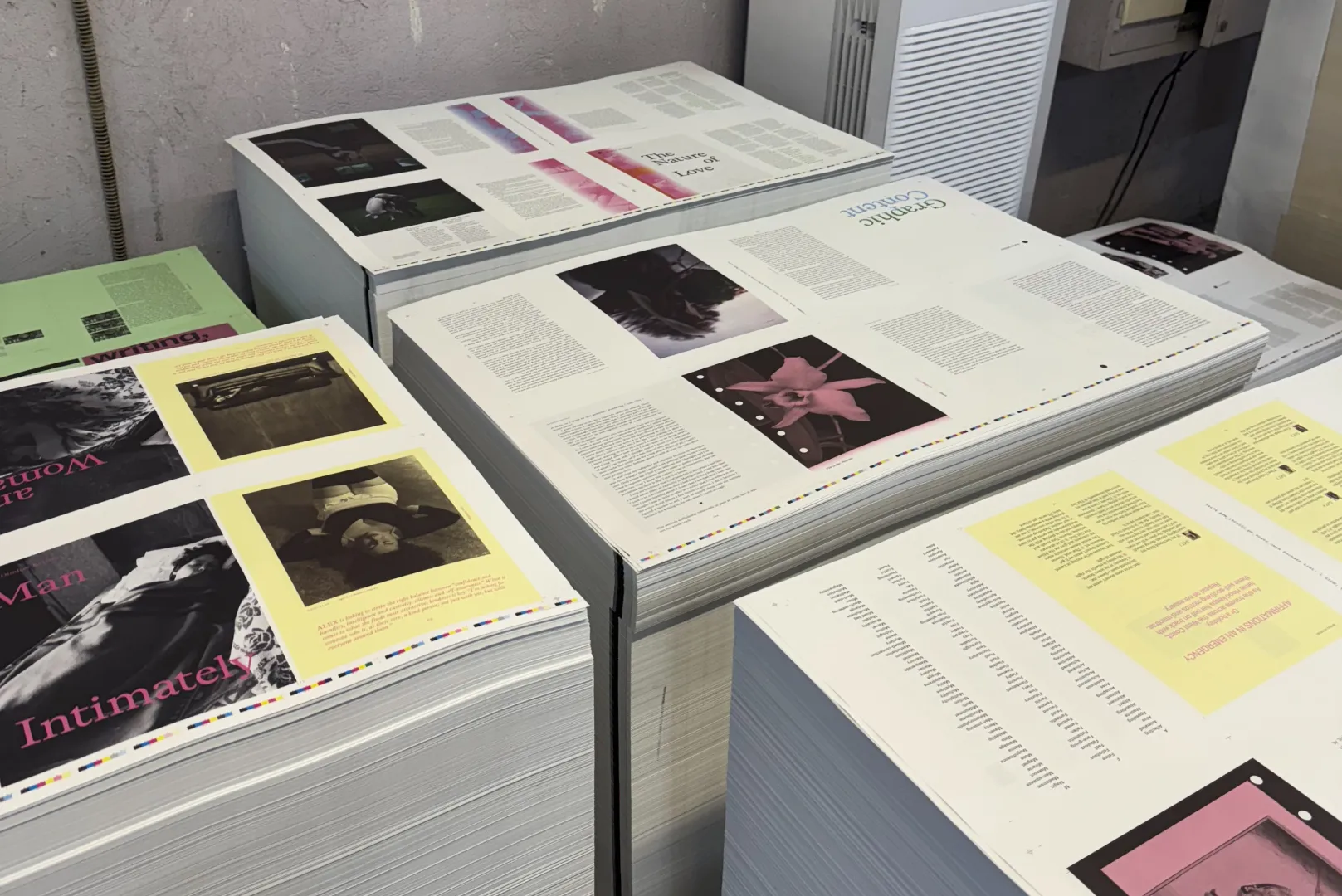
Ian, Creative Producer: “It is intimate, both in text and visuals. There is a vulnerability that exists when you print words and images into a page that can’t be changed once it hits the press. It’s cool to see this concept reflected in the works themselves.”
What are you most excited for readers to see?
Maria: “There are so many moments I love in this issue. I’m especially excited for readers to see Kelsey Lu’s cover story, photographed by Nan Goldin. Their ongoing friendship radiates through every image; it’s rare to see that level of trust and tenderness captured on film. There are also wonderful, surprising essays by artist and poet Hannah Black and journalist Dimiter Kenarov; a deep and rich conversation between Garth Greenwell and Ralf Webb; an excellent dating-themed short story by Hannah Gold, and so, so much more.
“I’m also proud of how Merel van den Berg, our new art and design director, has evolved the design language—it feels more deliberate and collectable, bridging magazine and art object. The pacing, the textures, the negative space: it’s all part of the story we’re trying to convey with AFM.”
Merel: “The member portraits that Kees de Klein photographed, which were the result of members reacting to an in-app call out. Kees said it was like going on eight different dates, and the result shows: they’re intimate, relaxed and courageous.”
Haley: “A second issue of a magazine is such a thrill to make—we have enough of a sense of what is and isn’t AFM at this point, but we’re also so new that we’re still determining what we want to be. It’s that mix of being open and staying true that creates the best tensions for editorial work. I think as a whole, I’m most excited for the readers who are returning to AFM to see for themselves what’s evolving and deepening since they saw the first issue, and similarly I’m most excited for the readers who will be completely new to AFM to discover who we are at this stage of the publication, and join us for how we move forward.”
Ian: “I will give the simple answer––all of it! It was a labor of love and I am excited for it to be out in the world.”
What were your motivations with this new issue?
Maria: “The first issue was about happiness and our varied pursuits of it; this one turns inward, to the landscapes of the mind. We set a high standard with issue one, and with this one we wanted to exceed that standard. It was an opportunity to push AFM further as a cultural project: to take more risks, commission more experimental work, and think about how a print magazine can function as both archive and conversation. Every piece, from poetry to photography to our member pages, reflects our editorial ambition to elevate how we think about, express, and convey relationships and sexuality.”
Merel: “I wanted to play with how we process and interpret image and language, how they influence each other and create new meanings. Also I wanted to make something that celebrates print as well as play on the different ways we interact with digital content.”
Haley: “Thinking about the specific thematic ideas we want to center in each issue is always really fascinating: when we choose a theme, like with Mind Games, we’re always thinking about what we’re hoping to see specifically from the contributors we reach out to, and we’re always so lucky to be surprised by how much farther those contributors can take a theme: they all bring their own individual complexities to every topic or subject they turn their attentions to, and it creates a collective feeling of such excitement and energy across the whole issue. I think we’re always trying to make AFM a magazine that can hold that quality and depth of work and present it to the reader as an invitation to bring their own perspectives into it, too.”
Ian: “My role is to create an environment where creativity and ideas thrive, while guaranteeing that we still have a physical magazine on newsstands. Making sure we have a playground to explore our thoughts is valuable, and it is a balancing act to hold this in the confines of the reality of time––we struck that balance this issue.”
How do Feeld members inspire AFM’s content and direction?
Maria: “Feeld’s community has always been our primary source of inspiration. The magazine is shaped by the curiosity, creativity, and openness that define the people who use the app.
“Each issue features work created with members—from photographs and questionnaires to playlists and personal reflections—but even beyond that, their way of relating to one another influences our editorial approach. The thoughtfulness and experimentation that exist within Feeld are exactly what we try to carry onto the pages of AFM.”
Merel: “We have created dedicated member pages in which the content is generated by members, and try to think from an online dating perspective always, selecting and shaping content that could address and deepen the experience of finding connection through online platforms.”
Haley: “One of the best qualities we’ve observed in Feeld members is their style in expressing themselves—the app is rightfully well-known for being a place where people can clearly communicate about their interests and intentions, whether that’s the ones they already know about, or remaining open to learning more about what’s possible for the future. This skill for talking and listening is one of the many necessary qualities also required for any good magazine; it’s that willingness to keep reaching for all forms of language, whether written, spoken, drawn, or seen that makes for the best kinds of art and the best kinds of relationships. I think that informs much of how we make AFM, whether that’s in the ways we invite or solicit contributors through Feeld or in the way we think about what we want to include in each issue.”
Ian: “In this issue we were able to use the app to draw content directly from Feeld members for multiple features, including portraits of eight of our members in Amsterdam; giving members the chance to ask Kesha anything, to which she gave some very heartfelt responses; and a quiz by the brilliant data journalist Mona Chalabi, where she was able to explore different styles of Feeld members through the ways in which they tailor their profiles. And beyond this direct relationship the members have, it is the openness, honesty, and creativity of the people this app draws [in] that inspires the work of the magazine. This is all supposed to be fun, and we intend to keep it that way!”
Describe AFM Issue 2 in a word…
Maria: “Illusion.
“In all the ways, good and bad, obstructive and necessary. We need our illusions, as much as we need our disillusionments. The issue is all about the games our perception plays with us—how we see, what we think we know, and the ways desire, memory, and imagination blur together.”
Merel: “Boisterous.”
Haley: “Dreamy, in both the surrealistic and subtextual sense.”
Ian: “Real.”
For more, dig deeper into curiosity, intimacy, and self-expression in AFM Issue 2.