First dates in the Späti glow: Mapping desire in Berlin's corner stores

Photographs by Marco Frattaruolo
Berlin, a late summer evening. After days, maybe weeks, of messages exchanged on a dating app, between jokes, blurry photos, and Tony Soprano memes, Giulia and Lena decide to meet in person. No reservations, no carefully curated or romantic scenery: just a simple message: “See you at Lausi?”.
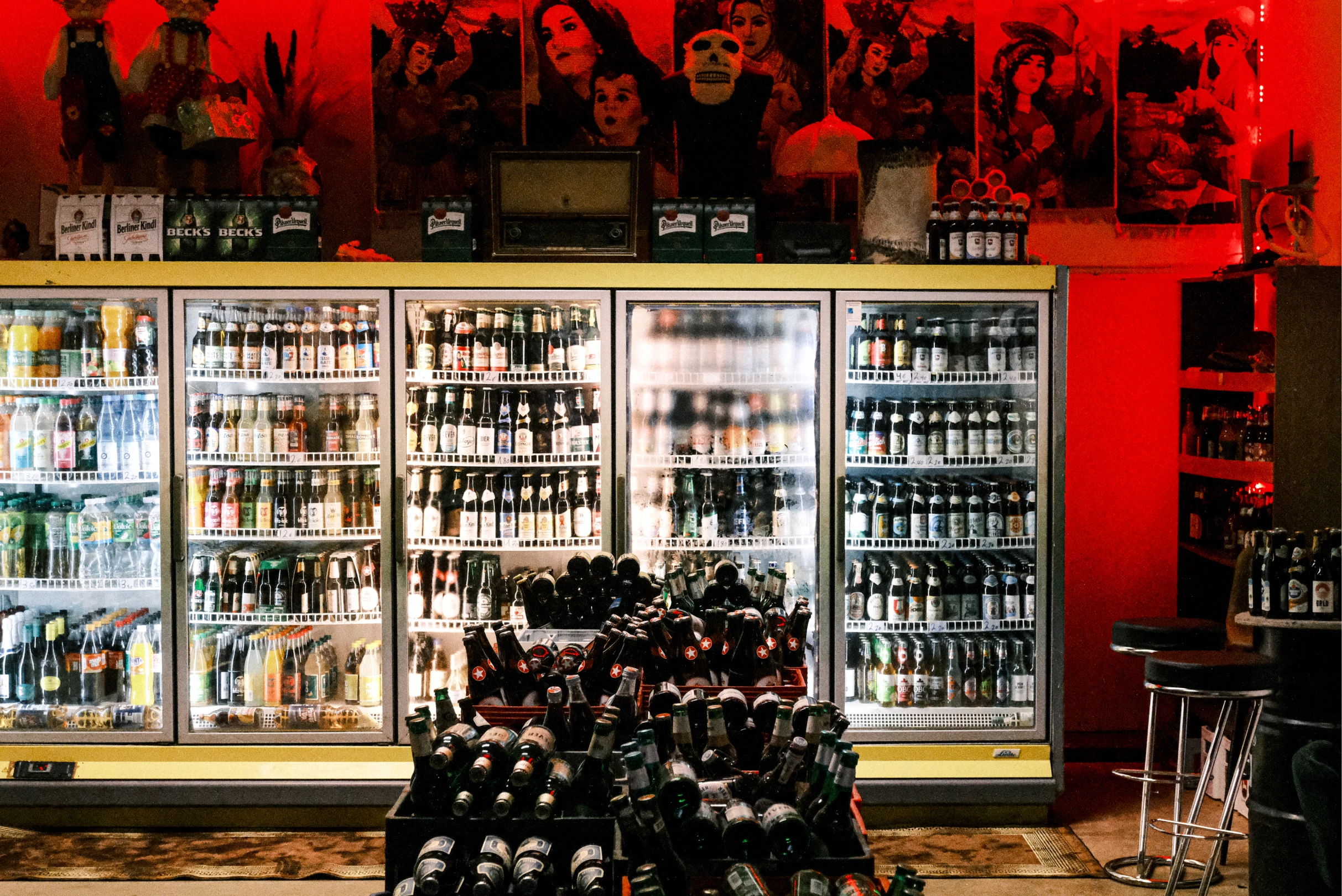
In front of a Späti—a type of late-night convenience store—in Kreuzberg, they recognize each other. Above their heads, a flickering neon sign saying “The Shop” lights up a few sidewalk tables, while inside it’s the dazzling beer fridge that catches the eye of passersby.
In this city, meeting outside a Späti has become a small but alternative ritual: informal, discreet, accessible. The place where a connection moves offline. A constant flow of people going in and out, bottle caps flying away, a background murmur of voices mixed with Turkish music spilling from behind the counter.

Many Spätis (short for Spätkauf, meaning “shop open until late”) are run by people of Turkish origin—largely dating back to the arrival of the so-called Gastarbeiter (guest workers) in the 1960s and ’70s, with some choosing to open small independent businesses, partly to avoid discrimination in the traditional job market. Over time, the Spätis have become almost an institution, the business model becoming a recognizable part of Berlin’s urban culture—and central places in neighborhood life.
You can find them along sidewalks, squeezed between residential buildings, with neon signs that catch the eye and invite you to get lost among shelves packed with drinks, snacks, tobacco, and newspapers. Inside, there will always be a lit fridge full of beer and soft drinks for one euro or a little more, almost tempting you to grab one. On the street, plastic benches and a few chairs create the perfect setup to relax.
A Späti almost never closes. It is the place where you can buy a beer at three in the morning, spend an afternoon chatting with a friend, or simply stop to talk about nothing in particular with the owner. Meanwhile, outside, through windows covered in punk stickers, city life keeps flowing relentlessly.
It is exactly this authenticity, with no great pretense, that makes it so charming as a meeting point. There’s no need to reserve tables, to follow a dress code, or stress about an overpriced bill. All you need to do is walk in, grab a beer, and start talking.
Relaxed romance
In recent years, Spätis have also become new spaces for romantic encounters: not bars, not restaurants, but hybrid and relaxed places where people meet for the first time after getting to know each other online. A curious phenomenon, but increasingly visible in what could be called the Berlin dating scene.
Giulia and Lena, 26 and 29, are drinking a beer and a Fritz-Kola while sitting on a wooden bench. It’s their first date. “We chatted for almost a week and then today we just said, ‘Come on, let’s meet at Lausi.’ It felt natural to sit here, in front of the Späti with a beer,” says Giulia with an embarrassed smile. “For me, the Späti is the perfect place,” adds Lena. “Not too crowded, people come and go. It’s a real, honest place.”
The way they talk is a little awkward, but there isn’t that tension that usually marks a first date. The reason lies in the freedom to simply be who you are, without the anxiety of appearing in any particular way.
“You can literally show up in pajamas,” continues Giulia. “Nobody judges you. You don’t have to ‘perform.’ No one expects anything here.” “It’s informal but still intimate,” says Lena. “A strange combination that works.”
Maybe it is exactly this “strange combination” that is the secret of the first Späti date: the freedom not to plan, not to perform. No table to reserve, no waiter interrupting or interfering with the conversation, no bill to split. Just two people, a cheap beer, and the possibility of leaving at any moment.
It’s precisely this last aspect that Giulia focuses on: “The Späti is a fairly safe place, definitely light. A place that doesn’t require much from you and where, if things don’t go well, you can simply say goodbye and leave.” In more formal settings like bars or restaurants, some people may feel that leaving a date can feel more complicated or awkward, because you’re tied to a table, a bill, and the social expectation of staying longer than you might want to. This makes the casual, relaxed atmosphere of a Späti particularly appealing.
At this point, we dive further into the topic of safety, and both girls agree that one of the things they expect from first dates is “being able to talk without feeling judged, knowing that the person in front of you respects your feelings and your boundaries.”
Connection over curation
 Inga
Inga
In the urban fabric of Berlin, the Späti also serves as an inclusive space, open to everyone without barriers. “It’s a place where everyone mixes,” says Inga, 37, a German single mother and Kindergarten teacher. “For me, it’s a melting pot of neighborhood people. Rich, poor, young, old... it’s a slice of society. The big city loses a bit of its coldness and anonymity: you recognize faces, even if you don’t know their names. And over time, that familiarity becomes a form of connection, something that shouldn’t be underestimated in a metropolis like Berlin.”
In a world where connections increasingly begin behind smartphone screens, the choice to meet outside a neon-lit kiosk is not random. It’s a conscious response, a desire to be spontaneous amid all the curated performance overload dominating social media and, often, to mitigate the anxiety of translating an online connection into an in-person one. “Here you don’t need to look fancy,” Inga continues. “A Späti shows you that you don’t necessarily need much to feel good, and that everyone is welcome regardless of economic or social conditions.”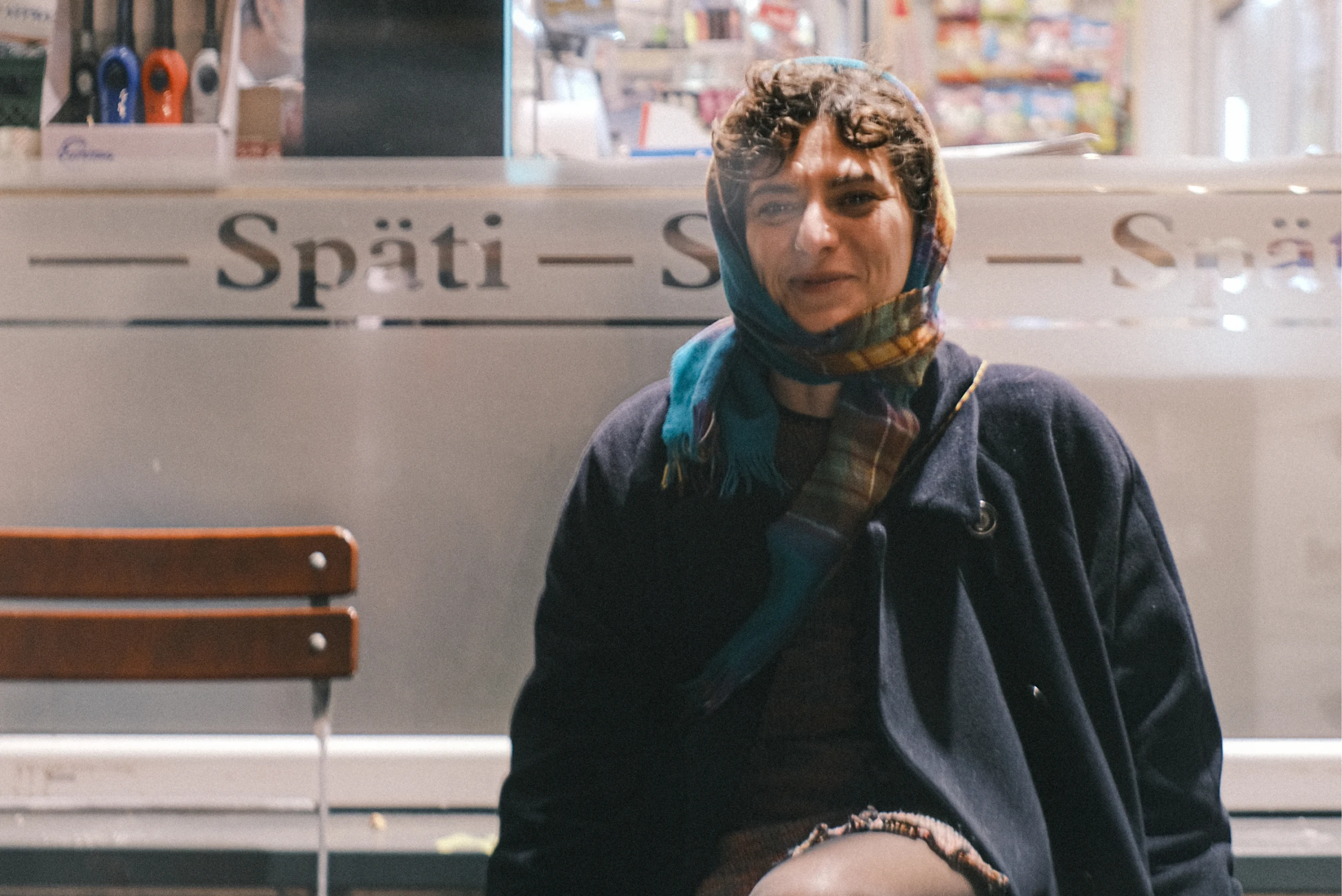 Zoe
Zoe
Zoe, 34, Italian and living in Berlin for almost five years, is smoking a cigarette outside a Späti in Charlottenburg, one of the most elegant neighborhoods in the German capital. While she waits for a friend she’s meeting before heading out to a club, she explains that, for her, Spätis could be a point of reference in both social and romantic life: “They’re absolutely inclusive places, and much cheaper than any bar, and they’re definitely low-commitment.” “A meeting outside a Späti,” she says, “probably implies a shorter stay than at a bar. It’s easy, affordable, always open, and you can even bring your own drinks or food.”
Sometimes Spätis are also the theaters of small urban stories, sometimes funny, sometimes surreal. Zoe remembers one in particular: “Once I witnessed a robbery,” she says. “Someone was chased and hid inside the Späti. And then, something that always amused me: the owners of the Späti near my house used to greet me with a ‘ciao bella!’ shouted from behind the counter.”
In this mix of lightness and feeling safe, a form of authentic intimacy seems to take shape, with public space becoming a ground for connection, a context in which to show yourself as you truly are. Lorenzo and Selina
Walking through Prenzlauer Berg, known for its leafy streets, cozy cafés, and eclectic boutique shops, I notice Selina, 28, and Lorenzo, 26. They immediately catch my attention because they look like they’re on a first date, even though their relationship is already well-established. When I ask them about their relationship with Spätis and how they met, Lorenzo tells me: “No, it’s not our first date. We’ve known each other for a couple of years, and we first met in London, drinking a beer outside a bar. Now that we live in Berlin, whenever we can, we stop at a Späti. It takes us back to our university years with cheap canned beers instead of expensive pints.”
For Lorenzo, Spätis represent a free space with an international feel: “I’m from Italy and lived [for] many years in England. We don’t have anything like this there. I love that you can buy anything, but also the vibe… [it’s] always very cosmopolitan. It’s kind of like watching TV,” he laughs. “In ten minutes a banker in a suit walks in, then someone who hasn’t slept for two days, then a kid just out of school.”
Selina thoughtfully specifies: "And you always feel welcome. You can find everything you need when you're out: beer, tampons, oat milk, a lighter." When we talk about safety and comfort, Selina says: “It’s not more or less safe than a bar. In a bar, there’s always staff who can step in; at a Späti, there’s the safety of being in public, on the street or sitting near other people. But regardless of that, I would never go on a Späti date in Berlin if it were dark and deserted.”
On the casual charm of Spätis, Selina says: “When we end up here, alone or with friends, it makes us feel relaxed. It has no financial impact, and we don’t worry whether it will be nice or not. It makes us feel young and a little silly, and it lets us take in everything around us.”
When I ask what importance the choice of venue has in the age of dating apps, Selina thinks for a while, exchanges a glance with Lorenzo and says: “If I were looking for something serious, I would always pay attention to the kind of date that is suggested to me, and I’ve realized that this becomes more and more important with age.”
Before saying goodbye, I ask them to share any curious events they’ve witnessed in these stores. Laughing, Lorenzo says: “Once I was sitting outside a Späti and I saw a guy go in with a monkey on his shoulder. He was only buying peanuts for it. I thought: WTF! But then I realized I was in a Späti, in Berlin, at 4am.”
* Leon Benz is a Berlin-based writer, and started out reporting on pop culture for VICE before shifting into television. He now works as a comedy writer, creating jokes, stories, and shows for a variety of TV formats.
Instagram: @leon_benz_