"THING," edited by Robert Ford, Trent Atkins, Lawrence Warren. Primary Information, 2025
A history of the fiercely truthful, soulful, and stylish zine that put a spotlight on black queer creativity in the 1990s.
The ten issues of THING magazine, published between 1989 and 1993, along with an abundance of hand written letters, photo proofs, article submissions, and videotapes of its creators, are kept in an archive at the Chicago History Museum. For me, parsing through the twenty-one boxes of ephemera—eulogies, manifestos, protest invitations, snapshots of transcendent social scenes—was as heart-wrenching, political, and complex as it was joyful and queer in all the best possible ways.
My exploration of THING brought me into the living rooms and memory lanes of some of the people who made that magazine. I visited the home of the model on the cover of the inaugural issue; I spoke to contributors over the phone; I studied all four hundred and sixty pages of THING, the collected archive published as a book by Primary Information in 2025, now available for sale on their website and in bookstores.
Every conversation and record has felt just as much like visiting a time and a place as it has felt like reading or speaking. In an American political moment when billionaire-driven federal administration has eliminated billions of dollars in public health funding, made disastrous cuts to HIV research, and terminated efforts to find a vaccine, it is this kind of grounding in our fundamental interconnectedness with others that will be our own source of resilience, survival, and efforts at charting an alternative path for our world. We owe it to the people in the pages of THING—living and beyond—to forge our own way through.
"THING," edited by Robert Ford, Trent Atkins, Lawrence Warren. Primary Information, 2025
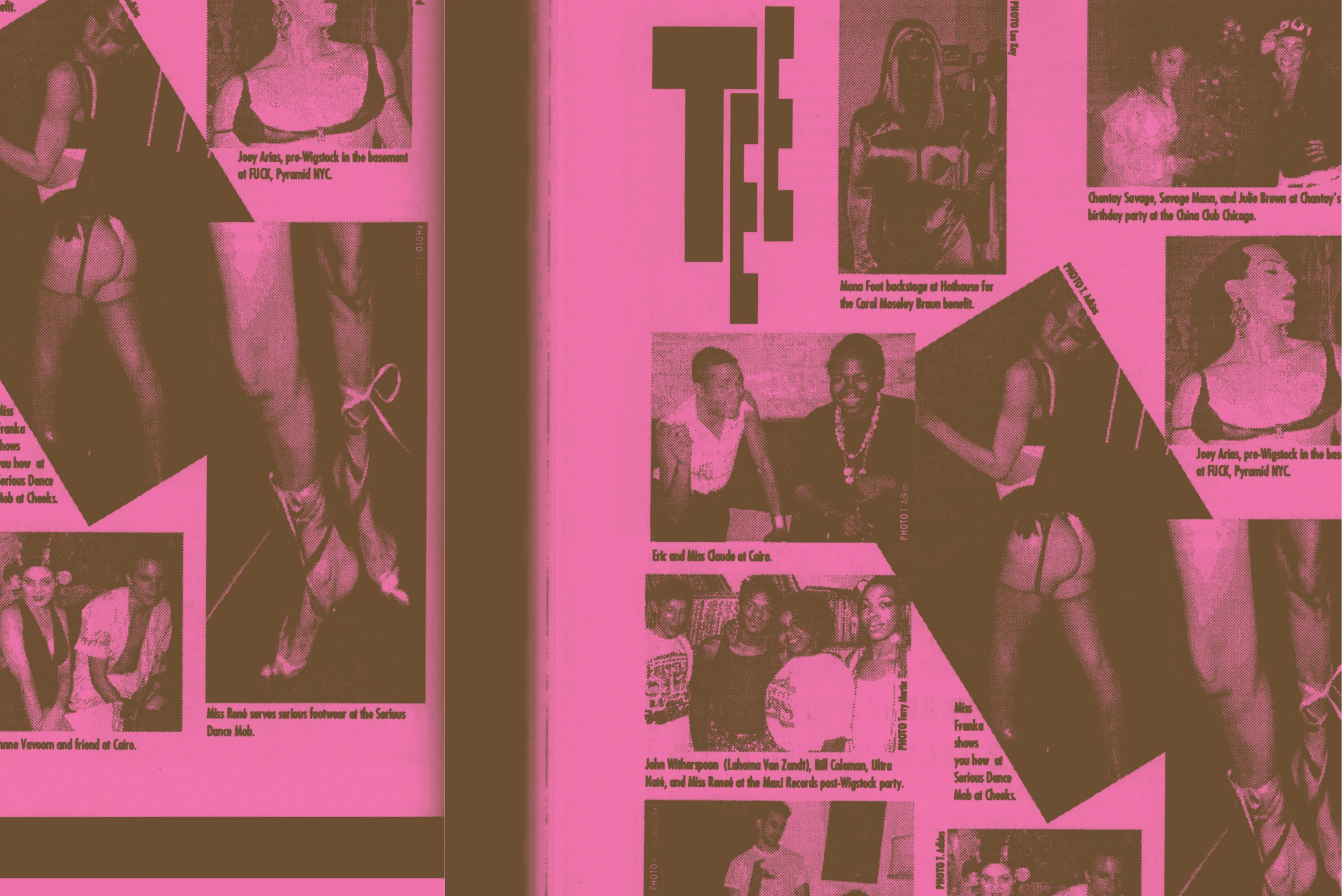
In 1989, three Black gay men from the South Side of Chicago—Robert Ford, Trent Adkins, and Lawrence D. Warren—started THING. It was a kind of grassroots publication that captured the essence of a special subcultural corner of the world—Black, gay, house culture and politics, at once very specific to its time, yet timelessly resonant; a zine that was both very Chicago, while reaching far beyond the geographic bounds of its makers. THING existed in the way only a project of collaboration, immersed in the world it also reflected, could be. THING featured interviews with prominent Black queer figures of the time, like the academic and poet Essex Hemphill, and filmmaker Marlon Riggs, whose seminal documentary, Tongues Untied, came out the same year as the zine’s first issue. Adkin’s “Tee” column included stories about Chicago’s Black and gay party scene, documenting minute yet profound changes as they were happening.
Reflecting on the zine’s lifespan in an interview, Ford described it as “a way of documenting our existence and contribution to society,” emphasizing the “rich and important cultural thing Black gay men have to share” as central to the intention of the magazine.
For those on the margins, the United States in the 1980s was politically fraught. Ronald Reagan’s second term as president was coming to an end, and his long legacy of devastatingly destructive influence on American social and political systems was just beginning; the deathly stigma surrounding the HIV/AIDS pandemic; and the so-called “War on Drugs” all had disastrous impacts on Black communities. This was a decade defined by skyrocketing incarceration rates, the false promises of so-called trickledown economics, and compounding public health crises that threatened and stole lives across the country.
The communities and culture that led up to THING paint a picture of how culture served as a space of resilience. In Chicago—the birthplace of house music, and forever a seedbed of Black and working-class political life—these communities were very much politically alive.
When I visited Ken Hare’s meticulously decorated Chicago home (coincidentally not far from my own), I saw the oil painting that was the reference for that image hanging opposite a strikingly 1980s mirror, framed with multi-colored jewels on the living room mantel. Hare was a crucial contributor to THING, working close with the founding trio as well as being a true face of the publication: the magazine’s art director, Simone Bouyer, painted a portrait of Hare from a Polaroid photograph of the then-model and hairdresser, and eventually turned it into the black-and-white graphic covering the first issue of THING. During our conversation, Hare described zines and newsletters as the era’s form of “social media”—deeply collaborative, DIY media, often made by collections of artists and, unlike what is more common in our contemporary moment, one where feedback was received primarily in person or by letter. The letters I spent some time with in the archive were mailed directly to Ford’s home address, which remained the zine’s publishing HQ over the course of its short but impactful four year lifespan.
Hare has been central to the magazine’s recent renewed life and reproduction, which has included art exhibitions, new reporting, and an annual anniversary issue created by some of the former zine’s contributors. People who knew him described Trent, one of the magazine’s primary nightlife columnists and a strong interviewer, as a social butterfly who was always out and about. Lawrence (friends called him “Larry”) knew all about Black history, always spouting this or that political fact, and held down much of the finance and operations aspects of producing the magazine. And Robert, who served as the magazine’s publisher and was largely seen as the anchoring leader of the whole thing, was described to me by contributor Stephanie Coleman as being not “a loud kind of fellow, but he had a presence.” He did much of the gruntwork to help disseminate the magazine as widely as possible: at its height, they produced 3,000 extremely coveted copies, and he fought hard to keep the magazine going when the budget was tight and the team was overburdened.
"THING," edited by Robert Ford, Trent Atkins, Lawrence Warren. Primary Information, 2025
As its own distinct genre, scene, and global phenomenon, house music was queer, it was Black, it was Chicago. And it was fundamentally a practice of collaboration, remixing, reinterpretation. For music lovers, THING was a destination: a place to get a list of music recommendations from Ford (also a DJ who worked at the popular Rose Records at the time), who wrote about acid house music and hip house, correctly identifying that there had always been rap in house music and that this genre finally had a name. It was a place for write-ups on the best parties and where to find the popular house DJs, calls for providing mutual aid to queer artists, education about HIV testing, and Owen Keehnen’s punchy political humor criticizing politicians like George Bush, Richard Nixon, and Clinton. There were invitations to join a once controversial gay contingent at Chicago’s annual Bud Billiken parade hosted by the Chicago Defender, and recaps of RuPaul Charles’s drag shows before RuPaul was RuPaul.
When I talked with Coleman over the phone, she explained making a newsletter or a zine was, at the time, “just kind of the thing to do.” In addition to her involvement in THING, Coleman was a part of putting out a newsletter called Planet Roc published out of the Wholesome Roc Gallery, an art gallery and gathering place. She and her then-lover Bouyer hosted weekly late-night parties that served as the backdrop for the community that put out both publications.
In the THING archive, you can find copies of many of the other magazines putting out similar work: Outlines (1987-2000), My Comrade (1987-1994), Chicago’s Babble, JFY/Just For You!, a magazine targeting Black and Caribbean gay men, and the sex positive zine Frighten the Horses, among others. Many of these publications cross promoted one another and mailed each other copies. One collaborator wrote to THING: “Hey Queens, we’ve been doing this thing for a full year now—time for some networking. How about an exchange?” Attached was an issue of their own zine.
"THING," edited by Robert Ford, Trent Atkins, Lawrence Warren. Primary Information, 2025
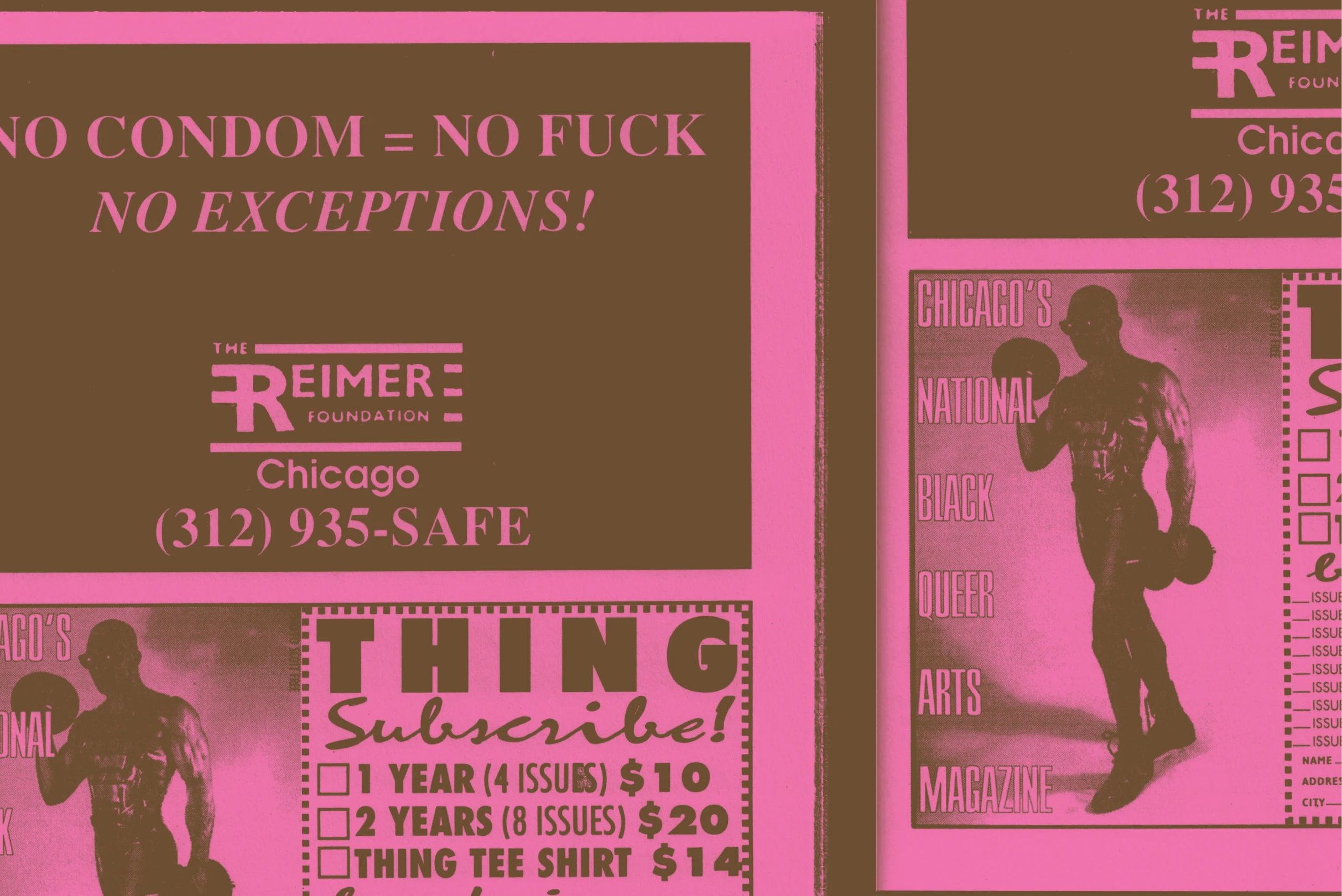
In THING, you saw Black artists grappling with the whiter gay political formations like ACT UP and Queer Nation at the forefront of the organized protest movement. And you had people like dance artist Ishmael Houston-Jones spelling out how the AIDS crisis was just one of an intersecting set of harsh realities facing the community. Black queer organizer, advocate, and filmmaker Mary Morten started doing community work around HIV and AIDS after her brother—who had once held the title of Miss Gay Black America—died of AIDS in 1990. Morten and others joined in an informal but serious effort to educate and gather information about HIV and AIDS among Black gay men by going to bars, passing out literature, and conducting surveys. Morten said that they “weren't seeing lots of images of ourselves. I mean, that was the reality. And so that's why something like THING magazine was so important.”
As it got more political, the magazine also went deeper on a personal level. Marlon Riggs, who died at thirty-seven in 1994, first disclosed his own HIV diagnosis in a bold and emotionally vulnerable essay. Published in THING’s seventh issue, “Letter to the Dead” confronted his experience of grappling with the broader Black community’s denial of the epidemic. “Our silence about AIDS was a quintessential ‘black thang’ but we refused to understand,” read the graphic that ran beside his work, the text written in big block letters. Ford, who met Riggs in 1992 when he was in town to promote his film Color Adjustment, wrote the following after Riggs’s death:
“While pharmaceutical manufacturers battle over research dollars, our friends and loved ones continue to drop like flies… And the pain of their absence isn’t soothed by the knowledge that they aren’t the first or the last. How many more of our artists and historians must die with their best work ahead of them before our society gets over its racism and homophobia and does all it can to curb this thing? Whatever the number, it’s too many…
… If Marlon had a lesson for us, it was that all of our stories are valid, true, and important and that those stories can and will inspire untold numbers of people in the future if we can only document them. His death challenges us to continue to learn and love our own history and to leave behind good work as he did.”
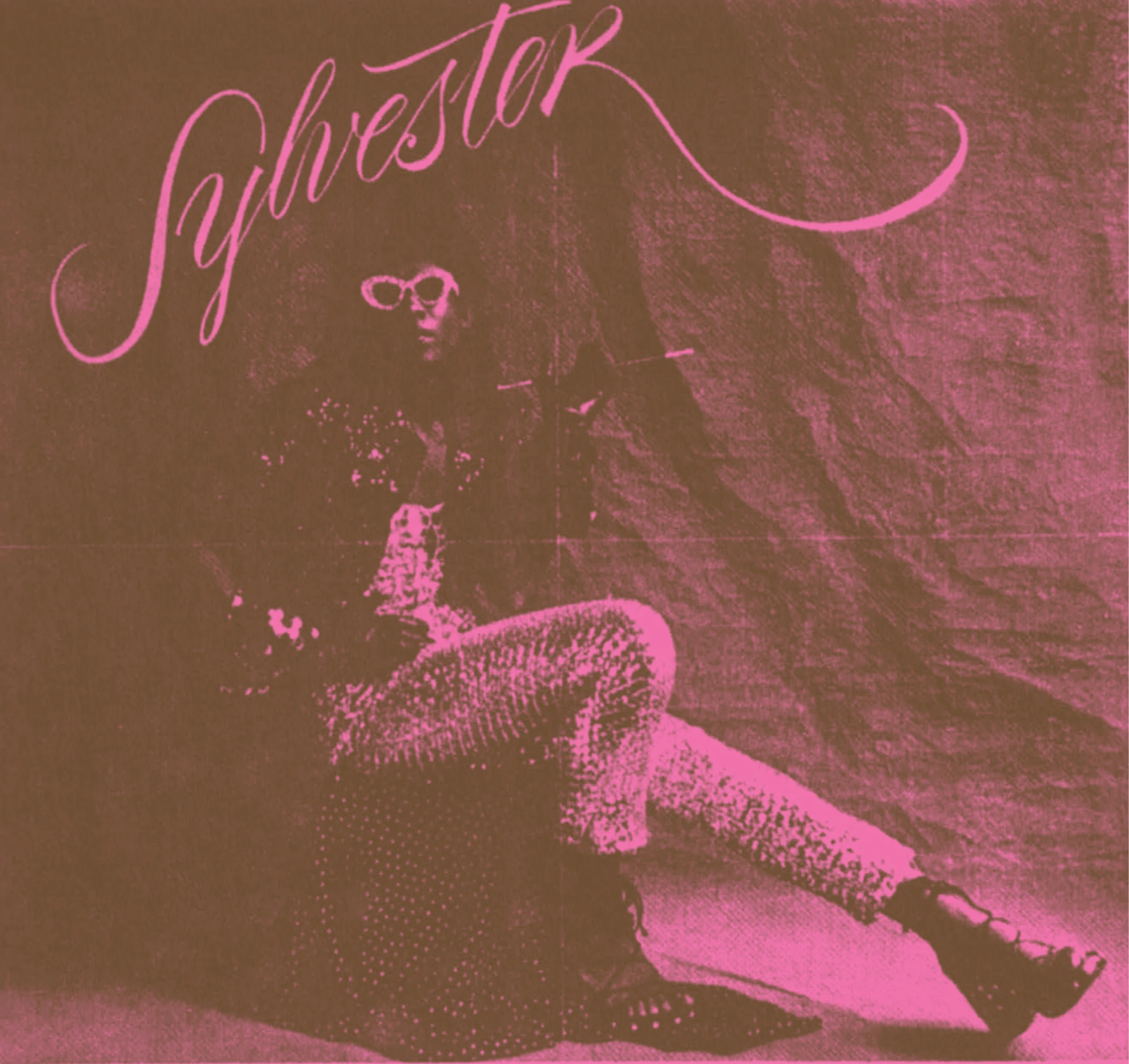
From the very beginning of THING there were remembrances for artists and friends who died of AIDS: disco queen Sylvester, Basquiat-collaborator and dressmaker Isaia Rankin, artist-advocate Keith Haring, to name a few. Co-founder Warren wrote longingly of Sylvester in the very first issue: “It is amazing the way you wrung every drop of respect out of a life determined to give you none. It is nothing short of a miracle that you could find joy in an existence constructed to despise and hate you.”
At the invitation of a local teacher, Keith Haring had worked with more than 400 Chicago Public School students as part of an earlier version of the city’s now expanded youth jobs summer program to paint a near 500-foot mural in the city’s central Grant Park. In town to complete the project just nine months before he died, Haring and Ford crossed paths around the time the zine first came out. Ford regrettably put off interviewing Haring for the magazine out of nervousness. In 1990, for THING’s second issue, he wrote: “My most passionate hope was that somehow he’d beat the odds, that his constant efforts to make the planet better for all of us would transcend biology and keep him alive… A little of my inspiration died with him.”
Issue 4, which would be the midpoint of THING’s entire run, was considered by some opinionated readers and by staff as weaker than the ones before it. Adkins wrote in a letter to the team, preserved in the archives, about the reasons for what was read as a faltering of quality. “[N]early everyone directly involved with THING is suffering from some normal and/or abnormal load of stress. Many of us who aren’t ourselves HIV+ or facing an ARC or full blown AIDS diagnosis are desperately searching for ways and means to give love and caring to family and friends who are infected or ill,” he said. “In this war, we are definitely our own worst enemies… there’s nothing more to lose and everything to gain.”
Ford—who eventually died of AIDS-related complications—wrote about his own experience not long before the magazine became too much to sustain. “Being an out black homo with AIDS was a label I ran from for years,” he wrote, but explained that he eventually had to learn to, once again, come out—to live in his own skin. In an essay series published in Babble not long after THING folded, titled “Life During Wartime,” Ford wrote, "Isn’t anybody angry anymore?” He continued:
“If you’re positive and keeping it to yourself, tell somebody who cares about you, and notice how the sun still rises the next morning. Face your own mortality; you could be dead at thirty-five or ninety-five or the moment you’re hit by a truck. When you go doesn’t matter; what you do while you’re here is what counts. Wasting your time on this planet with your head up your ass, thankful that AIDS is somebody else’s problem, doesn’t do any of us any good, least of all you.”
In Ford’s writing, I see so much of the energy that sustained THING’s formative run. To call this feeling grief would only begin to describe the emotion of knowing that we have so much of history to read and see, and yet, we mourn a past when the people who could have been our peers suffered from so much injustice and pain. But to grieve is also to remember, and to remember is to transcend the limits of such loss. There was an epitaph preceding a special conversation with friend and collaborator Steve Lafreniere, published in Babble just days after Ford died, that, for me, summed up all the contradictory feelings the memory of THING contains: “His presence will be felt in all of us that knew him until the day we die. Miss Thing—the pleasure was ours.”