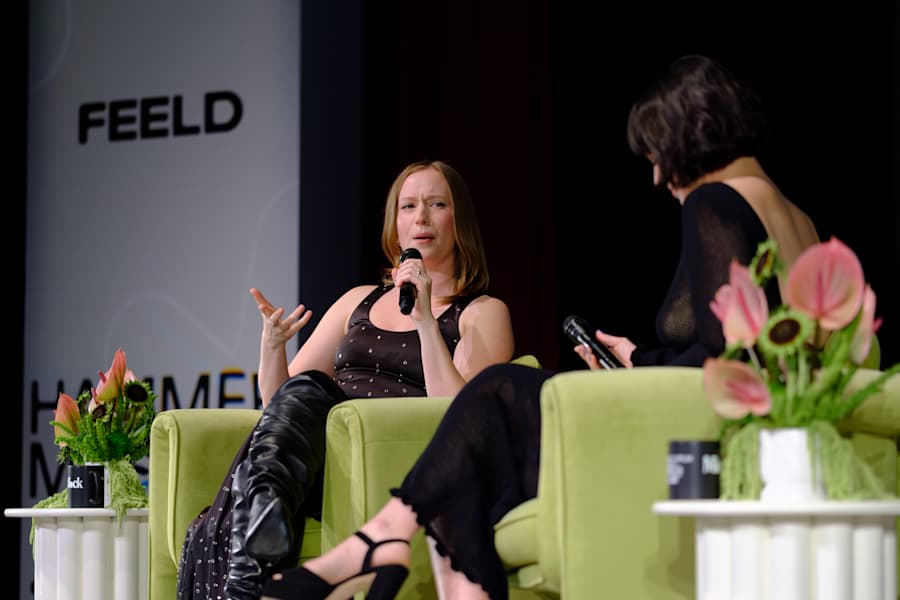
Are we over-therapizing intimacy? A conversation between Dr. Orna Guralnik and Karley Sciortino

Photography by Javier González and Alex Free
Psychoanalyst and "Couples Therapy" star Dr. Orna Guralnik joins sex and relationship columnist Karley Sciortino to interrogate the rise of therapy-speak in modern dating, and the pressure to find a perfectly healed partner.
This interview was originally conducted at Mindf*ck, Feeld’s first ever intimacy forum at the Hammer Museum in Los Angeles.
Karley Sciortino: I'm so excited to be here today talking to you. I'm a giant fan of yours and Couples Therapy, and today we're going to be talking about everything from sex to dating to therapy speak.
If there's one thing I've learned from being a sex writer for over 20 years, it’s that people are obsessed with whether they're having a normal amount of sex, me included. You talk a lot about normativity in relationships; how much of what we think we want is actually just what we've been taught is normal?
Dr. Orna Guralnik: I'm very excited to be here too. Great question. Yes, people are generally obsessed with what's normal, especially around sex, and it does often center around how much: How much is normal? People like to quantify things; without language, we don't actually know what we feel, and we don't know what we're thinking. We need a certain kind of structure to make sense of things—and sexuality is one of those things. We have drives, we have hormones, we have genes, and then we have all the human stuff that gets created between us that promotes all sorts of desires and fears. Sexuality is a very profound force, but there's no way for us to completely make sense of it or know what to do with it without some kind of norm.
On the other hand, there is a great deal of anxiety around managing these drives. In that sense, there is the force of normativity that is not only helping us make sense of our experience, but it's also controlling it, repressing it, and putting it in the service of other forces that don’t have much to do with sexuality, but are to do with managing society and power. In the case of normativity, we need it, but it also drives us crazy and restricts us and confuses us. So, when people start talking to me about how much sex they're having—is it good or bad, does one want more than the other?—it's actually a much more complicated question; it's usually wrapped in a lot.
KS: I like what you said about one person wanting more than the other. That feels like one of the most common problems on Couples Therapy. I have a friend who writes a lot about this topic—she's a clinical psychologist as well—and she was like, "We're taught to look for all these commonalities in a partner, like if you share their values, if you both want children. But we don't think enough about whether you both want to fuck the same amount until you die.”
OG: Good luck with that because that changes, and it changes for different people in different rhythms, and so I'm not sure that would be the measure of compatibility.
KS: That's not like a first date question… but there's probably some people for whom maintaining an active sex life in a relationship throughout your life is really important, and for some, it's not, right?
OG: Sure. If one person is sex positive, high sex drive, loves it, and the other one [has a very low sex drive], that's going to be a recipe for a lot of problems. But those are extreme cases. Most of the time it's much more subtle, and it changes over time: people can start off wanting to fuck the same amount, but then things happen (whether it's things happening to the individual or between them), and dynamics are created.
I can give an example from Couples Therapy. This couple was talking about the differences between them in terms of sexual appetites, with one of them supposedly incredibly full of desire and libido, and the other one was quite repressed. It looked on the surface as simply a matter of differing appetites. But once we started [exploring each of their sexual histories], the whole question of appetites moved to the background. It became like, oh, “here are two people with very different histories, and it's playing out in bed.” So the appetite question is often way more interesting and complicated than just levels of libido.

KS: This is what I love about the show: so often it's a fight that seems like it's about the dishes, then three episodes later it turns out it’s actually about somebody's alcoholic dad. But they needed many hours of therapy and a professional to get there. For those of us who don't have you helping us to move through this stuff, how do you advise people to begin to understand what’s beneath a fight about the dishes, or a fight about sex drives?
OG: First of all, we don't always need to understand things on a psychoanalytic level. I'm interested in that, but you can go through life without it. But there are other ways that you can get yourself out of being locked in a stuck situation. That includes pulling back from getting too dug into a particular narrative that you're telling yourself—whether it's about the dishes or the laundry or about who does what—and asking yourself, “What am I actually feeling here? What is the kernel of my need in this argument?” When we pause, it's like, “What's going on? What's bothering me really? Is it the fact that we didn't have sex last night, or that for two weeks I've been picking up the kids, or that somebody's about to leave on a trip and I'm having abandonment anxiety?” It's usually about something beyond the dishes, and it's not that hard to decipher that. You don't need seven years of analysis for that.
KS: I want to talk a little bit about dating. We've in theory entered this era of unprecedented sexual freedom. We can question all kinds of things from monogamy to gender norms to almost everything about relationships, and that's incredible in a lot of ways. But sometimes it does feel like there are these new rules emerging. Like, if you're not at least a little bit queer or a little bit open, you're “boring.” Do you actually think that we are more free, or are new rules just coming in to replace the old ones?
OG: I think it’s both/and. To refer to what I said earlier, we always need some kind of structure or rules to make sense of what we're doing. For example, in the ethical non-monogamy world, it's as if people are opening up to all these new possibilities, but then they have to commit to an incredibly detailed rule book of how they're doing their ENM. So nobody's escaping the rule book.
On the other hand, I do think there are an incredible amount of new possibilities on the horizon for people engaging in relationships nowadays—in terms of their understanding of gender, of hetero versus queer sexuality, of consent, of power, of family structure. There is something quite radical that's happening in the field that I think is wonderful. So it's both/and.
KS: It reminds me: I recently reread this Mary Gaitskill essay from the ’80s called “The Trouble with Following the Rules.” The thesis is like, “there were the rules my parents gave me, which were like, ‘don't have sex, bad girls have sex,’ and then there were the cultural norms, which were like, ‘it's cool to have sex with as many people as possible.’ But the problem with the rules is that neither factors in what you want or what's best for you."

OG: In psychoanalytic work, it's a complicated thing to be working with people on what they quote-unquote want. At least as Americans we have these liberation fantasies, the idea that doing what you want is the good thing, but it's never pure. What you want always needs to be structured in language and be part of the social structure. We want to belong to a certain set of norms or a certain community, we want to respect each other, to listen to where we're at in the group. Otherwise it's chaos and anarchy, and we're nowhere.
KS: It's crazy how hard it is to figure out what you want.
OG: You search for what you want within the matrix of where you're living and who you belong to. It doesn't live in some sphere independently. "Oh, I just have to open the door to what I want, and it's sitting there waiting for me to discover." It's always understood through language, through community. It's a complicated thing to tease apart: What do we even mean by what we want? And I can tell you, in analytic work, it's not a simple thing.
KS: Right? Because we inherit these ideas of what we should want…
OG: And that helps us understand who we are and what to want.
KS: Yeah. For me, I grew up Catholic, and it was like "don't have sex until you're married." And then I just always assumed what I authentically want must be the opposite of what my parents say I should want. And then through lots of therapy, I realized that my rebellion behavior [was still a symptom of] letting my parents dictate my life, just in reverse.
OG: There's no way out.
KS: But then how do you figure it out? How do you figure out if a desire is authentic or inherited?
OG: There's no simple way to talk about it. There's a little bit of an inkling, but it needs some kind of language to have expression and meaning—like if you’re told, “It's possible to be queer. It's possible to be two-spirit,” then you know better what you want. It doesn't exist before the thing that structures it. So it's both/and.
KS: That’s why visibility is so meaningful.
One of the most viral pieces of writing about relationships this past year was Chanté Joseph's Vogue essay, “Is Having a Boyfriend Embarrassing Now?” It’s part of this whole movement of women who are rebranding being single as aspirational, or at least not tragic, which is how it was thought of basically since the dawn of time, right?
OG: The old spinster.
KS: Yeah, exactly. With the cats, and you haven't been “chosen.” I'm 41, I don't have kids, and I've never been married. I always make the joke that, “until five minutes ago I was the cautionary tale, but now I'm trendy.” When things like this start to move in the culture, how does it change dating? And specifically, when a woman doesn't need a partner in order to be considered a whole person, how does that change the kind of relationship she chooses, or if she chooses one at all?

OG: Culture influences what kind of relationships people form, and if they form relationships at all. Part of what's going on is a shift in how we understand what women want—the big question of all time. There are new technologies, the fact that women can have babies without being married, without having a partner, that they can freeze their eggs. So these things change the trajectory of what relationships and families can look like.
And then there's been so much progress in terms of queer rights. Not to mention feminism—plus the MeToo movement, and what's happening culturally in terms of equity and pay. So there are lots of very serious reasons why this shift is happening. What it does to relationships and especially to hetero relationships is that it confuses the field, in the sense that you no longer rely on the older norms of why you get together, when you get together. There are so many new options, and the new norms are trying to get established. So I think we're in the middle of a big change, and this is just one step along the way.
KS: It does feel like there's really a shift happening. I read a stat recently which said that women under 30, so that would be Gen Z, are the first generation that make equal money to men, basically. So there's this meme where it's like, “for the first time in history, women are assessing men not based on financial need, but on their personality, and we're all single.” I think the problem is that people say we're in a gender war, but it's more about a shifting expectation: I think men understandably are like, "well, my job used to be paying for stuff, and that's not my job anymore. And now you want me to talk about my fucking feelings? Like society literally told me to never think about that." And women are like, "no, that's my priority now.” And I do think people are confused.
OG: I love it. I think it's a great shift. I feel for all of us, but particularly in this case for men who have to go through this huge transition where there have been so many ridiculous pressures and demands on them, and now they're like, "Wait, how do I navigate this world now? You told me, ‘Don't cry, don't feel, don't attend to that part of me, don't be a woman.’ And now you're wanting me to come out as much more nuanced as far as gender is concerned?” It's very confusing for men, and I think it's confusing for women, too.
KS: Let's talk about therapy-speak. Therapy-speak of course has become a kind of second language in modern dating. Everybody loves talking about their boundaries and their triggers. I've literally seen people on dating apps fully put their attachment style in their profile. It's like, "hi, I'm Brian. I'm 35. I work in IT, and I'm a fearful avoidant." Why do you think this happened? And would you say that you are in part responsible because millions of people watch Couples Therapy?
OG: I deny responsibility, vehemently, because I do not ever talk about attachment style, and I do not use "ghosting," I do not use “narcissism." I do not use those words on Couples Therapy. So I refuse to take responsibility for that.
What I will take responsibility for: I think our show has helped people understand that therapy is not a place where you're being crucified. Therapy helps you think more about what's motivating you, and what might be motivating your partner. There are many good things about therapy-speak that I think the culture is benefiting from. I think what's helpful about psychological thinking is that you can expand how you think about things, not simply latching onto something in order to diagnose and judge. That's kind of the opposite of what therapy is about. It's about making more room in your mind to understand yourself, understand someone else, generate compassion, generate care. The idea is to become better, more ethical, more capable people. It's not designed as a language to nail someone down to being a bad person or to be the cause of your grief. And I think that's the problem with how therapy-speak is being used. It's sort of anti-therapeutic to use it that way, so I cringe at that.
I do love the fact that people have a better language to think about their history, their childhood, to think about attachment in the sense of, "what happened to my partner early on in life that might be playing out with me?" That's very helpful.

KS: But do you think it's like largely becoming a net negative? We love diagnosing people…
OG: It's true. People do love diagnosing people. I am a very good diagnostician. I've diagnosed thousands of people for a living, and I rarely use diagnoses when I work with people. It's dangerous. It's pigeonholing. It's rarely actually useful to diagnose anyone because we're so complex, and people behave in such different ways in different contexts, and so much is systemic.
KS: Right? It becomes a catch-all where it's like, "oh, I have ADHD, so that's why I'm like this," and it oversimplifies.
OG: It oversimplifies. When a person diagnoses themselves, it might help them understand something about themselves, or put into words something that they couldn't before. But usually the way people use diagnoses is with other people and they do it to other, to push away, to reduce understanding rather than increase understanding.
KS: This might just be my algorithm, but I get so much content about avoidant men. My favorite is like, "He hasn't texted me back in three days because he's avoidant, or he's processing his trauma.” And sometimes I'm like, we are actually overcomplicating this, because I think the answer is: he's not texting you because he just doesn't like you. Do you feel like we're overcomplicating stuff?
OG: Yes. Reality is hard for people to bear.
KS: Is there a term you wish people would stop using?
OG: Of all those, I think my least favorite is "ghosting."
KS: Oh, interesting! How come?
OG: People tell me things like, "Oh, she's ghosting me," and I'm like, "describe… " And it’s nothing to do with ghosting. They're basically feeling bad, and [that means] someone's ghosting them.
KS: I'm actually pro no-response-is-a-response sometimes. I don't think you should sleep with someone for months and then just never reply to them again. But if you both go on a date and never text each other, I don't think you ghosted each other.
I recently did this poll: I wrote a Substack where I asked over 150 women what they're looking for in a man. I was very surprised that the most common response was emotional maturity. It does feel like there is this new standard in dating, where finding someone who's healed, who's in therapy, who's doing the work is something that people are looking for. These are, I think, positive things. But has therapy culture created an idea of perfectionism that's not realistic? Like, you're looking for someone that's fully healed, but are you?
OG: The idea of looking for someone perfect is destined to fail because none of us are. We also don't really know what's good for us. The wish for emotional maturity, for that to be the standard, sounds good to me. You want someone you can talk to, that cares, thinks about themselves, thinks about the world, understands their place in the world. That sounds like a good thing to look for, rather than someone who makes a lot of money.
KS: Totally. But I think if we asked women 20 years ago, “what are you looking for in a man?” I don't think anyone would have said emotional maturity.
OG: Right, but that's probably because the conditions were different where men were raised differently, and nobody even thought that was a possibility.
KS: Orna, I've loved talking to you. I feel so lucky that I got to interview you today. Thank you so much.