Lessons from 10 years of yearning.
The first time I had sex with my friend P, it felt like time travel. I was the 18-year-old who’d met him at a summer camp, whose massage request came off as friendly. The 19-year-old who confessed lust over WhatsApp and Skype, thanks to the 7,001 miles between us. He was the 20-year-old who built me an altar and declared that I was his spiritual guide.
Eight years of online communication went by, trading book recommendations, heartbreaks, unserious marriage proposals, and sex stories. Layering friendship over desire made me sometimes wonder: “Are we more than friends? But—what could be possible beyond friendship?"
In 2023, my wife and I got married. Within our then-monogamous relationship, inviting P to the wedding felt dangerous. Irresistible. But I trusted him, more than I trusted myself. Perhaps I hoped that with only one month’s notice, a PhD student who lived (now) 1,564 miles away wouldn’t make it. Despite a delayed flight, he used all his charm to convince a flight attendant he had to “stop a wedding” and made it to the ceremony.
It took two more years, my relationship opening, and traveling to a professional conference close to his city for us to see each other in person again for only the third time ever. Our first kiss was exactly 10 years after we met.
Against instant gratification
Slow burns are rare for the reckless. For those of us who cherish dating apps, expanded possibilities and quickened connections are world-opening. I almost relished how, “kiss first, ask questions later” broke my own heart, briefly but reliably. Instant gratification swelled into quasi-instant grieving. That’s how I have breezed through most of my life—and many others approach new connections in the same way. But the culture is shifting.
We are burning out from too much, too soon. And we’re rebelling. Some people are choosing to actively build more friction into their lives (also known as friction-maxxing) with a view to feeling desire again—whether that’s waiting for your coffee to brew from scratch vs. using instant pods, or craving romantic yearning over quick-fix connections. The success of Emerald Fennell’s controversial adaptation of Wuthering Heights, shows that extended yearning is back. For me, this has meant thinking about P’s lips for 10 years before meeting them again. And, thanks to the internet and distance, yearning became a thrice-over experience: meeting in-person as teenagers, flirting with the online idea of each other, and only finally touching each other’s naked bodies as 28-year-olds.
Looking for references to understand my experience, I struggled. Much of the research and media representations of yearning can’t think outside of monogamy and mononormativity. Polyamory, on the other hand, has the power to rewrite this script. While monogamous slow burns are often confined to a goal-oriented linear trajectory, polyamory allows for layered and multiplicitous longing. But that didn’t necessarily make things easier.
The yearning framework is trapped in monogamy
In 1993, Nancy Kalish, professor at the California State University, surveyed 1,000 people who contacted their lost loves. The results read like a romance novel. Within three weeks, 40% got together, many of whom later married, and 70% of these marriages were still intact in 2004. The successful couples had initially dated for at least a year, had formative experiences together, and broke up because of outside circumstances like a move or families’ opposition, rather than internal struggle.
That 1993 pre-easy-internet age is like a foreign land, bound by different laws and customs. Before, contacting a lost flame required effort. Now, Googling someone takes little thought or calculation.
Still, others were less of a success. At the time of the study, 30% of participants revealed they cheated on their spouses with their lost loves, a figure which jumped up to 62% in a 2004-5 follow-up study. Kalish changed her advice: “If you're married, think long and hard before contacting that first love,” she told Psychology Today. “Your life may be forever changed." But what if your life is not built around avoiding that risk?
Non-monogamy might in fact restore exactly that which the no-contact-with-exes monogamists intended to protect: intentionality, communication, transparency. Honoring a slow burn without letting it combust everything around it.
Possible lives
Two years after my wedding, my third in-person meeting with P was full of intoxicating lightness. It was 3.5 sunny days in the early fall where I gradually gave up on discovering his city, preferring to spend my time tracing the innermost parts of his thighs. For so long, the sight and sound of P were familiar, the smell and touch unknown. Now, it all breathed in front of me. For weeks after this encounter, I lived in blue skies, happy songs, and I was reading more than ever.
Another meeting four months later, 10 days long, was a heavier, more confusing cohabitation. My nervous system was overloaded with pleasure, as well as the effects of many questions as to why and how I should care so much about a person other than my wife. It was Carnival in New Orleans, then the post-celebration hangover, then a road trip to the beach. At the end of our time, I knew we had plans to see each other in Paris soon, but still it was hard to leave each other. This Carnival visit left bumps in my marriage as I started to imagine what shape this friendship could take longterm. My wife thought of going back to monogamy, but decided that wouldn’t be fair for her own girlfriend.
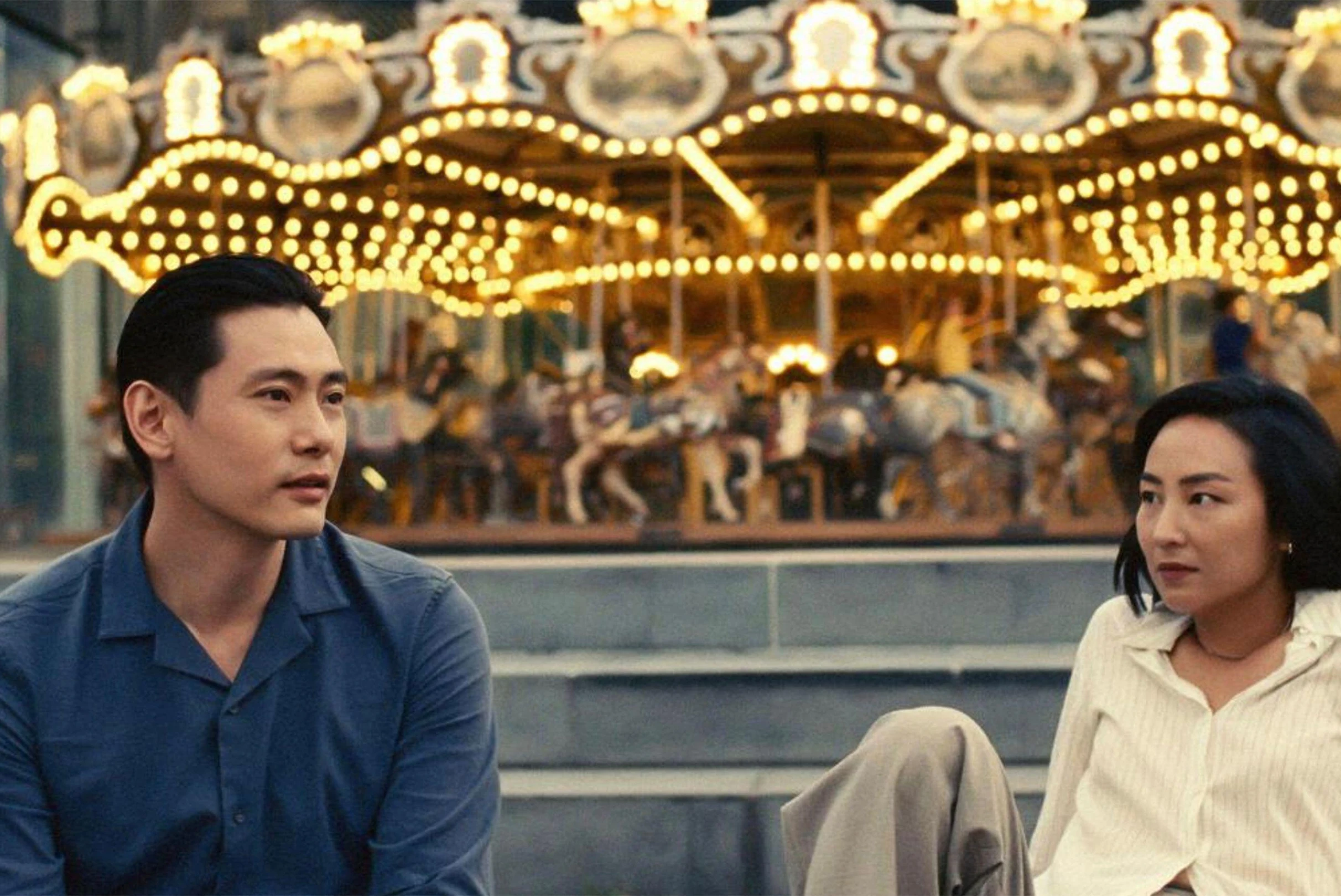
Following this intoxicating visit, I watched Celine Song’s 2023 movie Past Lives, which explores a woman reconnecting, twice, with her childhood sweetheart. The first time, at 26, they Skype constantly for months until she breaks it off, wanting to focus on her life where she is. A decade later, at 36, he visits her in New York City from their home country, South Korea. Now married to an American man, the main character [spoiler ahead] chooses the wise, safe, and arguably the most boring choice: foregoing her decades-long slow burn in favor of her existing but unexciting relationship. The intimacy she shares with her childhood sweetheart before saying goodbye forever is a conversation about possibilities in another life. As I lived my own story, I wondered what Past Lives would look like if monogamy wasn’t the only frame available. What promises and desire mean, what yearning hangs in the balance. Whether the childhood sweetheart and the husband could trade places, even momentarily.
Unknown destination
As our romantic lives open to polyamory, a more nuanced approach emerges—richer with possibilities, harder to navigate. I am not sure I fully know how to love two people at once. It means many conversations, which include false starts, partial truths, apologies for not being able to fully explain. Distance makes it more difficult too.
A few weeks after the second trip, I spoke to P about what was between us and how we could sustain it and explain it to others, including my wife. She had asked for a label, saying that it would reassure her. “I just want to know what space he holds in your heart and what space you hold in his.” After ten years of wondering what could exist beyond friendship, my best answer was still “friends in the widest degree.” She sighed. P sided with her, said it was a cop out. But he also said he always struggled to explain it to others and left it to me to figure out a label. “To me you are everything, or almost everything,” P told me., later adding: “You are in a very serious relationship, take care of it. I am not building my life around you.”
The beauty of that moment let my imagination lose contact with reality, in ways that are painful and that bring me great shame now. I thought intently about what a long-distance relationship would look like, and if I could rebuild a life around P. To this day, friendship is still the only label that rings true, albeit partially.
A few weeks later, P started dating someone and moved us away from flirting territory. As the bubble burst, I looked at what had sustained the illusion. I slowly found a truth: yearning had destabilized my love life to expose that I didn't love my life. I realized I wanted to recommit to a life of writing like the one he had and was surrounded by. Each of the 10 years had inched me away from living through creativity, molding my life around what I thought was expected from me. Before the conference visit, I had worked on convincing myself that the job that sustained me also fueled me. Seeing someone who has known me for so long, and with whom it’s always been easy to be honest, made it impossible not to interrogate this. I’m not sure I would have ever realized it without the way he touched my skin and whispered how soft it felt. Now, I am not doomed. It is not an external change I need. My current job is flexible enough to not keep me away from writing. I can choose it each and every day.
We will see each other soon in Paris, a city I grew up visiting and where I lived for two years. He is no longer dating someone and I have no idea what that means. I no longer need to know because I am the center of my own yearning. Paris may destabilize me again but I will wrest words from it.
Two weeks later, my wife will also land in Paris to join me for a vacation, giving her a glimpse into who I was the two years before I met her.
After this summer, P will move back to his country. Back to our original distance, our slow burn will return to its miles-apart spiritual form. A connection which, unlike his flight schedule, has no predetermined destination.
Curious about expansive connections of all kinds? Find what’s waiting for you on Feeld.