Photography by Javier González and Alex Free
The industries shaping our sexual expectations don't always have our pleasure, safety, or wellbeing in mind. But what happens when we build improved models of intimacy into the systems themselves? Cindy Gallop, founder of MakeLoveNotPorn, and Laura Ramadei, Safety Lead at Lovely Fate, discuss how digital platforms can better represent human connection.
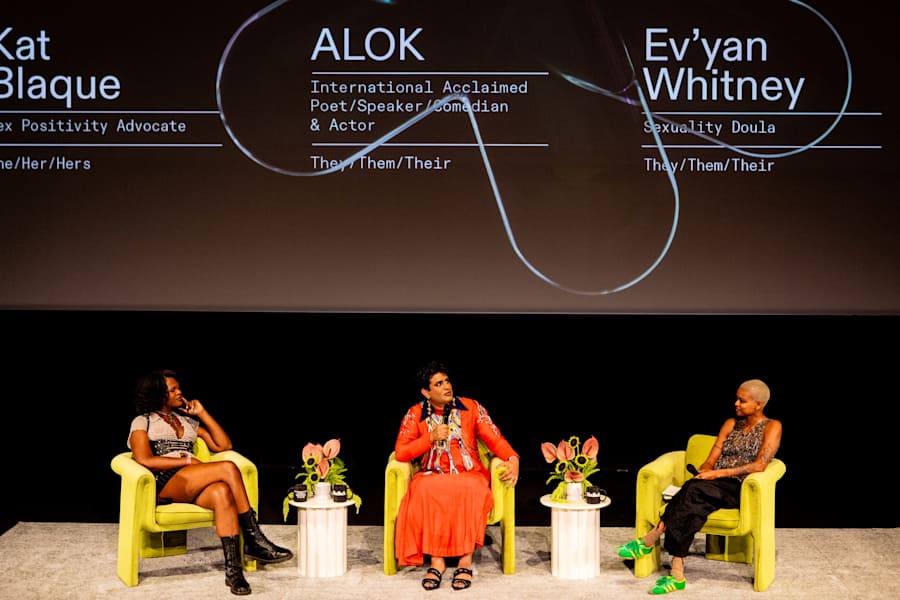
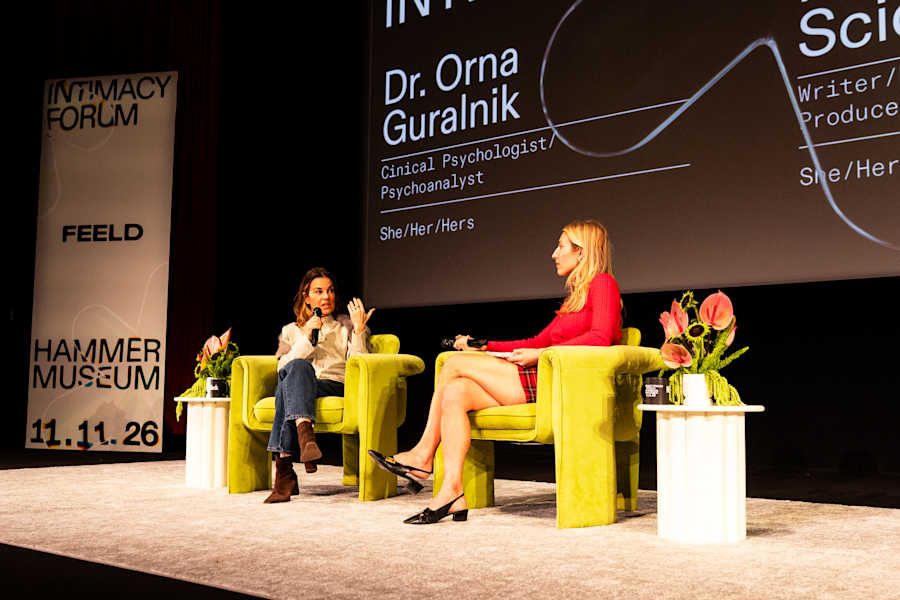
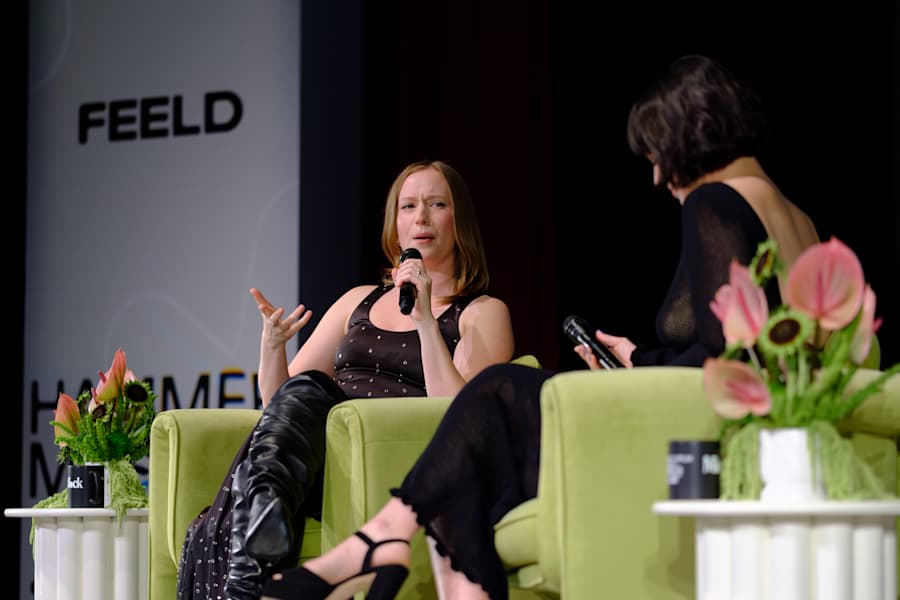
This interview was originally conducted at Mindf*ck, Feeld’s first ever intimacy forum at the Hammer Museum in Los Angeles.
Laura Ramadei: Cindy Gallop, you are the founder of MakeLoveNotPorn, which was founded on your philosophy of being “pro sex, pro porn, pro knowing the difference.” I host a podcast called Girls on Porn, where we are all about sex worker advocacy, adult media literacy, and just essentially helping people navigate the ethics of the porn space. So I think I need to kick us off with a question that has stumped Supreme Court justices, which is, what is porn?
Cindy Gallop: Oh my God! Do you know, I have to explain this all the bloody time. So my definition of porn—and please feel free to take this and use it, guys—is that porn is produced, performative, scripted, constructed entertainment. In our case, at MakeLoveNotPorn, and funnily enough, the clue is in the name: we are not porn, because we are where real people share the sex they actually have in the real world. If porn is the Hollywood blockbuster movie, MakeLoveNotPorn is the badly needed documentary. We are a unique window onto the funny, messy, loving, wonderful sex we all have in the real world. Nobody's performing; they're just fucking.
LR: Have any of your participants ever encountered difficulty around it being transactional? Like, "We're a real couple, but now we've made a business out of our real sex." Do you talk to folks on your platform about that tension?
CG: First of all, I only wish we were operating at a scale where we had that problem in a big way. When I came up with the idea of building a social sex video sharing platform—and bear in mind, 18 years ago this was an extraordinarily innovative concept—I designed it around a 50-50 revenue share business model. The reason I did that was to democratize access to income. Our members subscribe and pay to watch real-world sex videos. Half that money goes to our contributors, whom we call our MakeLoveNotPorn stars. But we designed MakeLoveNotPorn to ensure money would never be the primary motivation for anybody sharing their real-world intimacy—and this is the complete opposite of how every other platform on the internet operates.
We do not tell you which videos are the most watched. We do not believe that real-world sex is competitive; we value every single one of our contributors, every single amazing video equally. We did not want to create that dynamic where someone might go, "Ooh, if we have sex like that, we'll make more money." So we deliberately designed that dynamic out of the platform, to the extent that we have had MakeLoveNotPorn stars submit videos who had no idea they could actually make money from them.
We are on a mission, ultimately, to help end rape culture globally. Now that may sound like a very big mission, but we have 14 years of proof of concept at a micro level. We help end rape culture by doing something very simple that nobody else is doing: we show you how wonderful great, consensual, communicative sex is in the real world. We make all of that aspirational versus what you see in porn and popular culture.
LR: [You’ve had] experience [working] as an ad executive. Which business lessons do you think you have directly applied, and what have you resisted or put down for the sake of the mission of this platform?
CG: Everything I've learned in my 40 years of working in brand building, marketing, and advertising has absolutely contributed to how I designed and built MakeLoveNotPorn. I'm all about communication through demonstration. Don't say it, be it, do it, show it. My advertising boss used to quote Plato, who said, "It's information that goes in through the heart, not the head, that is most effectively absorbed and acted upon." In advertising, our creative strategy was: we don't sell; we make people want to buy. And so I absolutely applied the idea of communication through demonstration to MakeLoveNotPorn.
One reason why that’s so important [in this context]: Everybody today, quite rightly, is talking about consent. There are lots of nuanced, thoughtful think pieces out there about consent. Here's the problem: nobody knows what consent actually looks like in bed, and it is not only what people somehow think it is, which is at every step asking, "Is it okay if I do this? Is it now okay if I do this?” That is not [the extent of] consent. The only way we educate people as to what is great, consensual, communicative sex is by watching people actually having that kind of sex. It's so critically important that people get sex education through real-world demonstration.

LR: How do you demonstrate consent in a visual medium?
CG: Consent starts long before you ever get into bed.
LR: Agreed.
CG: Another philosophy that I designed into my own business is, I believe that everything in life and business starts with you and your values. I regularly ask people: What are your sexual values? And nobody can ever answer me because we're not taught to think like that. Our parents bring us up to have good manners, work ethic, sense of responsibility, accountability. Nobody ever brings us up to behave well in bed. But they should, because in bed values like empathy, sensitivity, generosity, kindness, honesty, trust, respect are as important as those values are in every other area of our lives where we're actively taught to exercise them. And by the way, because I pioneered this concept of good sexual values, over the years a lot of people said to me, "Oh, but Cindy, surely if someone had good values in life, then that translates into the bedroom." Absolutely fucking not, literally.
I am my own research lab at MakeLoveNotPorn. I started the platform because I date younger men. They tend to be in their 20s. I realized 19, 20 years ago, long before the rest of the world, that when we do not talk openly and honestly about sex in the real world, porn becomes sex education by default—not in a good way. And I built a solution for that. But what that means is, I am enormously selective about the younger men I date. I tend to meet them in all sorts of ways—cougar dating sites, IRL, etc.—and I date younger men casually and recreationally. I am that rare person who adores being single, never wants to get married, never wanted children, is not a relationship person, cannot wait to die alone, and dates younger men for sex. But no matter how casual the relationship, I have one fundamental criterion: they have to be a very nice person. I only date utterly lovely younger men in an atmosphere of mutual trust, respect, affection, liking, and yet, when I get into bed with those absolutely lovely younger men, I see them modeling the kind of body language that says, "my dick is the center of the universe," and that's because that's what they've grown up with. They've internalized male-centric, male lens porn. So no, having great values in life as a brilliant human being does not mean you'll then operate good sexual values and behavior—and [embodying those] starts long before you ever get into the bedroom. Our MakeLoveNotPorn videos show those values and behaviors in action, and that's what the rest of the world needs to learn from.
[We’re especially focused on] giving girls and women sexual agency, and celebrating equality of sexual agency. You're not seeing that in mainstream straight porn, for example. By the way, I get very frustrated when people use the word “porn” like it's all one big homogenous mass. That's like using the word “literature” to say it's all the same thing. The landscape of porn is as rich and infinitely varied as the landscape of literature—but you’re not seeing equality of sexual agency modeled on the most-visited tube sites.
In one example, a man left a comment on one of our threesome or moresome videos. He wrote, "This was fantastic. Obviously the sex was hot and all of that," but he said "What I especially loved was the way the three of you kept checking in on each other. You kept making sure that everyone was okay." I mean, that is consent in action. [In another example,] a married couple recently decided to try a threesome with another man. The husband was bi-curious, so they invited another man in and shared a video where they explained (in the narrative) that, during this threesome, something happened that triggered the husband. They immediately stopped everything, they talked and worked through things, and that is what can happen in the real world.
We exist to celebrate the full glorious spectrum of human sexuality.

LR: I absolutely love that. I love the detail of stopping when someone doesn't feel safe. That does feel contradictory to what we think of a polished product needing to be. That feels very real. I want to pose a two-sided question: First, what do you see as the most problematic areas of the larger industry? Second, what is perpetuating bad default sex education, and what do you see other platforms doing that is supportive or aligned with your mission?
CG: Honestly, the most problematic thing is that the porn industry currently is dominated by one massive monopoly, which would not be allowed to exist in any other industry. But nobody wants to bring antitrust legislation to the adult world. A company that used to be called MindGeek was acquired a few years ago and rebranded as Aylo, and it owns pretty much everything: Pornhub, YouPorn, Brazzers, et cetera.
LR: Basically, any branded major porn platform you can name.
CG: It’s the same problem in every other industry with a monopoly, which is that it completely rules out the ability for innovation and creativity to happen in a way that would massively disrupt and improve the industry. I have many friends in the porn industry who are brilliant feminist, queer, women pornographers. They are making brilliant, innovative, disruptive porn, but they cannot get the numbers, the traffic, the revenue they deserve.
When you have one demographic dominating an industry, that is immensely problematic for the rest of us. I am militant about the importance of funding female founders; that’s why I designed MakeLoveNotPorn through the female lens to be the safest place on the internet. Because the young white male founders of the giant tech platforms that dominate all our lives today, they are not the primary targets of online or offline harassment, abuse, sexual assault, racism, violence, rape, deepfake sexualization, intimate image abuse. Therefore, they did not, and they do not, proactively design for the prevention of any of those things on their platforms, and we see the results that are around us every single day. Those of us who are most at risk—women, Black people, people of color, LGBTQ+ people, people with disabilities—we design safe spaces and experiences, but we don't get funded. Only 1.7% of all venture capital last year went to female founders. What that means is that 98.3% of our daily lived experience and technology is through the male lens. But it also means that we haven’t seen how much safer, better, happier, and more lucrative the future of technology could be when it's designed and built through the female lens. This is what funding enables at scale. And so the solution to everything, including any issues anybody has with porn, is to fund female founders.
LR: You mentioned deepfakes. With the rise of AI deepfakes, "build your own ideal girlfriend" platforms, all of that tech, do you think that poses a threat to sites like MakeLoveNotPorn, or do you think it swings the pendulum the other way and creates more demand for you?
CG: Broadly speaking, no, that doesn't pose a threat because AI is our tailwind. In an era of AI slop generally, human-curated, handcrafted, artisanal [content] acquires massive premium value. I am very concerned about deepfake sexualization, and how it’s currently ruining the lives of girls and women worldwide at an unprecedented scale, and it’s only getting worse. So while it's not a threat to my business, I am absolutely focused on highlighting how much of a threat it is.

LR: I think that's a great note on which to bring it to the audience. Any questions?
CG: As you can see, you can ask me anything. No holds barred.
Audience member 1: You said there were many other venues/people making porn that are not getting funded. Is there any way for you to band together to boost viewership, as a competitive network against the male-dominated ones?
CG: It's a great question, and I can tell you that those of us trying to change all of this are already very much in a community. If you're not familiar with Pink and White Productions, I recommend Jiz Lee, and Shine Louise Houston's amazing queer porn the CrashPad Series. They run the San Francisco Porn Film Festival, and MakeLoveNotPorn sponsors that every year. Jiz is an old friend.
Unfortunately, the challenge for us is not about the ability to collaborate because we all want to do that. It is literally about the infrastructure. Every piece of business infrastructure that other tech startups can take for granted, we can't use because the small print always says, "no adult content.” I cannot get funded. I cannot get banked, and that makes life very difficult. Last year, MakeLoveNotPorn was debanked three times in two months. We found a fourth bank, but I live in daily fear that they’ll decide to kick us out as well. One of our biggest pain points is payments: PayPal won't work with adult [content]. Stripe won't. [Lots of] mainstream fintech won't. I have to work with the murky subculture of adult-friendly payment processors who charge extortionate fees. We cannot advertise on social media, and this is true for [other adult content platforms]. We all face the same barriers.
So we could not even get word of any collaboration out there in a way that would be impactful until we've solved the infrastructure problem. I'm a great believer that when you have a truly world-changing startup, you have to change the world to fit it, not the other way around. If the ecosystem that's meant to enable me to scale and thrive shuts me out, I'm going to build my own fucking ecosystem. And so I am working on infrastructure to solve our problems, that everyone else can use too, which will help us overcome these barriers. So trust me, I'm not going to let that stop me or any of us.
Audience member 2: What are other ways that we, as an audience, as a community, can uplift your work?
CG: Thank you so much for that question. By the way, I did not plant her. When I talk about building infrastructure, I have a product roadmap. This includes edtech, which is an idea I had 11 years ago because parents and teachers began begging me for a sex education extension of what we do. So makelovenotporn.academy is a global aggregator hub for the best of the world's sex education content that is being blocked, censored, and deplatformed everywhere else. Our mission at the academy is to organize the world's sex education information to make it universally accessible and useful. We are building the Google of sex ed, free for everyone to access. So, you can support us [in that venture].
We have a non-profit vehicle where anybody who wants to provide philanthropic capital can, and we're always looking for investors. But what I would love all of you to do is just spread the word. The fact we are banned from advertising anywhere is infuriating. In February of this year, Instagram deleted our MakeLoveNotPorn account, so we took Meta to small claims court. They still haven't [reinstated the account], but because of this, please tell everybody you know about makelovenotporn.com and about makelovenotporn.academy, to help us get the word out there about our resources.
LR: I think that's an excellent landing to wrap us up. Thank you very much, Cindy.