State of Reflections Volume 2: The Words We Didn’t Have

People crave authenticity, but authentic expression of desires may be difficult when individuals are trying to figure out who they are and what they want. Especially when it comes to finding intimacy online.
That’s why what we say matters—particularly when it comes to talking about what we want. But sometimes, we don’t quite know what we want. And at other times, we may intrinsically know our desires, but we might not have the right language to express ourselves comfortably.
Feeld offers a space where diverse and expansive community members can explore their own identity in a way that feels authentic to them and others. But identity does not spontaneously emerge. Social psychologists think of identity development as a life-long process of a reciprocal interaction between self and others. This means that others shape our identities and our desires (Williams, 2024; Banks et al., 2025). With the understanding that gender, sexuality, desires, and connection preferences are fluid, Reflections helps individuals figure out who they are, what they want, and helps inform how we communicate in virtual settings.
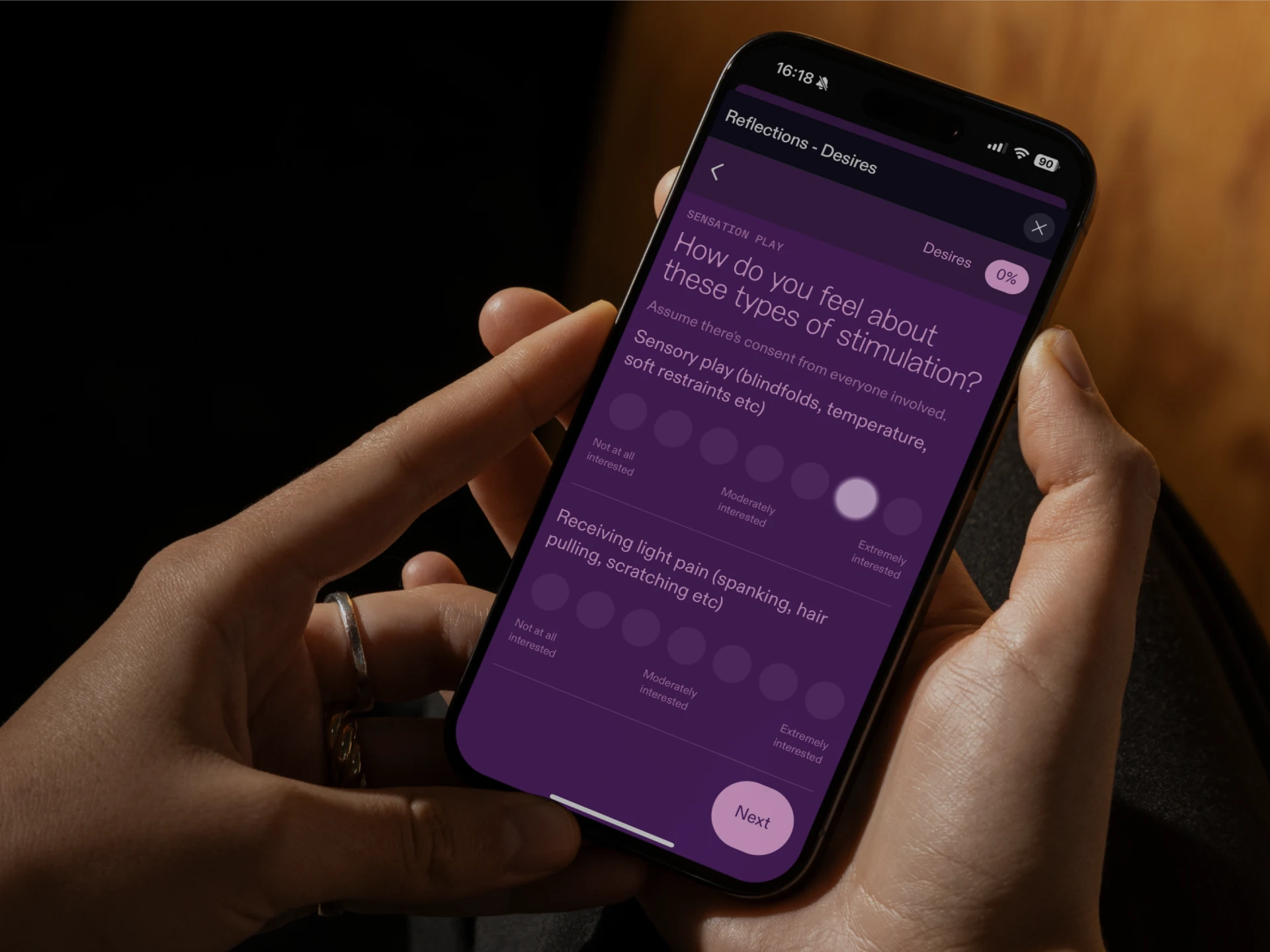
Forget the face work?
Online dating is a balancing act between authenticity and performance. Reflections helps reduce that tension by making self-expression clearer and more intentional.
Let’s be real. Being online involves a bit of image maintenance. We fret about balancing the need to honor our truths and the fear of coming off the wrong way. Social scientists call this impression management (Gibbs et al., 2006; Ward, 2017). Many of us are navigating the desire to show up authentically online while also feeling pressure to curate the ideal image of the self.
In online contexts, we often present ourselves strategically, in order to show our most desirable selves to others (Walther, 1996). Exploring intimacy adds another layer. We want to present our best selves in order to attract potential partners and playmates. But if we don’t truly know ourselves or how to express ourselves authentically, how can we make genuine and meaningful connections with others?
Reflections was designed to help Feeld members explore, clarify, and become more confident about their desires, boundaries, and relationship preferences, with the knowledge that not everyone has the same starting point. But in action, how has Reflections helped Feeld members discover themselves?
What we studied
We surveyed 1,112 Feeld members who used Reflections to explore their identity, desires, and boundaries. The results help us understand how members think about self-awareness and intimacy experiences.
What we found is that Reflections helped Feeld members develop clearer language around desire, intimacy, sexual safety, and boundaries—empowering some to act on their self-knowledge and make more intentional choices in how they date and relate to others.
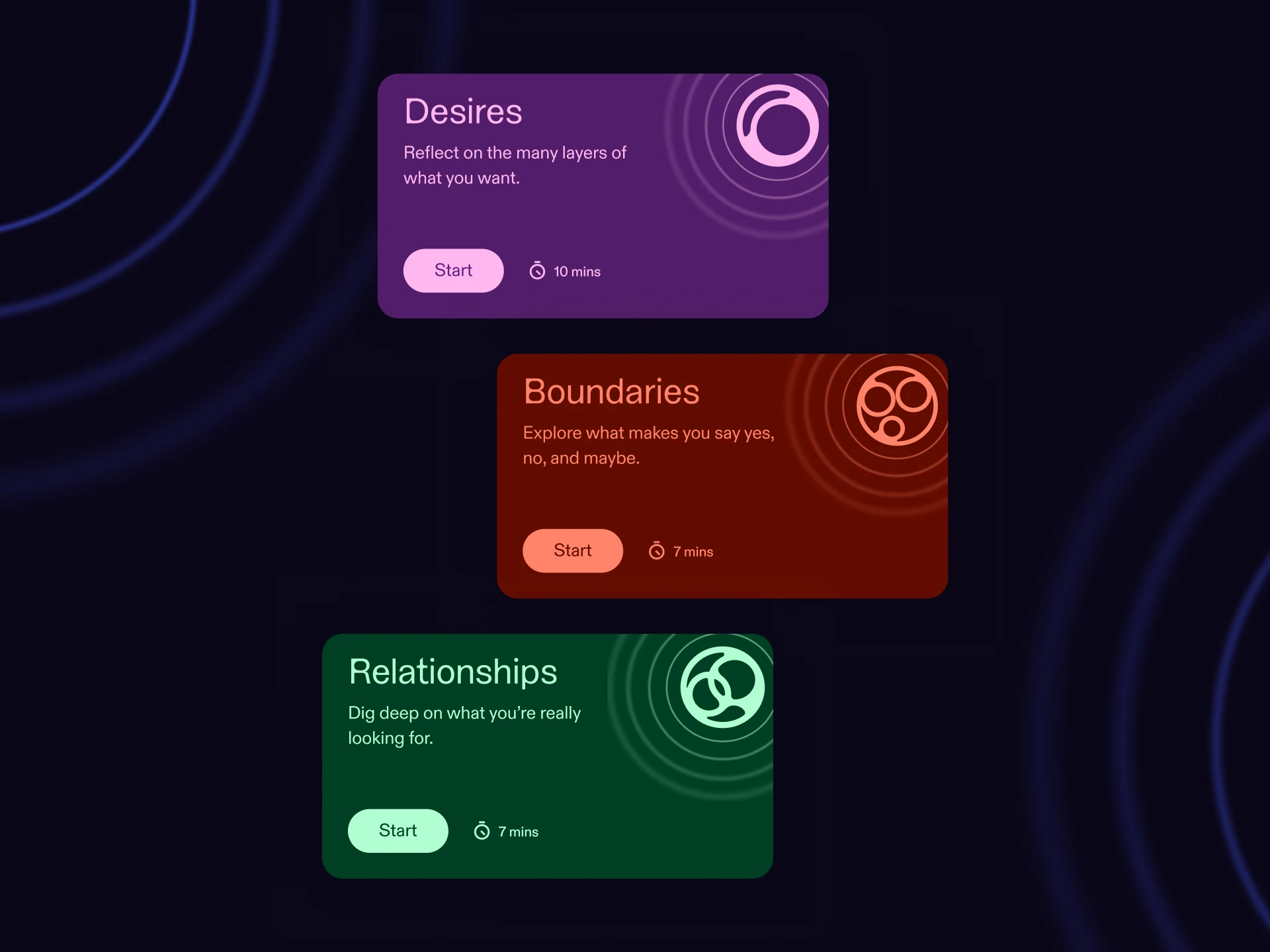
Reflections clarifies the language of desire
People don’t need to be told what their desires are. They need better language to express the ones they already have.
Reflections helped make language around intimacy and desire more tangible and relatable, giving them more precise ways to describe themselves to others. Some Feeld members gained language they were missing. For example, one member noted that Reflections helped “find the language I was lacking.” While another realized that taking Reflections made it possible to “put into concrete terms” their wants and how to communicate. Other members explicitly referenced Reflections helping them to better articulate their desires. For example, a Feeld member suggested that Reflections contributed to, “learning where I am in my communication around sex.” Another conveyed that Reflections helped to cultivate “more nuance in the type of kink” they were into. Finally, some thought that Reflections helped to better educate or explain fantasy and desires.
Big picture—having the tools and language to express ourselves gives us greater agency. When we recognize our intrinsic wants and desires, and we are equipped with the language to express ourselves clearly, we’re better able to communicate and advocate for ourselves. Feeld welcomes members at any point in their journey, which means some may have deeper familiarity with the language needed to frame desires and navigate relationships. Our data demonstrate that Reflections bridges the gap between knowing and saying.
Are we willing to have high stakes conversations?
Reflections increases willingness to talk about the things that matter most: desires, boundaries, and safer sex.
People are often apprehensive about communicating about topics related to sex. Women in particular, tend to want to communicate about desires and sexual boundaries, but tend not to due to discomfort, embarrassment, or fear of hurting their partner (Herbenick et al., 2019). Furthermore, communicating openly about sex can greatly impact relational and sexual satisfaction (Mallory, 2022).
As with any online community, especially one that focuses on interpersonal connections and intimacy, safety is a concern. Research demonstrates that safety concerns are exacerbated by marginalized identities, particularly race and sexuality (Banks et al. 2025; Williams 2024). That being said, folks who engage in online communities find pleasure, joy, and gratification in the experience. Recognizing that many truths can exist simultaneously, Feeld members seek to find space to hold and recognize these truths while balancing the need to communicate clearly and directly about safer sex, boundaries, and desires.
Our results found that Reflections acts as a catalyst to talk about the things that matter most: desires, boundaries, and safer sex, especially for marginalized groups who may benefit most from clearer language and validation.
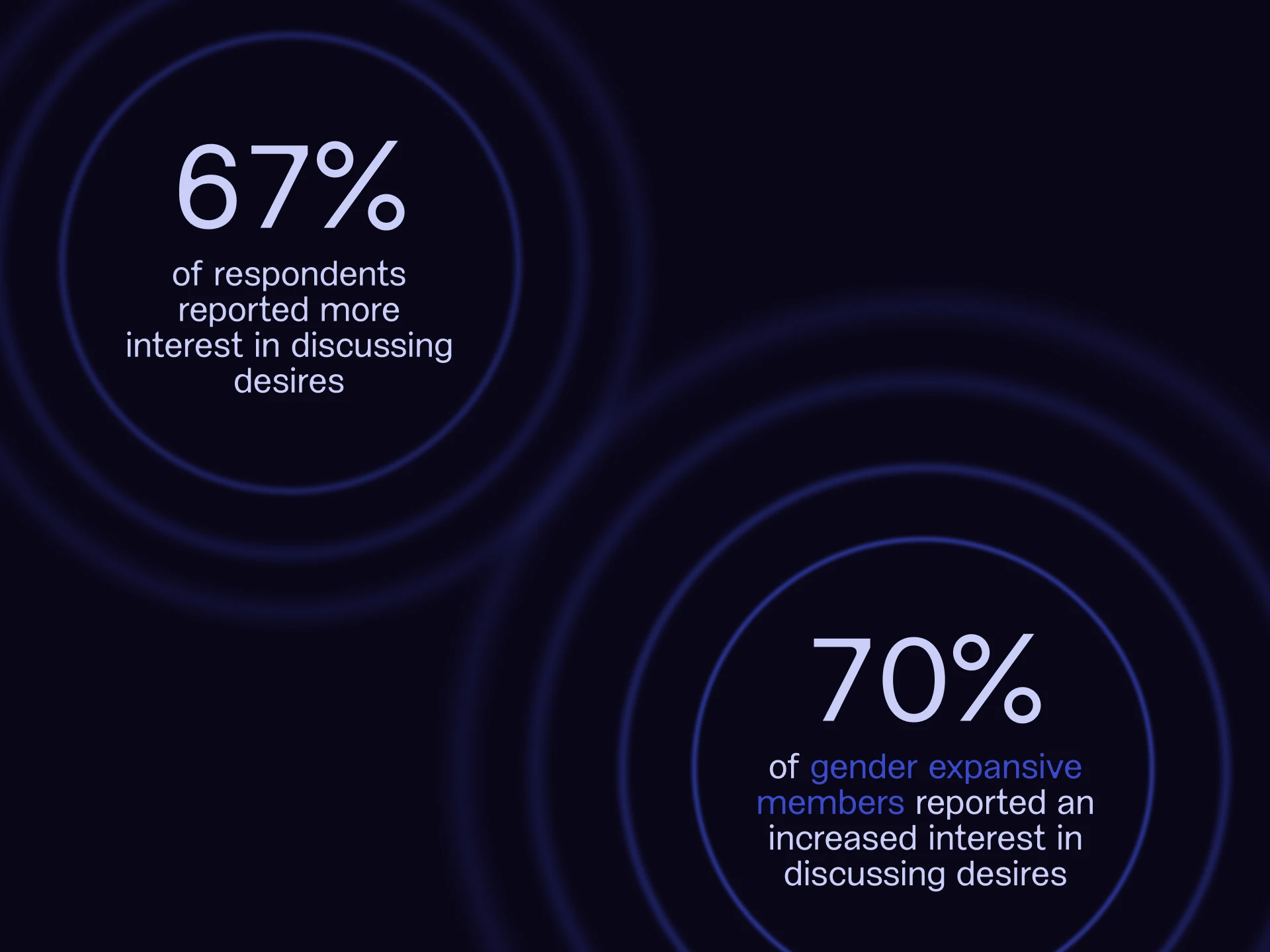
- 67% of respondents reported more interest in discussing desires.
- 50+% were more interested in discussing boundaries and safe sex.
- 61% are more interested in discussing desires.
- 54% are more interested in discussing boundaries.
- 53% are more interested in talking about safer sex.
- It was especially pronounced for gender expansive members: 70% reported an increased interest in discussing desires.
- Women were 12% more likely than men to be interested in talking about safer sex.
- Gen Z women were 24% more likely to be interested in discussing safer sex after taking Reflections, compared to Millennial women and older generations.
Reflections encourages more open communication around desires, boundaries, and safer sex, which may have notable implications for more intentional, safe, and mutually fulfilling intimate dynamics. One member put it best, “I just say what I want and don’t want.”
For individuals with marginalized identities, this may be especially beneficial. For gender expansive folks, perhaps Reflections provided validation and vocabulary for individuals outside the mainstream to express their desires with more confidence. And for young women, perhaps the feature empowered them with information, language, and self-clarity to better set boundaries and expectations around dating and intimacy.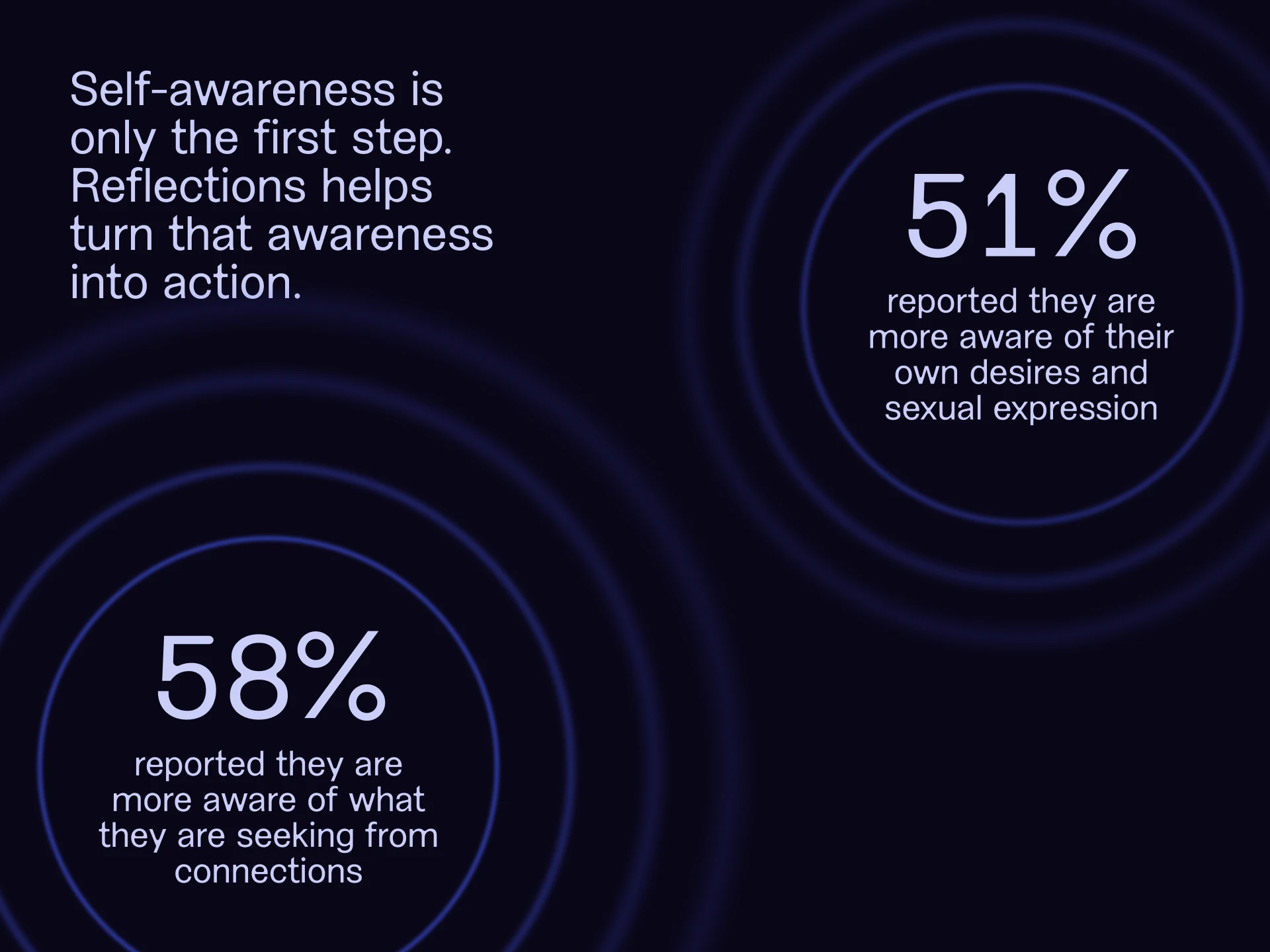
Vulnerability empowers authentic expression
Self-awareness is only the first step. Reflections helps turn that awareness into action.
While technology can often pose barriers to achieving authenticity, Reflections offers alternative ways of framing ourselves and our desires—encouraging, rather than shying away from vulnerability.
Our survey results show that members are interrogating their core values, growing more confident in articulating aspects of their identities, and that they feel more empowered to live their truth on Feeld without fear of judgment. Respondents report increased clarity about themselves:
- 58% reported they are more aware of what they are seeking from connections.
- 51% reported they are more aware of their own desires and sexual expression.
It’s one thing to feel empowered but it's another thing, entirely, to act on that energy. But how do we cultivate spaces where empowerment can move toward action? Ultimately, living authentically requires vulnerability. While it can feel scary to share those deep, resounding truths, we must voice them if we want to see those desires and values honored. How will our partners know what we need if we can’t tell them?
“I decided to be more clear in what turns me on.”
After Reflections, the increased clarity led to increased change:
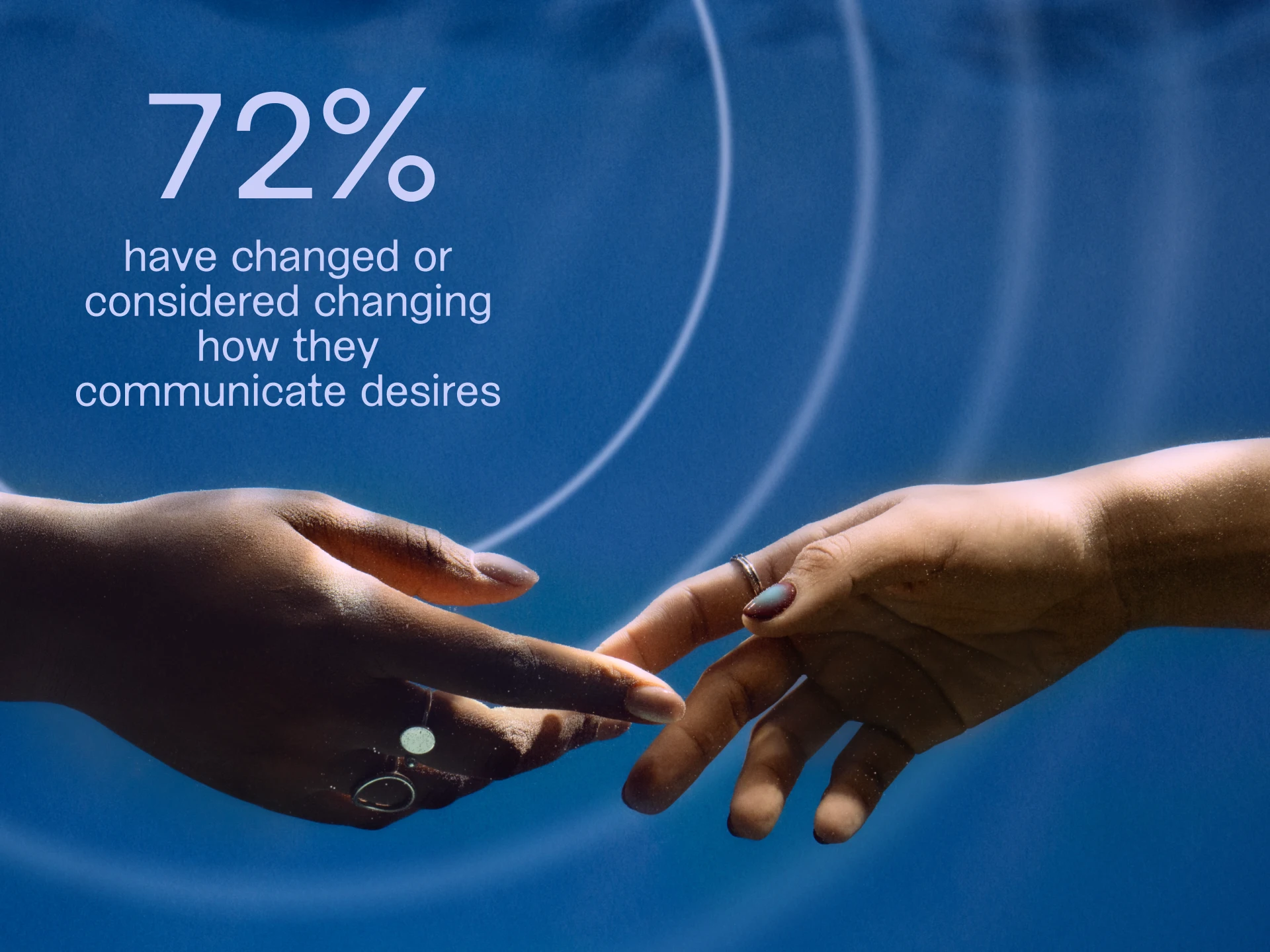
- 72% have changed or considered changing how they communicate desires.
In recognizing how important it is to center core values in members’ profiles. Members feel that it’s important or very important to update their profiles with:
- Desires (68%)
- Boundaries (68%)
- Communication style (65%)
- Relationship structure (61%)
In particular, women report feeling empowered to share their shifting perspectives on their profile. They were 51% more likely than men to say they intend to update their profiles—specifically with the intent to find greater compatibility.
Gender expansive members also reported making changes to their profile to clarify what they are looking for—but this energy is directed at finding meaningful friendships and non-romantic connections.
More broadly, gender expansive members are leading the way in creating authentic communities that are shaped by the desire to build spaces that are not founded on romantic attraction or interaction. This finding echoes our previous research where we found that queer and gender expansive Feeld members create more diverse uses for the app—beyond seeking out relationships or connections centered around sexual intimacy. This pattern aligns with broader research on online communities. Media studies research finds that tools that are used for appropriation and innovation can be liberatory for queer audiences (Li, 2024). Queer use of Feeld for friendship rather than sexual connection is an act of subversive resistance (Ahmed, 2018) against having our desires and identities shaped by others.
Own your safety
Reflections doesn’t just increase awareness. It drives real shifts in safety, boundaries, and sexual health.
As leaders of the team behind the research that shaped Reflections, we hoped that members would feel empowered to discuss their boundaries and take control of their sexual health. Our data demonstrate that 54% of members are now actively prioritizing conversations around safer sex, boundaries, and desires.
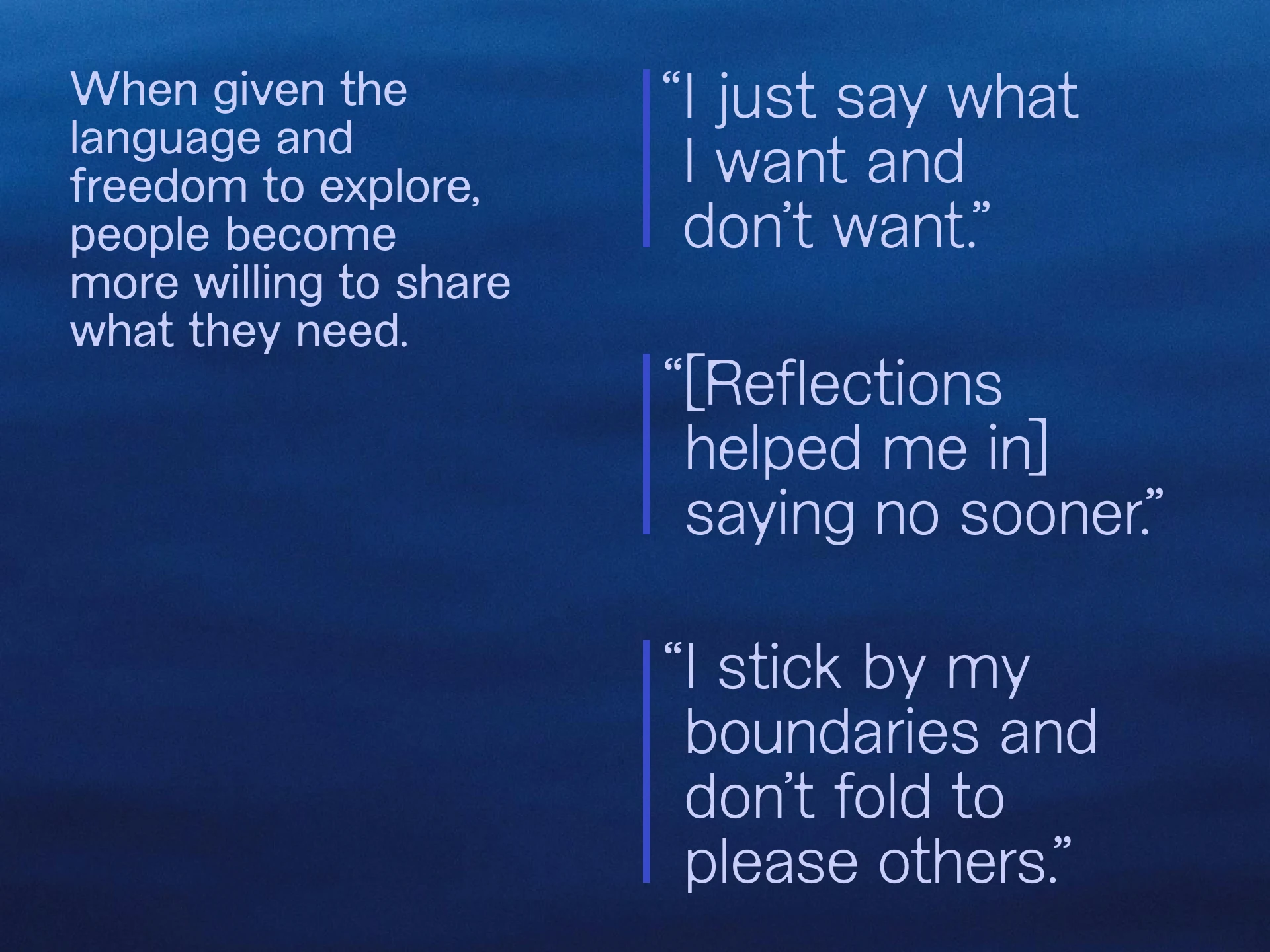
One Feeld member reported that Reflections helped them “just say what I want and don’t want” and another reported that it helped them in “saying no sooner.” In particular, women and gender expansive folks were more likely to say that they feel more sexually empowered after taking Reflections (32% and 19.5% respectively). When given the language and freedom to explore, people become more willing to share what they need.
This growth is important and substantial given the incredibly toxic culture of many online spaces (Ging & Siapera, 2018). Decades of research suggest that online dating and intimacy spaces can be particularly toxic—especially if they are dominated by cisgender white men. Queer people, trans people, and people of color are most vulnerable to this kind of toxicity (Williams, 2024).
Reflections empowers people to identify and reflect on toxicity:
45% of men and women agree that they feel more empowered to identify red flags in dating and intimate relationships. One member said, “I stick by my boundaries and don’t fold to please others.”
In particular, gender expansive members were 30% more likely to agree or strongly agree that they could more readily identify red flags and boundary violating behavior.
This means that Feeld members, empowered by Reflections, are stepping up to create a safer kind of community where communicating directly and meaningfully about boundaries and red flags is expected and celebrated. Likewise, 63% of gender expansive folks in the survey report feeling empowered to more directly communicate about their wants and needs with others in the community—highlighting that truthful and intentional communication can facilitate a respectful, mutual exchange of desires.
Beyond communicating about boundaries, our data suggest that Reflections helps members to more seriously consider their sexual health and safety as well as their sexual desires, with 53% reporting being more interested in talking about safer sex. Not only do people feel more comfortable talking about safer sex, they are ready to own their sexual health with one Feeld member reporting that they are“ready to take PrEP.” This signals a powerful emotional shift in which Feeld members report less self-doubt and more action and intention toward taking control of their sexual health and communication around sexual needs and desires.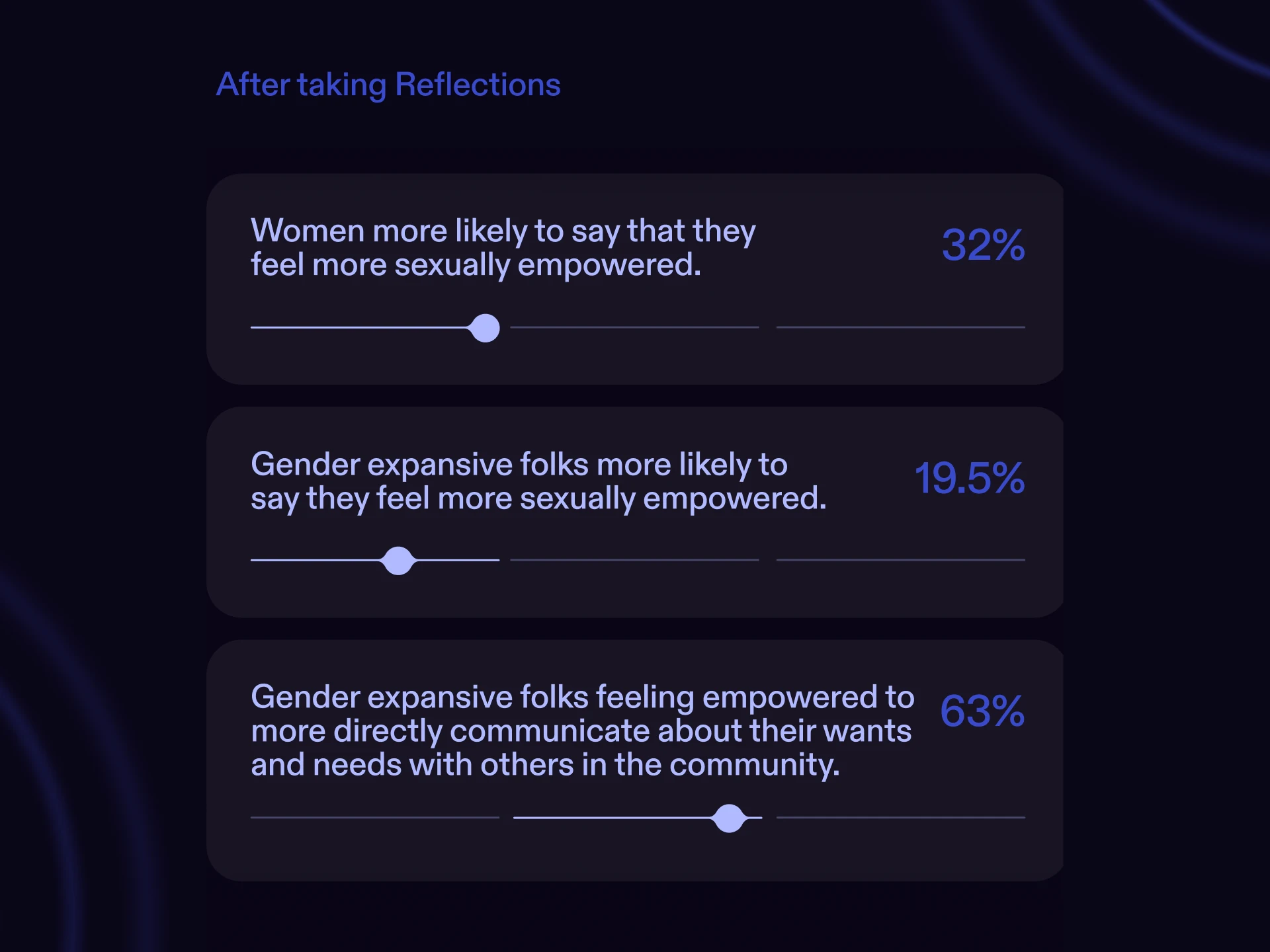
Gen Z leads the shift from self-questioning to self-assertion.
When members have clearer language to draw on, they may feel more empowered to communicate and advocate for themselves interpersonally and on Feeld. Yet one generation is moving from questioning themselves to asserting themselves more than others. Gen Z is modeling how empowered communication with clear assertive language allows us to act on our wants and needs. We found notable generational and gender differences that add nuance to how communication expectations are shifting:
- Gen Z (63.9%) feel more empowered to communicate their wants and needs than Millennials and older generations (53.5%).
- Similarly, Gen Z (54.9%) are more likely to feel empowered to identify red flags than Millennials and older generations (43.2%).
- Gen Z women are 11% more likely than Millennial women and older generations of women to want to discuss boundaries with partners.
- Gen Z men (43.8%) feel more sexually empowered than Millennial and older men (37.5%).
- And adding a surprising gender component, Gen Z men were 76% more likely to want to change their relationship structures (e.g. monogamy, ENM, etc.) compared to Gen Z, non-men.
This pattern is not limited to Gen Z. It reflects a broader behavioral shift across Feeld.
- 72% of Feeld member respondents, after taking Reflections, reported that they have already changed or have thought about changing how they communicate their desires on their Feeld profiles.
- Almost 67% indicated they were keen to change how they sought out sexual or romantic partners.
Taken together these findings suggest that Feeld members are using language and identity shifts differently, aligning with their distinct goals and social realities rather than one single way to communicate self-discovery.
Reflections doesn’t reinvent desire. It gives people the language, confidence, and structure to express their existing desires. And that shift changes how people date, communicate, and connect.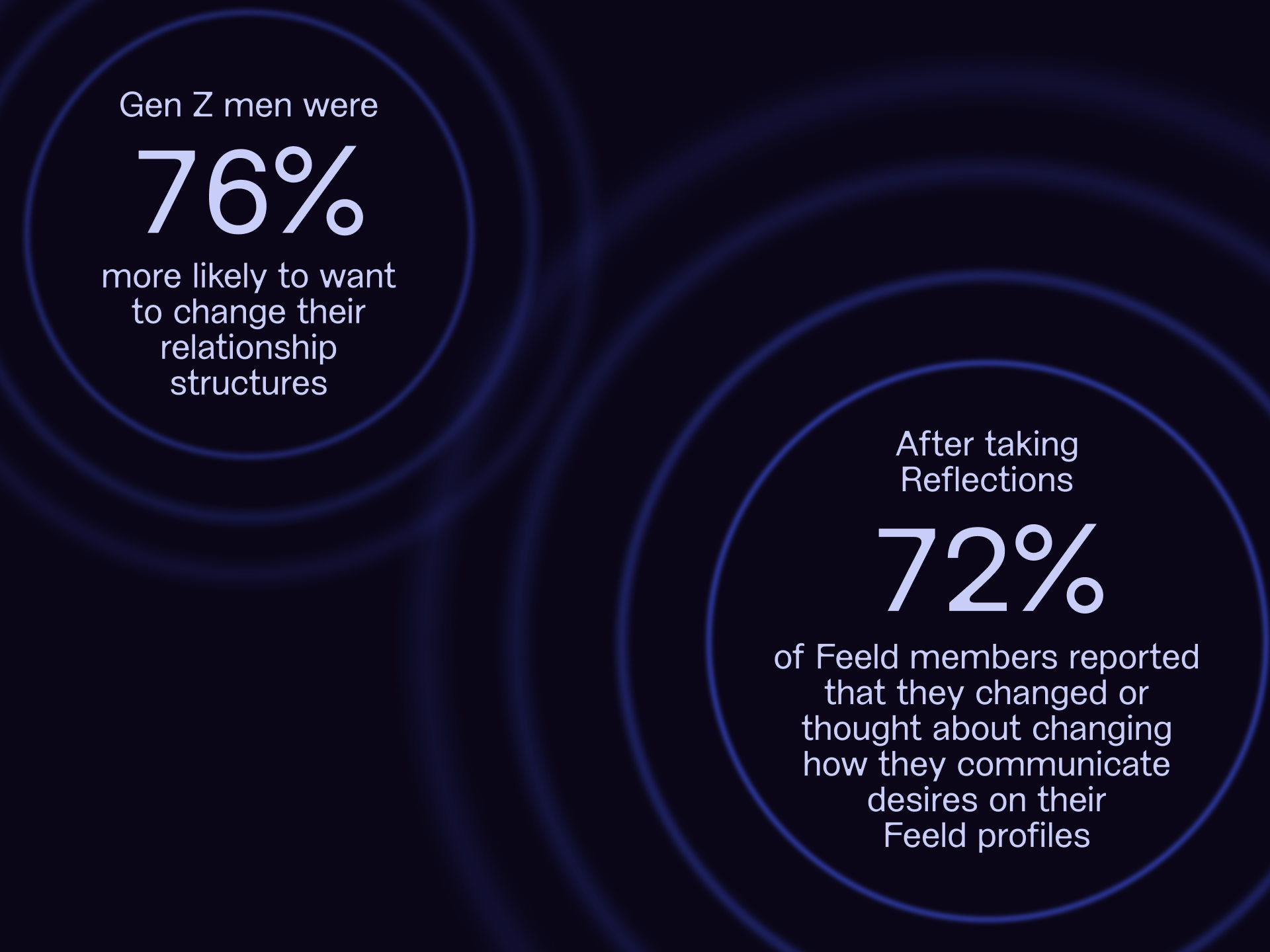
Final thoughts
Acknowledgment is the famous first step on the road to acceptance. To name the thing is its own kind of power, even its own kind of creation. But language is an imperfect tool, one that is always striving, but never quite reaching, absolute articulation. We see this poignantly in the ways we try to express ourselves and manage shifting identity labels: A sexuality that might feel sufficient one day, may not the next. A gender that can best be articulated for what it is not is less than ideal. Nevertheless, seeking new forms of language, trying to articulate our complexities, and creating new names for ourselves is the stuff of life. It is how we achieve a sense of selfhood, even if there is always going to be some part of ourselves that remains unspoken. Shared language, within ourselves and in our world, is how we keep discovering.
About the authors:
Dr. Apryl Williams, Ph.D., is Associate Professor of Media, Communication, and Digital Studies at the University of Michigan and Faculty Associate at Harvard University’s Berkman Klein Center for Internet & Society. She is the author of Not My Type: Automating Sexual Racism in Online Dating (Stanford University Press) and The Injustice of Fairness (University of California Press). Her previous research has appeared in The New York Times, Vogue, Wired, and Time Magazine, among others. She explores the lived black experience as it is shaped by algorithmic technocultures, the gendered black body, and race and racism as they manifest and evolve in our contemporary, artificially fragmented society.
Dr. Kyla Noni Brathwaite, Ph.D., is an Assistant Professor and LSA Collegiate Fellow in the Department of Communication & Media at the University of Michigan. Her research examines the social and psychological implications of communication technology use. A quantitative and experimental scholar, she draws on objectification, media effects, and social influence literatures. Her work focuses on the intersections of race and gender, particularly how these identities shape interactions with technology and with others, as well as engagement with social media activism. Her research has been published in leading communication and interdisciplinary journals, including Communication Monographs, Journal of Computer-Mediated Communication, New Media & Society, and Social Media + Society.
References (in alphabetical order)
Ahmed, Sara. “Queer Use (Lecture).” (2018).
Banks, J., Monier, M., Reynaga, M., and A. Williams. “From the Auction Block to the Tinder Swipe: Black Women’s Experiences with Fetishization on Dating Apps.” New Media & Society 27, no. 7 (2025): 4228–4245.
Gibbs, Jennifer L., Nicole B. Ellison, and Rebecca D. Heino. “Self-Presentation in Online Personals: The Role of Anticipated Future Interaction, Self-Disclosure, and Perceived Success in Internet Dating.” Communication Research 33, no. 2 (2006): 152–177.
Ging, Debbie, and Eugenia Siapera. “Special Issue on Online Misogyny.” Feminist Media Studies 18, no. 4 (2018): 515–524.
Herbenick, Debby, Heather Eastman-Mueller, Tsung-Chieh Fu, Brian Dodge, Kelsy Ponander, and Stephanie A. Sanders. “Women’s Sexual Satisfaction, Communication, and Reasons for (No Longer) Faking Orgasm: Findings from a US Probability Sample.” Archives of Sexual Behavior 48, no. 8 (2019): 2461–2472.
Li, Jingyi. “Toward Appropriating Tools for Queer Use.” In Proceedings of the Halfway to the Future Symposium, 1–4. (2024).
Mallory, Ashley B. “Dimensions of Couples’ Sexual Communication, Relationship Satisfaction, and Sexual Satisfaction: A Meta-Analysis.” Journal of Family Psychology 36, no. 3 (2022): 358–371.
Walther, Joseph B. “Computer-Mediated Communication: Impersonal, Interpersonal, and Hyperpersonal Interaction.” Communication Research 23, no. 1 (1996): 3–43.
Ward, Janelle. “What Are You Doing on Tinder? Impression Management on a Matchmaking Mobile App.” Information, Communication & Society 20, no. 11 (2017): 1644–1659.
Williams, Apryl. Not My Type: Automating Sexual Racism in Online Dating. Stanford: Stanford University Press, 2024.