State of Reflections Volume 2: The Words We Didn’t Have
By Dr. Kyla Noni Brathwaite and Dr. Apryl Williams
Download Feeld

Intuitive language, academic research, and designing with members in mind…
Reflections, Feeld’s academically-backed self-discovery tool, was built to help members learn more about the intricacies of their desires, boundaries, and priorities in relationships.
The tool is made up of a series of guided questions and in-depth results, developed in collaboration with the University of Michigan—covering everything from how kinky you are, to how authentic you feel during sex.
Here, Feeld’s designers, researchers, copywriters, engineers, and product team share insights into the creation of Reflections. Dive into the design ethos, technical approach, academic research, and member experience...
Lavina Lim, Lead Product Manager: “Our mission at Feeld is to elevate the human experience of sexuality and relationships, and to imagine a world where everyone is more intimately connected to each other and themselves. We wanted to develop a self-discovery tool that was geared towards helping members understand themselves better, leading to increased confidence and better-quality interactions. Based on this, we scoped our MVP (Minimum Viable Product) to support an experience accessible to all through the website and the app.”
Natalie Shaw, Senior Content Designer: “Reflections was never meant to tell people who they are. It was designed to help them notice. There’s no single destination in this journey, no badge or type to achieve. The beauty lies in what happens while you move through it—and in what lingers when you’re done. The thoughts you can’t unthink, the questions that linger. The interface becomes a mirror: not to define you, but to reflect you back to yourself. Every interaction asks, softly—How does this feel? What might this mean for you?”
Ella Marke, Frontend Engineer: “Dating on Feeld is as much about discovering yourself as it is about discovering other people. We love that our members learn so much about themselves as they meet new people and explore their identities and desires. Modern dating often feels too fast-paced, transactional, and full of miscommunications and misalignments. We wanted to create a space where people could quietly contemplate exactly what feels important to them, what they feel curious about and what their boundaries are. Vulnerability and curiosity are celebrated here!”
Natalie, Senior Content Designer: “Slowness, in a culture of acceleration, becomes a radical act. The design of Reflections is intentionally unhurried: conversational pacing, supportive context, gentle scaffolding. Micro-interactions breathe. Transitions stretch just enough for you to settle in. We call this slow UX—design that honors the tempo of emotion. The interface doesn’t demand; it invites. It gives people time to think, to feel, to discover at their own rhythm.”
Charlie McEvoy, Senior Digital Designer, Web: “My design ethos was centered on the interplay between the seen and the unseen. I wanted the visual language to feel sleek, ethereal, and intentionally mysterious. Since the tool is designed to help members explore the deeper, often unexamined layers of their identity, the aesthetic needed to mirror that journey of self-discovery.”
“On the landing page specifically, I used a visual metaphor of 'revelation through light.' By incorporating ripple patterns, fading edges, and organic glowing shapes, we created an environment that feels like it’s shifting—much like one's own self-perception. The subtle gradients and directional light aren't just decorative; they represent the moment a hidden part of yourself comes into focus.”
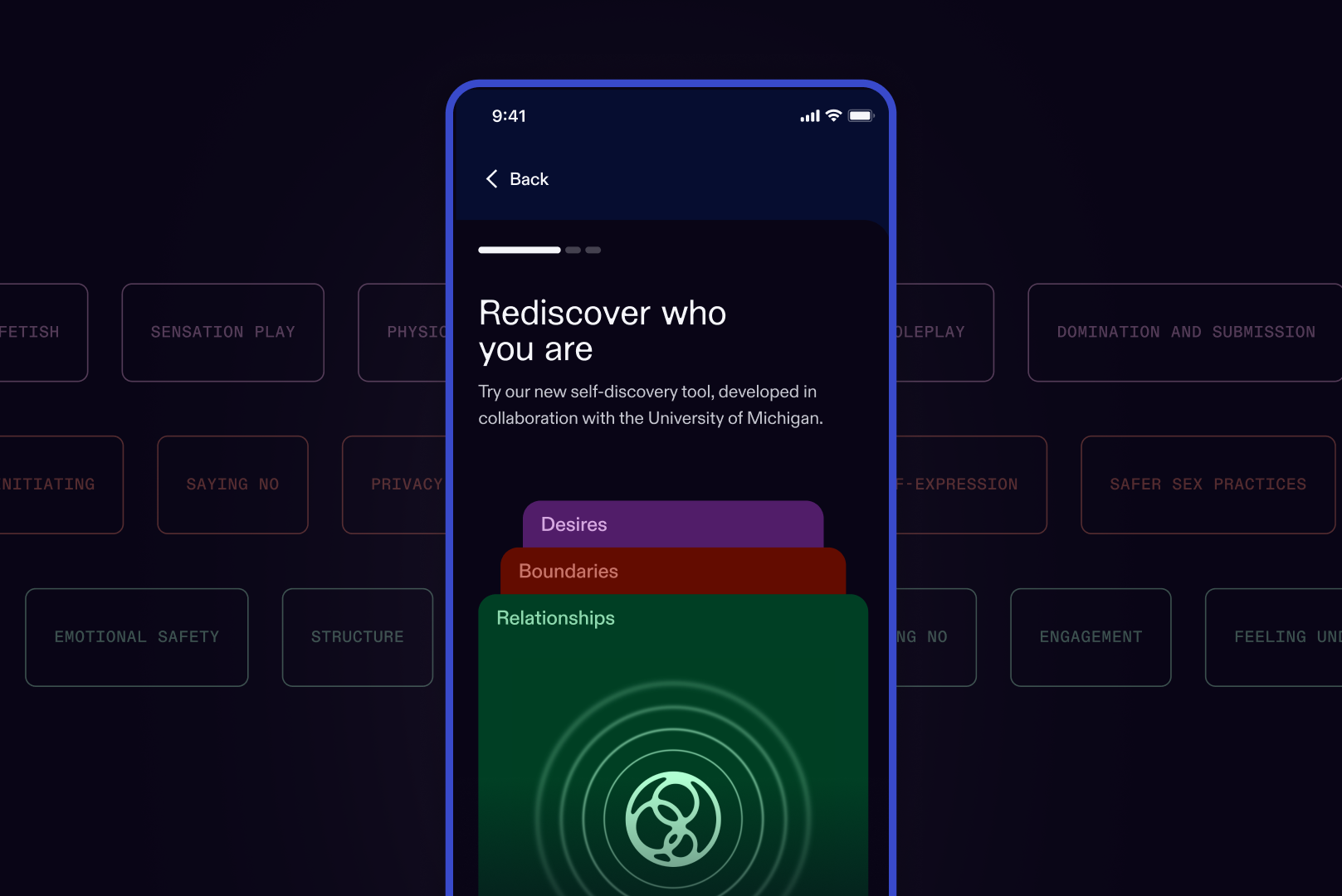
Ella, Frontend Engineer: “We knew that members were going to be sharing vulnerable parts of themselves with us, so safety and security were absolutely paramount. We designed every part of the process with this in mind, ensuring member data is secure, and that members can navigate the tool knowing they can be totally honest and open. Understanding that this experience requires time and gentleness, we ensured it felt removed from the excitement of the discovery feed, and that members could pause their experience at any time and return to it later.”
Otavio Barros, Squad Lead: “Building Reflections meant putting security and member trust at the foundation of everything we did. From how we designed the system architecture to how we integrated different parts, every decision came back to data protection—making sure that members’ personal reflections would be stored securely and only shared with people they chose.”
“We wanted to deliver something that felt seamless. The technology just gets out of the way so people can focus on their personal exploration.”
Alexandra Kilpatrick, Head of UX Research: “Given the sensitivity of the space, an early priority was making sure we approached the work with the right level of care and rigor. We needed to extend our internal knowledge with external expertise, and a broader cultural lens.
“For that reason, we partnered with The Bodies, Identities, Intimacies, and Technologies (BIIT) Lab at the University of Michigan. Led by Dr. Apryl Williams, the BIIT Lab is a research group composed of award-winning sociologists, demographers, psychologists, and communication scholars with industry experience (and they are a women and femme-led, queer community of color). They critically explore identities such as race, gender, and sexuality, intimacies with others and our devices, technologies, social media, AI, and dating apps. The Lab delivered independent research that could both challenge and strengthen the brief, providing an unbiased, external perspective on what members actually need.”
“It’s important to acknowledge the diligence that went into getting the language and design right—translating the research vision into something that feels warm, welcoming, and safe for members, while staying true to the nuance of the insights.”
Sära, Senior Product Designer: “Our Feeld members have been at the heart of this work from the outset, and this project would not have been possible without hearing their voices and stories. During the product design and development phase we conducted user interviews and usability tests (with a diverse group of members and non-members). We listened and leaned on their real-life experience, combining this learning with the rich research and science provided by our collaborators at the University of Michigan.”
“Some of the most enjoyable moments for me personally have been hearing our members’ stories, reactions, and witnessing those ‘ah-ha’ moments of self discovery mid-interview! Our members’ willingness to be vulnerable and honest during this process helped us to better understand how to meet them where they are.”
Caroline Zavakos, Copy Director: “One of my favorite things about Reflections—especially in this day and age—is that it’s entirely human-written. From the academics at the BIIT Lab to our own team of writers from many backgrounds, each thought and word was carefully considered and informed by our own expertise and lived experiences. I believe human desire, ways of relating, and boundaries are deeply personal, complex, and ever-changing, so much so that this kind of work could never be outsourced to a machine.”
“This person-first mentality absolutely informed how we approached the creative expression of Reflections. In our short-form video, for example, we illustrate what it looks like, feels like, and sounds like to go beyond the surface with yourself and others. To be able to capture this feeling with a team of brilliant creative people—from visually-expressive directors and photographers to music composers—was a gift.”
Natalie, Senior Content Designer: “The tone of Reflections is built with the same precision as its visuals—every phrase pressure-tested for neutrality, warmth, and consent. We write plainly about things that are often whispered: anal, masturbation. Not to provoke, but to normalize. To speak about what’s real without apology or euphemism. Language here becomes an act of respect. It holds space for curiosity without judgment, honesty without shame.”
Alexandra, Head of UX Research: “We carried out research with an extremely diverse sample of members, representing a wide breadth of experience across BDSM, kink, and non-traditional relationship structures. This included everyone from an ex-pro dominatrix to people who described themselves as more ‘vanilla’ and were taking their first steps on the app. Ensuring this range was important to us so the work could reflect the real diversity of experiences, comfort levels, and needs within the Feeld community.”
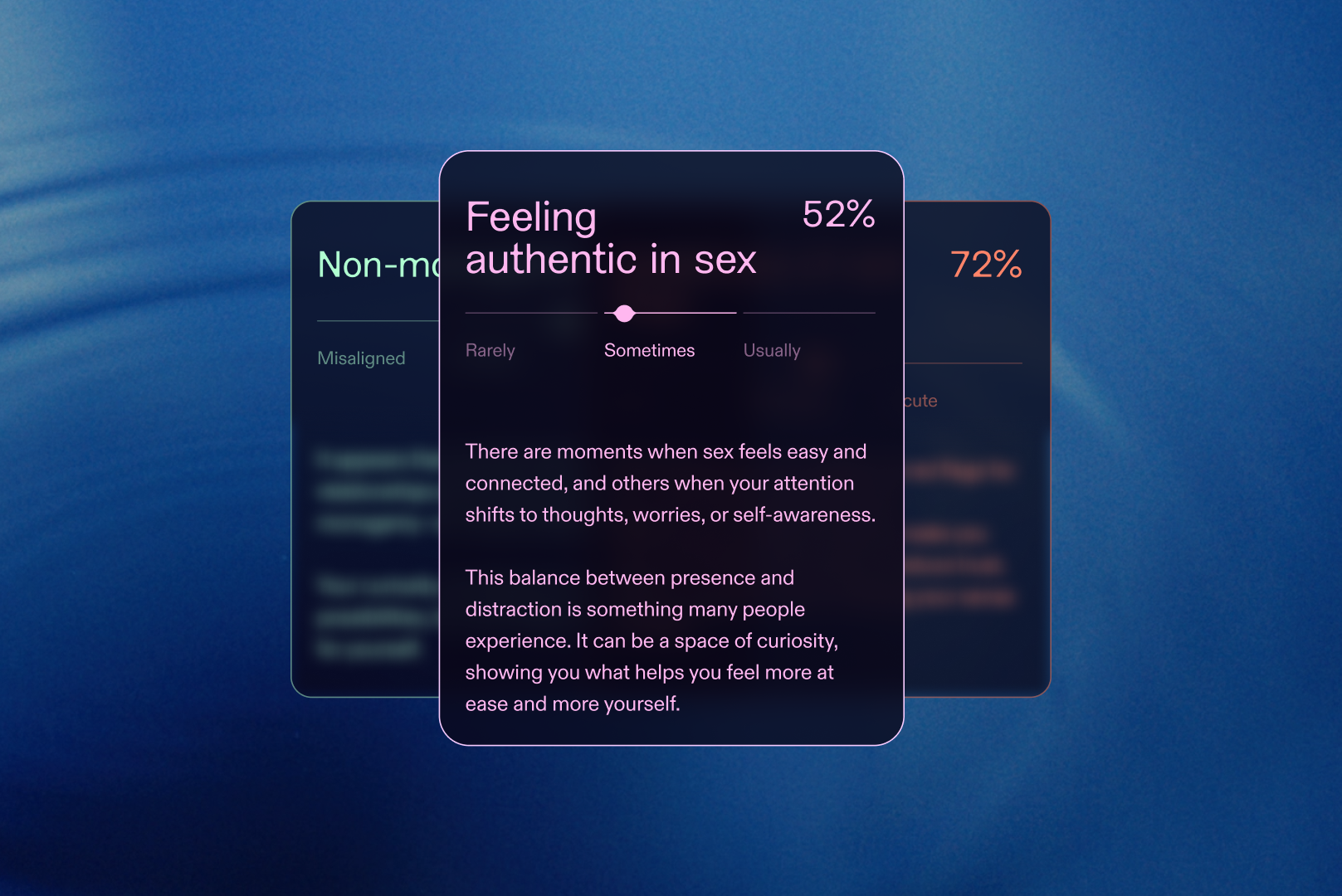
Caroline, Copy Director: “Reflections deals in extremely nuanced and personal matters. With 165 prompts, it’s hard to imagine any two people receiving the same insights. And not everything reflected back to you is necessarily easy to learn. You may confront a disparity between your sex drive and sexual desire. You may find out that you have a low awareness of consent or recognition of red flags. Honestly, it takes a lot of bravery for a person to be willing and able to look inward this deeply.”
“Our approach creatively had to be equally nuanced, human, and brave. A great example of this is how we approached the opening of our video. In it, you hear a choir of voices citing tried and tired first-date questions before you see a young woman plunge face-first into a body of water, cutting out the noise. This is a frustration we all feel or have felt. Pain points can be unifying, even if all our experiences are different. To crave depth in connection is not just a human desire, but a need. Plucking out moments like these has the power to make something really expansive feel relatable.”
Natalie, Senior Content Designer: “To design Reflections was to design for multiplicity. For the monogamous and the poly, the straight and the queer, the curious and the questioning. For those who have never thought about who they are, and those who have spent years naming it. Inclusivity here isn’t a checklist—it’s an attitude of spaciousness. We write so that everyone might recognize themselves and be expanded by what they read. Every prompt and scale is designed to build safety, agency, and consent. People are not categorized, only mirrored.”
Lavina, Lead Product Manager: “We hope that the entire Reflections experience helps to drive and facilitate personal growth for people who are curious. We imagine that perhaps members are encountering some of these questions for the first time, and that it sparks an honest dialogue with themselves—plus a clearer, deeper understanding, and language to describe what they’re looking for.”
“The results are developed to be an honest snapshot of where a person is at that moment in time. We include a timestamp for results to help when referencing them in the future. Members are encouraged to continuously take Reflections alongside their Feeld journey, if they sense change and think a moment of introspection may support them in clarifying where they are and what they want at any [given] time.”
Natalie, Senior Content Designer: “The reflections don’t just end with results or labels. There’s no ‘type’ to become. Instead, there’s affirmation—of whatever someone discovers. The design validates fluidity, complexity, and change. It says: You’re allowed to be more than one thing. You’re allowed to be unfinished. By resisting binaries and outcomes, Reflections mirrors the truth of identity: It shifts, it grows, it resists containment. That’s what makes it alive.”
Curious about your own self-discovery journey? Try Reflections, and go beyond your surface with Feeld.